The Great Controversy

imageshack-share-photos-pictures-free-image-hosting-free-video-hosting-image-hosting-video-hosting-photo-image-hosting-site-video-hosting-site

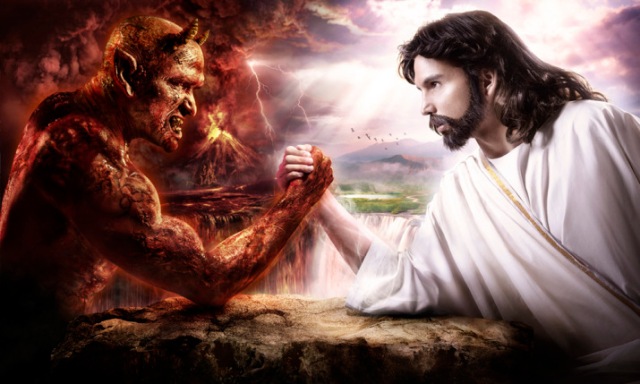
It is hard to describe to someone who did not grow up a Seventh Day Adventist how integral the Great Controversy motif is to their worldview.  We are taught this perspective from a very tender age, and it is made to sound fun.  I used to look forward to seminars on such topics because to me it was like watching Star Wars.  I enjoyed the graphic art, imagery, and apocalyptic language.

In this post I will attempt to define my understanding of the Great Controversy and then analyze it to determine the major premises it is predicated upon.

The Great Controversy Defined

Below is a cut and paste from the 8th fundamental belief of the Seventh Day Adventist Church that defines the belief well enough.  It is important to remember that the fundamental beliefs of SDA don’t define the whole scope of their teachings, but since this is one of the fundamental beliefs it allows Ellen White’s teachings on the topic in the door as they are the only source of the hermeneutic.

“All humanity is now involved in a great controversy between Christ and Satan regarding the character of God, His law, and His sovereignty over the universe. This conflict originated in heaven when a created being, endowed with freedom of choice, in self-exaltation became Satan, God’s adversary, and led into rebellion a portion of the angels. He introduced the spirit of rebellion into this world when he led Adam and Eve into sin. This human sin resulted in the distortion of the image of God in humanity, the disordering of the created world, and its eventual devastation at the time of the worldwide flood. Observed by the whole creation, this world became the arena of the universal conflict, out of which the God of love will ultimately be vindicated. To assist His people in this controversy, Christ sends the Holy Spirit and the loyal angels to guide, protect, and sustain them in the way of salvation.”

Though the SDA confession touches on these things I will expound with a few extra details that you have to attend their seminars to learn.  After this rebellion kicked off in heaven a third of the angels are cast to the Earth right after the fall along with the Devil.  While this is going on created beings on other planets are curious and cannot discern who is wrong and who is right so they are watching Earth to see how everything shakes out.

What they won’t plainly state is that in this view the Devil is seen as an equal with God, not in the divine sense, but certainlyInvestigative Judgment in the sense of a rival.  In this motif it is actually possible for Satan to win and for the universe to fall into darkness.  Fortunately, Jesus pulled it off and managed to defeat Satan by the skin of his teeth on the cross and everyone breathed a sigh of relief.

SDA believe that it was made clear at the cross to all of the other created planets which side was right afterall.  SDA will tell you that today the Great Controversy is over who we will choose.  Will you choose to be saved by keeping the Sabbath day and proving your loyalty or will you choose to serve the Devil and go to church on sunday instead?  Ultimately SDA believe that the Great Controversy is God’s plan of proving his character and vindicating himself from those who have wrongly accused him of evil.

What is sad is that I am not putting forth a straw man argument, this is actually what they teach. In this series I am going to Biblically disprove this heresy thesis by thesis in the same fashion that I did the Investigative Judgment.

Great Controversy Analysis


My assessment of the Great Controversy Doctrine is that it is based on a few Biblical claims that if fairly evaluated and proven false would topple the whole framework.  Because of this I am going to focus on each one at a time.

Aliens:  According to the Great Controversy Aliens not only exist on other planets but this fact is taught in scripture and we have just missed it the whole time.  Is this true?  What does the Bible really say?

The Nature of God:  For the Great Controversy to work there must on some level be an equality with God and Satan in that it could at least have been theoretically possible for Satan to win and defeat God at some point in the Biblical narrative.  How does such a view distort the scriptures on the nature of God?

Burden of the Law:  Part of the Great Controversy motif is that the Devil accused God of making the law too burdensome.  In this Great Controversy it is God’s ultimate goal to prove that the Devil was wrong and that the law isn’t too hard to keep after-all.

Example of Christ:  A key element of the Great Controversy is the means by which the character of God is vindicated.  To do this human beings are called to ultimately reach a plane of sinlessness in this life.  Doing so gets God off the hook for presumably making the law too difficult.

Vindication of God:  For the Great Controversy to be true it would need to be Biblically necessary for the character of God to be in question.  Also, the scriptures would have to teach that created beings are in some way standing in judgement over God at least in the same sense as a Jury does over a defendant in a court of law.

The Nature of Man:  For the Great Controversy to work unregenerate man must posses a salvifically relevant free will.  By that I mean, such free will  must have the cosmic power to in some way assist in their own salvation and alter or impact the divine Will of God.

I will be examining each of the above topics one by one.  It is my assessment that if even one of these can be proven not to work in line with SDA teaching the Great Controversy motif would collapse completely as it is presupposes all of them in a systematic framework.

Do you think that I missed something important?  Please drop a comment and let me know.  Also, if you would like to study the same material you now have my outline so please feel free to add your thoughts with each post if that is something you want to do.


Posted in Leaving Adventism | Tagged , , , , , | 16 Comments

Age of the Earth

In a previous entry I made it clear that I believe the Bible teaches 6 literal 24 hour days of creation.  You can find that by clicking HERE.  In this post I am going to address the time that has transpired since the fall.  It can be debated as to whether or not the traditional view is the 6000 year model attributed to the work of James Ussher.  However, for the sake of simplicity I am going to refer to his work as the traditional view.

6000 Years

Even if one ignores James Ussher, if you add up all of the genealogies in the Bible it is true that you have about 6000 years to work with.  Below is a graph illustrating this point below.

chronology_chart_from_adam_to_abraham

For the source of this image please click HERE.

In the above chart we see the lifespan and lineage of the Biblical Patriarchs in Genesis.  If you assume that there are no gaps in these genealogies you end up at 6000 years or so since the fall.  This is because it is pretty easy to date backward to Abraham thanks to the clarity we find in Paul’s writings.

“Now to Abraham and his seed were the promises made. He saith not, And to seeds, as of many; but as of one, And to thy seed, which is Christ.  And this I say, that the covenant, that was confirmed before of God in Christ, the law, which was four hundred and thirty years after, cannot disannul, that it should make the promise of none effect.” Gal 3:16-17 KJV


Above Paul is referring to the amount of time between Abraham and Moses.  Which would have been around 430 years in total.  The time between Moses and today is relatively fixed.  Different scholars place him and different points of history but it doesn’t vary that much.  This would mean that the time of Abraham wouldn’t vary too much either.  Reaching back to the patriarchs and attempting to place them on a calendar is not so easy though.


In order to do this many date back the Biblical genealogies. The problem with this is that the age of the Earth is not a formal or even informal topic of scripture.  One has to piece the available genealogies together and make assumptions.  Because of that I would avoid being dogmatic either way, as doing so is not a fight for Biblical authority.


Telescoping of Genealogies


Many scholars today argue that the Genealogies of the Patriarchs were condensed.  They argue that this is a common practice in ancient documents to save space on expensive parchment and or to arrive at pleasing round numbers.  I argue that telescoping of these genealogies is certainly possible, and would explain a lot if true.  I am going to present the argument for this theory that convinced me.  If you want an in-depth verse by verse analysis arguing for telescoping please click HERE.


Below is a quote from that article found on GodandScience.org focusing on the words at use in ancient Hebrew and Greek.

“Another important difference between ancient and modern genealogies is vocabulary. In modern English, we have a whole host of words to describe precise familial relationships. For example, we have son, grandson, uncle, father, cousin, brother, and ancestor. Hebrew has a very small vocabulary, so only a few Hebrew words carry all of these modern meanings. The Hebrew words for “son” means son, grandson, great grandson, and descendent. For example, Genesis 29:5 refers to Laban the son of Nahor but we know that he was the grandson. Similarly, “father” means father, grandfather, great-grandfather, and ancestor. We find in Genesis 28:13 that God tells Jacob, “I am the LORD, the God of your father Abraham and the God of Isaac,” (emphasis added) but Abraham was the grandfather of Jacob. “


I have checked the above claim on other sources and it appears legit.  The meanings of these words identifying familial relationships were simply different at the time of their writing.  It doesn’t exclude the possibility of direct parentage but that isn’t the only potential meaning either.


Furthermore, since the text itself doesn’t teach on such matters there really isn’t much else to appeal to.  With nothing else to go on I would lean towards the traditional understanding but the fact is it can be proven that telescoping does exist in scripture when different genealogies of the same periods of time are compared against each other.  See another quote from the same article.

“Moses, Aaron, and Miriam all play critical roles in the Exodus, and their genealogy appears four times in the Bible (Exodus 6:16–20; Numbers 26:57–59; 1 Chronicles 6:1–3; 23:6, 12–13). Joshua, son of Nun, was also a part of the Exodus and has his own genealogy (Numbers 13:8, 16; 1 Chronicles 7:20–27). Both sets of genealogies span the same 430–year period (Exodus 12:40–41; Acts 7:6) from the sojourn to Egypt until the Exodus from Egypt, yet one lists four generations and the other has twelve.”
Gene


Please review the source that I am quoting from, it is not as reputable as others I could have used but I highly respect his analytical work, even on articles that I disagree with.  Based on the above I argue that since the text allows for telescoping in the words for “son” or “father” and since telescoping can be proven in other genealogies, it is entirely possible that telescoping was also done with the Patriarchs as well.


Some argue that the word “begat” found in the patriarchal genealogies negates telescoping, but just as with the words “son” and “father” this isn’t necessarily the case.

“The word “begat” is another word that is commonly used in biblical genealogies. (The NIV translates yalad as “became the father of” or “gave birth to.”) Like father  and son, this word has a much broader meaning than the corresponding English usage (Vine’s, “to bear”). An example of this broader usage is found in Deuteronomy 32:18, where God reminds Israel that He “begat” them. Similarly in Numbers 11:12, Moses declares that he had not “begotten” Israel and hence was not responsible for them.”


There are other broader uses of the word “begat” that can be found in scripture, if you want a comprehensive listing I recommend checking out the article that I linked to above.  Ultimately, my conclusion is that telescoping of the Patriarch Genealogies is a real possibility.


Particularly I would identify the time period between Noah and Abraham as the greatest possibility of extensive telescoping.  There isn’t a great deal that happens in this time relevant to the Biblical narrative, except for of course the Tower of Babel.  Also I find it rather unlikely that enough people would have been born from just Noah’s three sons in only 5 generations to form the small nation we see building the Tower of Babel in Genesis 11.  If a great deal of time precedes and/or follows the Tower of Babel it could place the first 11 chapters of Genesis in a pre-historic time period.


How much telescoping do I think is possible?  Well I would put 6000 years since the fall at the absolute minimum.  Though I think it is unlikely it is certainly within the realm of possibilities that there is no telescoping at all.  On the other end of that I would put 100,000 years as the absolute maximum, just as unlikely as the alternative I mentioned above.  The reason I select that amount is it is the highest number I have ever heard from reputable proponents of this theory.  I don’t personally care what the exact amount of time is, but it is helpful to have a shot group to work with.  The bottom line is we just don’t know how long it has been since the fall.


What do you think?  Am I way off base here or do you think I have presented a fair analysis?  I would personally classify this topic as well within the range of Christian freedom to agree or disagree on as there is no clear scripture either way.  So if you think I am wrong let me have it in the comments.  If you think I got it right but missed something important please let me know about it.

Posted in Armchair Lounge | Tagged , , | 2 Comments

Noah’s Flood

In my last post I covered the topic of creation, if you want to take a look at it please click HERE.  Today I am going to analyze Noah’s Flood, which is closely related.  Specifically, I am going to present two popular views on the Flood and then I will explain the one i have selected and why.

Before continuing I recommend you read through Genesis 6, 7, 8 and 9 if it has been a while.  I will be quoting in the KJV because it is my favorite but another version that you might find helpful for this passage is the ESV.

Local Flood

Noah's Ark

A view that is getting more and more popular is the Local Flood model.  To give a basic summary, the doctrine asserts that Noah’s Flood did not cover the whole Globe.  Instead what took place was a very large flood covering as much as a continent but no more than that.  The reason popularity is building on this is because it goes hand in hand with Old Earth Creationism (OEC).  Specifically, you need millions of years of pre-fall rain for OEC to work which is why they interpret verses like this (Gen 2:5-6) in a local context.

The argument to support Local Flood centers around a few key verses and associated facts.

  • The word “earth” in this passage doesn’t have to mean the whole Globe.  In the original Hebrew it can mean “land” in a general sense.
“The earth also was corrupt before God, and the earth was filled with violence.  And God looked upon the earth, and, behold, it was corrupt; for all flesh had corrupted his way upon the earth.  And God said unto Noah, The end of all flesh is come before me; for the earth is filled with violence through them; and, behold, I will destroy them with the earth.” Gen 6:11-13 KJV
This argument is entirely sound, the word Haaretz can mean either the whole planet or a smaller part of it.  Source Biblehub.com
Gen19-28Gen1-1
  • The word “mountain” doesn’t have to mean mountain, it can also mean hill.  When understood in a local context this would mean the highest hills in the area.

Fifteen cubits upward did the waters prevail; and the mountains were covered.” Gen 7:20 KJV

local-flood

Source: Answers in Genesis

This verse above is a critical one for global vs local flood.  If the water really did go 15 cubits over the mountains that does mean Global flood.  Unless you are going to insist that there was a force field holding the water in a certain area as demonstrated in the picture above.

Local flood proponents do not argue this, instead they say that the word mountains is mistranslated because it can mean either mountain or hill.

Gen7-20

Deut12-2

King22-17

Above I have posted three examples of the Hebrew word Heharim on Biblehub.  I have found that it does in fact vary, sometimes it is mountain sometimes it is hill.  It is context that determines which the translator selects and they don’t always agree.

The last point of the argument is as follows:

  • Since the tower of Babel is what eventually separated humanity, that means humans were all living in one area.  It therefore follows that the wrath of God would only be poured out on the area in which they lived.

This argument above is more from logic than it is any particular verse.  The problem that I see with it is that it is making assumptions where the text doesn’t speak.  The fact is that we don’t know what pre-flood society or government was like.  I would assert though, that if it can be proven that humanity was spread out across the planet before the flood, that would negate local flood entirely (Gen 6:5-7).

Those are the three primary points of the Local Flood argument.  They do bring a few other things up but the argument generally is that since the text allows for a local flood that means it was.  The rest of the Local Flood argument focuses on addressing problems pointed out by the traditional view.  I will attempt to incorporate those into my presentation on Global Flood as appropriate.

Global Flood

the-flood

This is the view that I hold as I believe it is the Biblical understanding of the scope of Gods wrath typified in the flood.  I have scanned these three chapters of Genesis back and forth many times as I wanted to ensure that I am not holding to this view simply for the sake of tradition.  I will share with you which passages convinced me.

And God saw that the wickedness of man was great in the earth, and that every imagination of the thoughts of his heart was only evil continually.  And it repented the Lord that he had made man on the earth, and it grieved him at his heart.  And the Lord said, I will destroy man whom I have created from the face of the earth; both man, and beast, and the creeping thing, and the fowls of the air; for it repenteth me that I have made them.” Gen 6:5-7 KJV

To understand the above passage in a Local Flood view you would have to assume that God only means the animals associated with man, and that man only lived in a local area of the earth.  The problem is the referent for defining the scope of this outpouring of judgment is the creation account itself.  Thus, all men and animals who were created are receiving the judgment.  Limiting this to only some animals associated with all mankind is reading into the text.

For all mankind and all animals to receive this outpouring of judgment it follows that the flood would have to cover the whole globe.

“And of every living thing of all flesh, two of every sort shalt thou bring into the ark, to keep them alive with thee; they shall be male and female.  Of fowls after their kind, and of cattle after their kind, of every creeping thing of the earth after his kind, two of every sort shall come unto thee, to keep them alive.” Gen 6:19-20 KJV


The above verse is a point of logic for me.  One may argue that the water covered the tallest hills rather than the mountains, that is fine as the text allows for both, but it plainly states that birds were on the Ark to keep them alive.  Today birds of all sorts fly from one end of the continent to another to stay alive as seasons change.


If the flood were only local they could have simply been sent to another region for a few years.  Instead God wanted them on the Ark.  The only conclusion I can draw from this is that there was no safe place to go.


So putting the Birds and the use of creation terminology in verses 5-7 togrther I think what we see here is a larger scope of judgment than a local flood would allow for.  That being the case, this gives us a reason to understand “Haaretz” in a global fashion rather than a local one.

“And I will establish my covenant with you; neither shall all flesh be cut off any more by the waters of a flood; neither shall there any more be a flood to destroy the earth.” Gen 9:11 KJV


I would argue based on the above text that in a Local Flood motif the above verse is stripped of meaning.  We have had many horrendous floods throughout human history.  Some have destroyed very large populated areas.  Specifically I am thinking about the tsunami that obliterated the Philippines a number of years ago.  If Noah’s Flood were local it would follow logically that the covenant promise is local too.

The last point supporting my argument for Global Flood is the apocalyptic language we find in the New Testament.


“For Christ also hath once suffered for sins, the just for the unjust, that he might bring us to God, being put to death in the flesh, but quickened by the Spirit: By which also he went and preached unto the spirits in prison; Which sometime were disobedient, when once the longsuffering of God waited in the days of Noah, while the ark was a preparing, wherein few, that is, eight souls were saved by water.  The like figure whereunto even baptism doth also now save us (not the putting away of the filth of the flesh, but the answer of a good conscience toward God,) by the resurrection of Jesus Christ: Who is gone into heaven, and is on the right hand of God; angels and authorities and powers being made subject unto him.” 1 Pet 3:18-22 KJV


Above notice the scope of the Judgment and Mercy of God.  This is a wrath that was poured out on everyone alive in Noah’s day, pointing typologically to the Judgment poured out on everyone who has ever been alive on Judgment Day, juxtaposed with the mercy of God poured out in his blood on the cross and received in the waters of baptism.  I don’t see a geographic limitation on any of these themes.


“For this they willingly are ignorant of, that by the word of God the heavens were of old, and the earth standing out of the water and in the water: Whereby the world that then was, being overflowed with water, perished: But the heavens and the earth, which are now, by the same word are kept in store, reserved unto fire against the day of judgment and perdition of ungodly men.” 2 Pet 3:5-7 KJV


Here Peter is clear that the world which stands out of the water and in the water was overflowed with water and then juxtaposes that with Judgment Day.  I have to be honest, I would have to really strain hard to try to see a geographic limitation here.  This seems rather all encompassing and I am not going to read my Bible through a liberal kaleidoscope.

Conclusion


As with OEC I do not believe Local Flood is heresy, but it is certainly heterodoxy.  To adopt the view one has to on some level twist the scriptures to fit their motif.  My concern with doing so is not so much that one loses the Global Flood, but rather that they have adopted a magisterial methodology of understanding scripture.  Once one caves in to this there really isn’t any good reason to hold back on doing the same thing with other passages one finds distasteful.


How do I accept a Global Flood in light of modern science?   Speaking for myself, I don’t feel the need to explain the flood in naturalistic terms.  I don’t see why we can’t simply view the flood as a miracle.  We don’t we try to explain how Jesus walked on water, or how Jonah survived inside of a whale.  The reason is because these things are miracles, by definition they defy nature and expectation.  Personally, I think that pretty much addresses anyone’s objection to the flood.


In summary, Local Flood argues that since a few words stripped from their context allows for Local Flood then that means we have a Local Flood in view. Global Flood argues that those specific words can go either way, but when put in context and compared to other scripture you have a global event.


I will address one question though that many bring up.  Some argue that since a finite size is given for the Ark in the Bible, how is it that all the animals fit on the Ark in the first place? This is a sound question, and isn’t really the point of my post but since it is so common I will post a short YouTube video that addresses it below.


Posted in Armchair Lounge | Tagged , , , | Leave a comment

Six Days of Creation

15848899655_07912f461d_o

This is a popular topic for everyone today.  Though I have never seen any official studies on such statistics I think it would be fair to assert that a large majority of Christian apologetics in our day addresses the topic of creation.  This will probably be my first and only post on the this as I don’t really think this is as complicated as some make it out to be.


Many who deny the traditional view of creation discount the book of Genesis altogether.  The problem with that is Jesus and the Apostles always referred Genesis in a historical context.


(Matt 19:14)(Mrk 10:6)(Jhn 8:44)(Rom 4:1-2)(Jhn 8:58)(Jude 1:7)(Jhn 5:46) (2 Ptr 2:5-7)(Matt 24:37)


Because of this, if you reject the Book of Genesis then that means you on some level reject the words of Christ and the Apostles.  The ramifications of such a theological foundation are quite severe if taken to their logical conclusion.


A growing Biblical alternative to the traditional view on creation is “Old Earth Creationism”.  It is the only one that I consider an honest contender to the traditional view.  I have spent a great deal of time studying it, particularly in the works of a man by the name of Hugh Ross.  If you are interested in studying this doctrine I recommend starting with his materials.  Though I would not rebuke his work as heresy I still believe it is wrong.  I would simply classify it as heterodoxy.  For those unfamiliar, heterodoxy is something that is wrong but not necessarily outside of the visible Christian faith.


To sum it up, Old Earth creationism is the belief that each “day” in genesis is an indistinct period of time.  One who holds to this belief would argue that each creation day happened much as it is laid out in the first chapter of Genesis but that the days themselves are actually ages consisting of millions or even billions of years.  This belief actually rejects both secular and theistic evolution which is why many on the fence find it appealing, it mostly just adds a great sum of time to the creation account.  Ultimately they believe that the universe is 13.5 Billion years old, or however old they are saying it is these days as this does change from time to time.


I am going to present their argument on the creation days and then explain why I came to reject this doctrine in favor of the traditional understanding.


“Yom”

The nuts and bolts of the argument for both Young Earth Creationists (YEC) and Old Earth Creationists (OEC) centers around the Hebrew word for “Day”.

“And God called the light Day, and the darkness he called Night. And the evening and the morning were the first day.” Gen 1:5 KJV

An OEC will rightly point out that the Hebrew word has more than one possible usage.  Below is a quote from another blog that I think explains this dynamic well.  You can find the source written by the Institute of Creation Research HERE.

“It is recognized, of course, that the word “day” can be used with a number of variations. It can have any of five meanings:

1) a period of light;

2) a period of 24 hours;

3) a general, vague time;

4) a point of time;

5) a year.

The context determines which of these is intended by the writer. The English language also can have up to 14 definitions for the word “day.” The reader should be reminded that the purpose of language is to communicate. Moses wrote in a language that was meant to communicate to his readers. Words must be defined by their relationship to one another.

As the writer I quote indicates, the word “Day” in English can also vary in its usage.  Because of this I think turning to Hebrew here does very little theologically speaking.  Sometimes it is helpful to learn more about the original languages at play as there are nuances that can be enlightening.  The overall teachings of Genesis 1 are clear enough on the days that turning to the original language yields little for any argument.

The OEC argument is that the Bible and the “Book of Nature” are equal sources of authority.  Thus, since there is so much evidence for an old universe in the “Book of Nature” that means the word for “Day” in Genesis must mean “age”.

It is on the premise that I reject the OEC argument.  While God did in fact create the universe it is not the Word of God.  While I respect a great deal the findings of modern science and recognize them as authoritative in general, I believe we are to place this beneath the Word of God in matters of faith and theology.  Putting it bluntly, only the Bible gets a vote when it is speaking clearly.  Without the OEC system of interpretation I am left with only scripture, going forward I will analyze the passages in dispute on the principle of scripture interpreting scripture.

Simply because a day can be a long period of time doesn’t mean that it is.  One has to look at the context to rightly discern how much time is in view.

“And the second day they compassed the city once, and returned into the camp: so they did six daysAnd it came to pass on the seventh day, that they rose early about the dawning of the day, and compassed the city after the same manner seven times: only on that day they compassed the city seven times.” Joshua 6:14-15 KJV


I have never seen anyone try to argue that Joshua marched around Jericho for millions of years.  Why is this? Well that is simple, the context reveals that a calendar week is in view.  First of all you see a total of 7 days which in the Jewish calendar was a single week.  Second of all you see that these days are associated with the rise and fall of the sun by the use of the word “dawning”.  Any rational human being will rightly discern that normal 24 hour days are in view here in Joshua.  If YEC is correct then we should see a similar pattern in Genesis 1.


Evening Morning the next Day


In each and every creation day we see the association of the word “Day” with evening and morning.

“5 ... And the evening and the morning were the first day.

8 ... And the evening and the morning were the second day.

13 … And the evening and the morning were the third day.

19 … And the evening and the morning were the fourth day.

23 … And the evening and the morning were the fifth day.

31 … And the evening and the morning were the sixth day.” 

Gen 1:5, 8, 13, 19, 23, 31 KJV

“For in six days the Lord made heaven and earth, the sea, and all that in them is, and rested the seventh day: wherefore the Lord blessed the sabbath day, and hallowed it.” Exodus 20:11 KJV


Attempting to force this into an OEC view would mean that either there was a single evening and morning delineating each age, or that these evenings and mornings are to be understood in a poetic figurative sense.  The reason I reject such a notion is because it is begging the question.


First of all, to insist that an evening and morning is drawing the difference between ages lacks intellectual substance.  This is because in an OEC model each age bleeds into the next.  You have plants for example growing, maturing, and evolving in a horizontal sense all throughout the history of the earth and well into the sixth day.  There would be no logical reason to separate them as each would be progressive in nature.  Such a notion would make the separation of days entirely meaningless which is absurd seeing as they are the only thing in the entire chapter conveyed with clarity.


Secondly, Genesis is not a poetic work but a historic one.  To insist that dual genres are in play would require that I make up my mind before approaching the text.  There exist no examples in scripture of any genre mixing poetic narrative with historic.


The only logical conclusion is that each day was intended to be associated with a literal evening and morning with another evening and morning following right afterwards.  Hence 24 hour days are the only option.


Cardinal Numbers


My above argument standing by itself could leave a tiny chance of OEC being true if I’m incorrect on discerning genre.  But when you add this next fact there is only one Biblical conclusion.  Moses often used cardinal numbers in the books he wrote so we can draw a comparison on these various texts and reach a sound conclusion.  This is a technical mathematical term, so if you want to look it up  please click HERE.


Essentially Cardinal Numbers are counting numbers, they tell you how many of something there are.  A good example would be counting the number of apples you need for a Pie.  The argument is as follows:


  1. Since the days of creation are Cardinal Numbers,
  2. and all other uses of cardinal Numbers in the books of Moses are associated with 24 hour days,
  3. it follows that there are precisely six 24 hour days of creation.


“For in six days the Lord made heaven and earth, the sea, and all that in them is, and rested the seventh day: wherefore the Lord blessed the sabbath day, and hallowed it.” Exodus 20:11 KJV


Above we see Moses referring back to the creation account he wrote in Genesis 1 as six total days and then relays a prescriptive command where the final day in a single week is observed as the Sabbath.


“Ye shall not eat one day, nor two days, nor five days, neither ten days, nor twenty days;” Num 11:19 KJV


“In the fourteenth day of the first month at even is the Lord’s passover.” Lev 23:5 KJV


“And on the fifteenth day of the same month is the feast of unleavened bread unto the Lord: seven days ye must eat unleavened bread.” Lev 23:6 KJV


“And ye shall count unto you from the morrow after the sabbath, from the day that ye brought the sheaf of the wave offering; seven sabbaths shall be complete: Even unto the morrow after the seventh sabbath shall ye number fifty days; and ye shall offer a new meat offering unto the Lord.” Lev 23:15-16 KJV


Above is just a small example of Moses use of Cardinal Numbers to identify days.  There are well over 100 in the first five books of the Bible .  In all 5 books there are no uses of the word Day along with cardinal numbers that ever refer to long periods of time.  In every single example a 24 hour period is accepting by theologians, even those who confess OEC.  This is compelling, if you have morning and evening associated with the word “Day” along with cardinal numbers that have a clear pattern of use by the same writer as referring to 24 hour days why would you interpret them as anything other than a single rotation of the Earth upon its axis?


The only place being called into question is the first chapter of Genesis and that is because millions of years are necessary to make the chapter compatible with prevailing secular thought on the age of the universe.  I would argue that this simply isn’t a good enough reason, one has to make their argument from the text and the fact is that there is no stand alone Biblical reason to read millions of years into the text.  That doesn’t mean one shouldn’t address or consider modern science, I’m simply saying it is inadmissible on matters of theology.  I would have to say I concur with Martin Luther’s advice below.


“But if you cannot understand how this could have been done in six days, then grant the Holy Spirit the honor of being more learned than you are. For you are to deal with Scripture in such a way that you bear in mind that God Himself says what is written. But since God is speaking, it is not fitting for you wantonly to turn His Word in the direction you wish it to go.” Martin Luther – Ewald Martin Plass, What Luther Says: An Anthology (St. Louis: Concordia, 1959) 3:1523.


Conclusion

My concern with OEC isn’t so much their conclusions on the age of the Earth.  Point of fact, for some reasons I am glad that it is out there because it is a semi Biblical view and if that is what someone needs to hear to start taking the Bible seriously then perhaps OEC has some redeeming qualities.  My concern with it however is that if one is intellectually honest with their approach to scripture that means they will use the same general methodology for interpretation throughout.  It is the methodology of OEC that I have the biggest problem with.

If one were to play fast and loose with other passages in the same manner that they do with Genesis 1 suddenly the Trinity, Deity of Christ, Salvation by Grace, and Penal Substitutionary Atonement are all up for serious debate as well.  Do you think the Body of Christ is divided now?  Check back in a few hundred years after this one plays is course.

That said, though I do not consider secular science as having a vote on matters of theology I have to at least address it in a philosophical sense.  So rather than bend the Bible to science I am going to take the reverse approach.  How do I explain the apparent age of the Earth and Universe?   Personally, I think that the heavens and earth must have been created in a state by and large how we find them today, minus the curse of course.

For example, when trees were created on the third day do you suspect they had rings?  I don’t see why they wouldn’t, after all Adam was created as a fully grown man.  As far as I am concerned universes must just come out of the oven fully cooked at 13.5 billion years old.

I have heard different theories but that is the one which I believe stays intellectually honest while placing man in theological subjection to the Word of God.  Some I have read online take different approaches, and I ask the reader to study and discern for themselves if this is something that troubles you.  My only caution that I will leave you with is to always place the Word first.

Posted in Christianity 101 | Tagged , , | 10 Comments

Food Laws

Good_Food_Display_-_NCI_Visuals_Online


When I grew up SDA I was taught that it was ideal to be a vegetarian or even a vegan.  Not just that it was better for your health, but that you are a better Christian because your body is a temple so you should eat healthy (1 Cor 6:19).


Secondly, they state that it is not a sin to eat meat in general so it’s your choice.  But that you have to abstain from certain kinds of meats such as pork and shrimp and that it is a sin to eat them.  The code that they follow here is the same as the Jews and can be found in Leviticus 11.  Growing up SDA I happen to have this figured out in a general sense.  I knew that I couldn’t eat pork, shellfish, or duck.  There are a few other particulars but those are the only common “unclean meats” offered in the american diet so I didn’t have to memorize everything.


Though I was not a vegetarian I did follow the Leviticus 11 rules for most of my life.  Before getting started in presenting why it is Biblically permissible to eat or abstain from any particular food I want to address this concept of the body being a temple.  To do so I am going to paste the whole passage so that we can see it in context.


“12 All things are lawful unto me, but all things are not expedient: all things are lawful for me, but I will not be brought under the power of any. 13 Meats for the belly, and the belly for meats: but God shall destroy both it and them. Now the body is not for fornication, but for the Lord; and the Lord for the body. 14 And God hath both raised up the Lord, and will also raise up us by his own power. 15 Know ye not that your bodies are the members of Christ? shall I then take the members of Christ, and make them the members of an harlot? God forbid. 16 What? know ye not that he which is joined to an harlot is one body? for two, saith he, shall be one flesh. 17 But he that is joined unto the Lord is one spirit. 18 Flee fornication. Every sin that a man doeth is without the body; but he that committeth fornication sinneth against his own body.  19 What? know ye not that your body is the temple of the Holy Ghost which is in you, which ye have of God, and ye are not your own? 20 For ye are bought with a price: therefore glorify God in your body, and in your spirit, which are God’s.” 1 Cor 6:12-20 KJV


Read through the above carefully, notice that he is speaking about sins against the body, specifically with regards to sexual immorality.  Also notice in verse 13 he precludes food from being included in this classification.  It is clear from the context that Paul is speaking on spiritual matters not carnal ones.  My point is that it is poor practice to make this passage about health in general.  Doing so strips verse 19 from its context.  Eating healthy is a good thing, but no spiritual blessings or curses are promised either way.


Furthermore it is inconsistent on the part of SDA to assert that you must be a vegetarian due to the fact that your body is a temple, but then say it is not a sin to eat meat.  The passage is about sin, so if it applies to vegetarianism then it would be a sin to eat meat.  It is either one or the other you can’t have it both ways.


The New Covenant


The Bible is actually very clear that prescriptive food laws are obsolete in the new covenant.  They served a function and purpose for a time but apply no longer to a New Covenant Christian.  For a full Biblical breakdown on this I recommend reading my post titled The Law of Christ, you can return after breezing through it.  My point is that Lev 11 is not our source for laws anymore, instead we are to turn to the texts of the New Covenant.


“Let no man therefore judge you in meat, or in drink, or in respect of an holyday, or of the new moon, or of the sabbath days: Which are a shadow of things to come; but the body is of Christ.” Col 2:16-17 KJV


This verse above is very clear, most notably there is no other first century religion Paul could be referring to other than Judaism.  And the food laws that they followed are the ones detailed in Leviticus 11.  So since Paul is saying not to judge each other for matters of food and drink when he clearly tells us to judge each other righteously with regards to sin in other places (1 Cor 6:2-3) that must mean that the Leviticus 11 food laws are no longer prescriptively binding on New Covenant Christians.


“Now the Spirit speaketh expressly, that in the latter times some shall depart from the faith, giving heed to seducing spirits, and doctrines of devils;  Speaking lies in hypocrisy; having their conscience seared with a hot iron;  Forbidding to marry, and commanding to abstain from meats, which God hath created to be received with thanksgiving of them which believe and know the truth.  For every creature of God is good, and nothing to be refused, if it be received with thanksgiving: For it is sanctified by the word of God and prayer.” 1 Tim 4:1-5 KJV


Above we see a chain of events starting with people giving head to seducing spirits.  Forgive me, it might be my own life that I am reading into the text here but I have no problem seeing Ellen White at least applying to this verse in principle.  Even without that though, Paul clearly condemns commanding people to abstain from meats as if it were law and then states:


every creature of God is good, and nothing is to be refused, if it be received with thanksgiving


I don’t know how one with an honest heart can just ignore that.


“And he saith unto them, Are ye so without understanding also? Do ye not perceive, that whatsoever thing from without entereth into the man, it cannot defile him; Because it entereth not into his heart, but into the belly, and goeth out into the draught, purging all meats? And he said, That which cometh out of the man, that defileth the man.” Mark 7:18-20 KJV


This verse above is a big one for me.  It used to bug me a great deal as a kid because I was reading it in the NIV at the time.  It bothered me so much that I switched to the clear word where all such verses had been removed or altered.  Because of this many SDA prefer the KJV over other versions as this passage in Mark is easier to ignore due to archaic language.  Let’s look at the same verse in the NIV, not my favorite translation but it was the one I first used as a kid so in this case I’ll pick it for that reason.


“Are you so dull?”he asked. “Don’t you see that nothing that enters a person from the outside can defile them? For it doesn’t go into their heart but into their stomach, and then out of the body.”(In saying this, Jesus declared all foods clean.) He went on: “What comes out of a person is what defiles them.” Mark 7:18-20 NIV


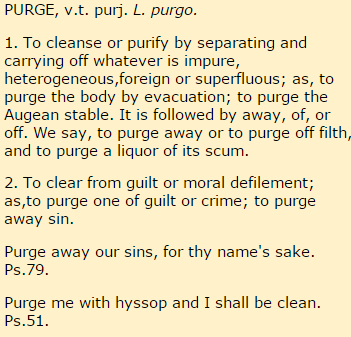
In the context of defiling one’s self with sin we see that Jesus has declared all foods clean.  In the KJV it uses the word purge, which can be confusing today because purge is most commonly used to describe throwing something away, like to purge files from your computer.  Below is an excerpt from the 1611 KJV found online.


Purge


As you can see, in old english it means the same thing as we see in the NIV or any other modern translation.  All foods are being made clean, and it’s no longer a sin to eat them.


Another passage that just put’s this case to rest is found in Romans 14.

“2 For one believeth that he may eat all things: another, who is weak, eateth herbs.; 3 Let not him that eateth despise him that eateth not; and let not him which eateth not judge him that eateth: for God hath received him.; 4 Who art thou that judgest another man’s servant? to his own master he standeth or falleth. Yea, he shall be holden up: for God is able to make him stand.; 5 One man esteemeth one day above another: another esteemeth every day alike. Let every man be fully persuaded in his own mind.; 6 He that regardeth the day, regardeth it unto the Lord; and he that regardeth not the day, to the Lord he doth not regard it. He that eateth, eateth to the Lord, for he giveth God thanks; and he that eateth not, to the Lord he eateth not, and giveth God thanks.” Rom 14:2-6 KJV 

Simply put, in a Spiritual sense it doesn’t matter what you eat or what day you go to church on.  Anybody who rejects this is in open rebellion to the Word and needs to repent. This passage is too clear to be interpreted in any other way.


I feel I have made my case on this topic, if there is something you feel I have left out please drop a comment at the bottom.  Before signing off though I am going to address one final thing that many SDA bring up.  It’s more an argument that the laity toss around, you don’t see serious SDA theologians using it.  But for the sake of those whose consciences might be burdened I’ll take a moment to talk about Noah.


In the Book of Genesis God tells Noah to divide the animals clean from unclean, and to bring different numbers of each into the Ark so that they would survive.


“Of every clean beast thou shalt take to thee by sevens, the male and his female: and of beasts that are not clean by two, the male and his female.” Gen 7:2 KJV


This is of course true, obviously since Moses was the one writing Genesis it stands to reason that the meaning of clean and unclean is the same as what we find in Lev 11.  The argument an SDA will put forward here is to say that:


  1. Noah had to divide the animals by clean and unclean.
  2. Therefore he had to follow the Lev 11 laws.
  3. Since such a distinction existed before the ceremonial law…
  4. The conclusion is that such laws must still in effect today.


The problem is that their argument breaks down at #2.  We have no clear verses commanding Noah to obey the Lev 11 dietary laws nor do we see any examples of his following them.  Instead all we see is how many of each he is to bring on the Ark.


Besides that, there are very clear verses that plainly state Noah did NOT keep the Lev 11 food laws.


“And God said, Behold, I have given you every herb bearing seed, which is upon the face of all the earth, and every tree, in the which is the fruit of a tree yielding seed; to you it shall be for meat.” Gen 1:29 KJV


Based on the above passage it would be fair to assert that God wanted all humans to be vegetarian after creation.  This is far more strict than the food laws of Lev 11 in that it excludes all meat from the diet.  So if Gen 7:2 were talking about clean and unclean meat for Noah to eat that would contradict Gen 1:29 where he wasn’t to eat any.  It is because of that reason that I think the purpose of “clean” and “unclean” in Gen 7:2 is to classify the animals rather than to give Noah directions on what to eat.


And below is the biggest problem for turning to Noah to rescue the food laws from the Old Covenant.


Every moving thing that liveth shall be meat for you; even as the green herb have I given you all things.” Gen 9:3 KJV


There is no escaping that, after the Flood God opens up the menu for all meats.  He doesn’t restrict it again until Lev 11.  Some SDA have complained about this saying that it is not okay for Noah to eat a poisoned frog.  I find this silly because its not a Biblical assertion at all.  Of course it would be foolish for Noah to eat a poisoned frog, but the eating in and of itself would not be a sin.  And for Noah’s sake I would hope that he would clean the poison from said frog before eating, if possible, as that would just be common sense.


I would argue that of all the things SDA get wrong this one is the most obvious.  They really don’t have a Biblical leg to stand on with their dietary restrictions.  I would personally find it refreshing if they changed their position and simply asserted that they choose to keep healthy food practices for the sake of health.  But then that would be a medical conviction not a religious one.


Posted in Heresy & Heterodoxy, Law, Leaving Adventism | Tagged , , | 29 Comments

Perseverance of the Saints

jesus-ascension-to-heaven


The purpose of this post is to answer a common question in Christianity since the reformation.

Can a true Christian fall away from the faith and ultimately be damned?  

I will attempt to present both sides of this view fairly and then offer what the scriptures teach in response.

The doctrine I am addressing is called Perseverance of the Saints.  I realize that this belief goes by other names and that there are nuances that differ in each of them.  However the underlying principal is that once one is saved they can never fall away from the faith, and that if one does fall away that means they were never truly saved.  There was a brief period of time that I accepted this and it was due to the following passages.


“For I am persuaded, that neither death, nor life, nor angels, nor principalities, nor powers, nor things present, nor things to come, Nor height, nor depth, nor any other creature, shall be able to separate us from the love of God, which is in Christ Jesus our Lord.” Rom 8:38-39 KJV

“My sheep hear my voice, and I know them, and they follow me: And I give unto them eternal life; and they shall never perish, neither shall any man pluck them out of my hand.  My Father, which gave them me, is greater than all; and no man is able to pluck them out of my Father’s hand.” John 10:27-29 KJV


I realize there are other passages which proponents of this doctrine use, but these are the clearest and were the ones that spoke to me.  The first one I posted is in Romans, and the apostle is very clear that nothing can separate us from the Love of God.  The second is in John and it is very clear that nobody can pluck us from the hand of God.


That said, it is not so simple as to just read these verses and ignore the rest of the Bible.  There are very clear passages that do indeed teach that one can fall away.  Most notably is the one found in Hebrews.


“For it is impossible for those who were once enlightened, and have tasted of the heavenly gift, and were made partakers of the Holy Ghost, And have tasted the good word of God, and the powers of the world to come, If they shall fall away, to renew them again unto repentance; seeing they crucify to themselves the Son of God afresh, and put him to an open shame.” Heb 6:4-6 KJV


Here is the problem with asserting “once saved always saved”.  The words in the above passage speak of these former Christians in the past tense.


“once enlightened”


This would mean that there was a time in which they were enlightened but now they are not.


“have tasted”


This is saying that they did receive the word and even ingested it.


“were made partakers of the Holy Ghost”


At one point they were indwelt by the Holy Ghost but now they are not because “were made” is in the past tense.


“shall fall away”


This is the clearest of all as the words “fall away” are ascribed to those who were once partakers of the Holy Ghost.  If one was never a Christian and was always fallen how can they fall away from being fallen?  I think Hebrews is clear enough on its own but if you would like more passages on this topic to compare it to I have hyperlinked some below.


(Matt 7:21-23) (2 Pet 2:20-22) (Ezk 18:24-26) (2 Tim 2:11-12) (Heb 10:26-28) (Rom_11:22) (Rev 2:4-7) (Gal 5:4)


The problem is that most Christians today seem to pick one passage to abrogate the other with.  This approach to theology pits the Bible against itself.  The fact of the matter is that both teachings are true at the same time.


  1. It is true that because of the Gospel of Jesus Christ and the covering of his shed blood for all of my sins I can never be separated from the love of God.  It is true that I am in the palm of his hand and nobody can pluck me out.


  1. It is true that I could fall away from the faith and end up in hell.


The question is not which of these are true, the question is how can they both be true at the same time?  Furthermore, it is a question that doesn’t need an answer.  One can simply accept both as true based on the clear scripture and confess that they don’t know how all the pieces fit together.  A sound philosophical explanation is nice but it is not required for everything.


How one attempts to answer that question will usually depend on the other things they believe.  If they are coming from a calvinist perspective they will usually attempt to abrogate thesis #2.  If one is coming from an Armenian perspective they will instead abrogate thesis #1.  To be completely honest this is one of the main reasons I rejected both of those schools of thought as I don’t find either embracing Sola Scriptura.  Instead each abrogates pieces of scripture with philosophy.


Rather than that I think we should use philosophy in a ministerial sense to reconcile both in a way that doesn’t conflict with any scripture.  In my studies I have found some who attempt to do this.  The best explanation that I have read is that we are the ones responsible for damning ourselves and that God is the one who does the saving.  Specifically, a Lutheran would look at (Rom 8:38-39) and ( John 10:27-29 ) as gospel passages speaking to those who are in Christ, the “saint nature” of man, and define them as his unfailing work toward us.  Conversely they would categorize (Heb 6:4-6) as a law passage in that it speaks to the “sinner nature” of man in cutting himself off from the unfailing Love of God.  I think that this explanation makes sense but it is something I will have to blog on in depth in the future as it lies outside of the scope of this post.


Below is a few short videos by a pastor who attempts to do this. If you don’t want to wait for me to blog on this topic I would recommend starting here.


Posted in Armchair Lounge, Soteriology | Tagged , , | 4 Comments

Papacy Examined

building-on-foundation


In this post I am going to present one of the major reasons I reject the premise of the Roman Catholic claim to modern apostolic authority embodied in the office of the Papacy.  

I am going to present the argument that I believe undermines the entire foundation of their teaching while playing by their rules.  That’s right, I’m not going to stand on scripture for this one as that would be too easy.  Instead I am going to show how their claims don’t even pass the test of history.


Vatican I


This was the first Vatican council ever and was convoked by Pope Pius IX from 1868-1869.  As with all the others many teachings and anathema’s came out of this council.  Specific to this post though Matt 16 was discussed.  Below is a quote from the council, though I am pasting the surrounding material for context, I am going to focus on #4.


“Chapter 1 On the institution of the apostolic primacy in blessed Peter

  1. We teach and declare that,

    • according to the gospel evidence,
    • a primacy of jurisdiction over the whole church of God
    • was immediately and directly
      • promised to the blessed apostle Peter and
      • conferred on him by Christ the lord.

    [PROMISED]

  2. It was to Simon alone,

    • to whom he had already said
      • You shall be called Cephas [42] ,

    that the Lord,

    • after his confession, You are the Christ, the son of the living God,

    spoke these words:

    • Blessed are you, Simon Bar-Jona. For flesh and blood has not revealed this to you, but my Father who is in heaven.
    • And I tell you, you are Peter, and on this rock I will build my church, and the gates of the underworld shall not prevail against it. I will give you the keys of the kingdom of heaven, and whatever you bind on earth shall be bound in heaven, and whatever you loose on earth shall be loosed in heaven [43] .

    [CONFERRED]

  3. And it was to Peter alone that Jesus,

    • after his resurrection,

    confided the jurisdiction of supreme pastor and ruler of his whole fold, saying:

    • Feed my lambs, feed my sheep [44] .
  4. To this absolutely manifest teaching of the sacred scriptures, as it has always been understood by the catholic church, are clearly opposed the distorted opinions of those who misrepresent the form of government which Christ the lord established in his church and deny that Peter, in preference to the rest of the apostles, taken singly or collectively, was endowed by Christ with a true and proper primacy of jurisdiction.

  5. The same may be said of those who assert that this primacy was not conferred immediately and directly on blessed Peter himself, but rather on the church, and that it was through the church that it was transmitted to him in his capacity as her minister.

  6. Therefore,

    • if anyone says that

      • blessed Peter the apostle was not appointed by Christ the lord as prince of all the apostles and visible head of the whole church militant; or that
      • it was a primacy of honour only and not one of true and proper jurisdiction that he directly and immediately received from our lord Jesus Christ himself:

      let him be anathema.”


Response


Notice that they say “as it has always been understood“.  The problem they have is that throughout Church history the interpretation of Matt 16 has always varied.  Furthermore, if I can prove historically that there has been a variance in the interpretation of Matt 16 in Church history that would prove that the Church council is not infallible.  Let’s take a quick peek at the passage before continuing.


“15 He saith unto them, But whom say ye that I am? 16 And Simon Peter answered and said, Thou art the Christ, the Son of the living God.

17 And Jesus answered and said unto him, Blessed art thou, Simon Bar–jona: for flesh and blood hath not revealed it unto thee, but my Father which is in heaven. 18 And I say also unto thee, That thou art Peter, and upon this rock I will build my church; and the gates of hell shall not prevail against it.” Matt 16:15-18 KJV


The question here is what is the referent of this “rock”.  To that scholars across Church history do not agree.  Some say the rock is Peter, some say it is the confession of faith that Peter renders, some say the rock is Christ.  I believe that the rock is faith, but that is not material to my argument in this post.  What is critical, is that if I can prove that Matt 16 has not ALWAYS been understood as Peter being the rock then that would mean that Church Council can fail, and that Roman Catholics are incorrect in placing their faith in such.


“In a passage in this book, I said about the Apostle Peter: ‘On him as on a rock the Church was built.’ . . . But I know that very frequently at a later time, I so explained what the Lord said: ‘Thou art Peter, and upon this rock I will build my Church,’ that it be understood as built upon Him whom Peter confessed saying: ‘Thou art the Christ, the Son of the living God,’ and so Peter, called after this rock, represented the person of the Church which is built upon this rock, and has received ‘the keys of the kingdom of heaven.’ For, ‘Thou art Peter’ and not ‘Thou art the rock’ was said to him. But ‘the rock was Christ,’ in confessing whom, as also the whole Church confesses, Simon was called Peter. But let the reader decide which of these two opinions is the more probable.” St. Augustine 354-430 (The Retractions, 1:20:1)


Clearly St. Augustine not only believes that the rock is confession of faith, but he also says the text is open to interpretation.  If it were true that the rock was Peter, and that he has been passing his Papal power down to each generation Augustine would have known this.  He lived in a time when the first generation of Church history was within the reach of ancestral memory.  Such matters would not have been mysterious to one in his position.  Instead of agreeing with Vatican I he leaves the door open.


“The Lord speaks to Peter, saying, ‘I say unto thee, that thou art Peter; and upon this rock I will build my Church, and the gates of hell shall not prevail against it. And I will give unto thee the keys of the kingdom of heaven; and whatsoever thou shalt bind on earth shall be bound also in heaven, and whatsoever thou shalt loose on earth shall be loosed in heaven.’ And again to the same He says, after His resurrection, ‘Feed my sheep.’ And although to all the apostles, after His resurrection, He gives an equal power, and says, ‘As the Father hath sent me, even so send I you: Receive ye the Holy Ghost: Whose soever sins ye remit, they shall be remitted unto him; and whose soever sins ye retain, they shall be retained;’ yet, that He might set forth unity, He arranged by His authority the origin of that unity, as beginning from one. Assuredly the rest of the apostles were also the same as was Peter, endowed with a like partnership both of honour and power; but the beginning proceeds from unity.” Cyprian 200?-258 (On the Unity of the Church, 4)


I obtained the above quotes from CARM, you can find the specific article HERE.  There you will also find more patristic quotations separated by their varied interpretations of Matt 16.


To be fair some Church fathers do attribute a special place for Peter among the apostles.  Some even interpret Peter as being the Rock of Matt 16:18.  The problem for Rome is that there is not unity on this in church history.  Their claim in Vatican I was that their interpretation of Matt 16 has ALWAYS been held by the Church.


So devoid of Church council as an infallible authority what remains?  And to that I say the Word of God.  To place anything above the Word, even in an interpretive sense, would be to on some level assert that God lied to us.  I reject such a notion even without examining the claims of Rome on their own merits.  That being said, I think it is important we do our homework.


Posted in Armchair Lounge, Christianity 101, Creeds & Councils, Heresy & Heterodoxy | Tagged | 3 Comments

Faith

jesus-walks-on-water-656x372


The purpose of this post is to Biblically define the word “Faith”.  This is actually a very important thing to do.  Many functionally define faith as belief without reason, or a warm fuzzy feeling in their heart.  When you apply this misconception to scripture it poisons your hermeneutic with falsehood.

I am going to assert and then prove that Faith is a noun, not a verb.  Faith is a substance that God places inside of you.  It is something that you cannot have on your own or obtain through secular means.

Faith can be quantified

My first argument in this post is that you can quantify faith.  This is a big part of why I believe it is a noun.  You cannot quantify a verb in the sense of one possessing it.


“And Jesus said unto them, Because of your unbelief: for verily I say unto you, If ye have faith as a grain of mustard seed, ye shall say unto this mountain, Remove hence to yonder place; and it shall remove; and nothing shall be impossible unto you.”  Matt 17:20 KJV


“And the apostles said unto the Lord, Increase our faith.

And the Lord said, If ye had faith as a grain of mustard seed, ye might say unto this sycamine tree, Be thou plucked up by the root, and be thou planted in the sea; and it should obey you.” Luke 17:5-6 KJV


Above we see that faith the size of a mustard seed is great enough to produce a verb of moving a mountain.  I would argue that this is not a goal one is to actually expected to obtain, you can never have enough faith to command a literal mountain to move.  Go outside and try it!  I think what is being illustrated here is that since you cannot muster faith to move a mountain, neither can you muster saving faith on your own either.


“Wherefore, if God so clothe the grass of the field, which to day is, and to morrow is cast into the oven, shall he not much more clothe you, O ye of little faith?” Matt 6:30 KJV


“And immediately Jesus stretched forth his hand, and caught him, and said unto him, O thou of little faith, wherefore didst thou doubt?” Matt 14:31 KJV


“And he saith unto them, Why are ye fearful, O ye of little faith? Then he arose, and rebuked the winds and the sea; and there was a great calm.” Matt 8:26 KJV


Notice above Jesus is quantifying their faith as “little”, and that because of this they were in a state of fear.

“Then Jesus answered and said unto her, O woman, great is thy faith: be it unto thee even as thou wilt. And her daughter was made whole from that very hour.” Matt 15:28 KJV


Above Jesus quantifies her faith as “great” and a miracle happens in the presence of God.


“And he said unto them, Why are ye so fearful? how is it that ye have no faith?”  Mark 4:40 KJV


My overall point by posting these verses is that faith can be quantified.  I would argue that this supports my thesis as a noun or substance can exist in greater or lesser quantities.  Verbs however cannot be quantified, and can only be performed by nouns.


Verbs come out of faith

I would Biblically assert that faith as a noun which verbs pop out of.  For example, because one has faith they also believe.  This is significant because it demonstrates that one cannot believe without faith.


“For we walk by faith, not by sight” 2 Cor 5:7 KJV


“For God so loved the world, that he gave his only begotten Son, that whosoever believeth in him should not perish, but have everlasting life.” John 3:16 KJV


Above I would argue that we are seeing belief springing forth from faith.


“19 He answereth him, and saith, O faithless generation, how long shall I be with you? how long shall I suffer you? bring him unto me…..  23 Jesus said unto him, If thou canst believe, all things are possible to him that believeth.” Mark 9:19, 23 KJV


With this passage in Mark we see that a lack of faith is being connected symbiotically with an inability to believe.  I would argue that faith and belief are not the same, but they are certainly related.  If one does not believe then they have not faith.  But one cannot muster faith to believe, as they cannot place more of a noun inside of themselves that they don’t possess in the first place


“That your faith should not stand in the wisdom of men, but in the power of God.” 1 Cor 2:5 KJV

I think it is interesting above that faith is supposed to stand.  Clearly this is a figurative use of the word stand, but even in a figurative sense faith is performing an action.


Faith is a Gift

Faith is not a substance you can obtain under your own power, but rather the Bible states that it is a gift from God.  Read the next verse carefully.


“For by grace are ye saved through faith; and that not of yourselves: it is the gift of God” Eph 2:8 KJV


What is the referent for the word “it”?  Read it one more time if you have to.  I would argue that the word “it” refers to both grace and faith.  Both are given to us by God and function as means by which righteousness is imputed.  There are many places one can go with this, but I will stop right here by pointing out that gifts are nouns.  You cannot give someone a box of running or jumping.


Faith as an object


“And he said unto them, Where is your faith?….” Luke 8:25 KJV


Faith can have a location


“testifying both to Jews and to Greeks of repentance toward God and of faith in our Lord Jesus Christ.” Acts 20:21 KJV


Faith can also be “in” something


“Now faith is the substance of things hoped for, the evidence of things not seen.” Heb 11:1 KJV


The above verse actually calls faith a substance, which works nicely for my thesis.  Other translations use the word “evidence” and while that works with my thesis it doesn’t proof-text it as easily which I why I felt the need to make a study out of the topic.


Conclusion


In earlier posts I made the argument that God uses means of Grace to give us faith.  I think this is more clearly understood when faith is defined as a substance.  Obviously the implications are quite significant.  For starters, it would be misleading for a Christian to refer to another religion as a different faith.  Biblically the only faith in existences is given by God, and is in Christ.  So another religion would actually have no faith at all.


Secondly this undermines a cultic view on faith as blind thoughtless belief abstract of reason.  The burning passion in your bosom is not faith, it’s an emotion.


Lastly, I would argue that this completely strips decision theology of its entire premise.  Analyzing that will have to wait for another post on another day as its rather complex and beyond the scope of what I am writing about today.  What are you’re thoughts?  Let me know in the comments.  If you wish to repeat my study the only  source I used in this one was a concordance.  This is one of the easier posts I have put together but it means a lot of me.

Posted in Armchair Lounge, Soteriology | Tagged , , , | 5 Comments

Age of Accountability

o-BABY-BAPTIZED-facebook

Baptism: Baby Boy

The goal of this post is to critically examine a doctrine that has crept into the Church in the past few hundred years.  If you are an American Evangelical, or used to be one, there is a good chance that you have come across the teaching before.

The Age of Accountability Defined

I am going to define the age of accountability by quoting a source that argues in favor of the doctrine.

“The concept of the “age of accountability” is that children are not held accountable by God for their sins until they reach a certain age, and that if a child dies before reaching the “age of accountability,” that child will, by the grace and mercy of God, be granted entrance into heaven.” GotQuestions – Age of Accountability 

In the entire Bible there is no clear teaching on this doctrine whatsoever.  That in and of itself should debunk it right there.  I would insist on a verse that plainly states what I quoted above from the Got Questions article.

Some might say that this is unfair of me, but I think its perfectly fair as I hold myself to the same standard.  We are on the topic of salvation, and in this topic above all others we must rely on clear scripture with defined terms.  So for me to accept the age of accountability I would want at least half a chapter in the new testament actually teaching it with no ambiguity.

There are however two verses that proponents of the doctrine will often turn to so lets examine those now.  The first and most common verse is found in 2 Samuel.

“But now he is dead, wherefore should I fast? can I bring him back again? I shall go to him, but he shall not return to me.” 2 Sam 12:23 KJV

To explain the context of the above verse as it applies to the Old Covenant I am going to quote Water with the Word: a Baptism Q&A by Kelly Klages

“David’s first son by Bathsheba is struck with illness because of David’s sin. At seven days old, before the child is circumcised and brought into Abraham’s covenant, he dies. In verse 23, David says, “But now that he is dead, why should I fast? Can I bring him back again? I will go to him, but he will not return to me.” Some Christians who hold to “believer’s Baptism” suggest that David is professing faith that he will join his child in heaven. By extension, it is thought that infants never needed to be brought into God’s family, whether by circumcision under the Old Covenant or Baptism under the New Covenant, in order to have a claim on heaven.

The fact that this is a very weak proof text is evidenced by the reality that even those who oppose infant Baptism often don’t buy this line of reasoning. The passage isn’t talking about heaven at all. When David says that he will go to his son, he’s simply saying that he, too, will one day go down to the grave in death. But his son will not return to him– that is, will not suddenly return from the grave and join his father again in life on earth. It is a sad statement, not a hopeful one. David is coming to the same painful realization that all of us who have lost loved ones have faced: the difficult physical separation that death brings into our lives here on earth. Jacob makes a similar statement when believes his son Joseph to have been killed: “All his sons and daughters came to comfort him, but he refused to be comforted. ‘No,’ he said, ‘in mourning will I go down to the grave to my son’” (Genesis 37:35).

As for those who grieve the untimely death of an infant, there are certainly much better means of Scriptural comfort to offer than the vague and uncertain interpretation of this passage. These verses have no relation to the subject of Baptism, an “age of accountability,” or heaven, nor are we given any hard facts about the spiritual fate of David’s child. It’s simply not a text that applies one way or the other to the issue.”

The last statement that she made there is the most important, especially since this is the strongest verse available to defend the phantom doctrine.  The other verse that will get quoted from time to time is in Deuteronomy.

“Moreover your little ones, which ye said should be a prey, and your children, which in that day had no knowledge between good and evil, they shall go in thither, and unto them will I give it, and they shall possess it.” Deu 1:39 KJV 

In the above passage we see that the Children of the Israelite’s will be allowed to possess the promised land but their parents will not.  Not all of those who favor the doctrine will use this verse simply because it’s historic narrative.  If I were to attempt to use this verse to advocate for the Age of Accountability I would try and argue that it is a type and shadow of the New Testament.  The problem is there is no clear language regarding the Age of Accountability for this to typo-logically be referring to.  Instead what we have is a one time judgement being placed on a specific generation, and that is it.

The Age of Accountability Refuted

Beyond the fact that there is no clear textual support for the age of accountability, there are many clear passages one must disregard to hold to that view.

For starters the Bible teaches that we are Born sinners, it is not something we become later.

Behold, I was shapen in iniquity; and in sin did my mother conceive me.” Psa 51:5 KJV

“And you hath he quickened, who were dead in trespasses and sins;
 Wherein in time past ye walked according to the course of this world, according to the prince of the power of the air, the spirit that now worketh in the children of disobedience: Among whom also we all had our conversation in times past in the lusts of our flesh, fulfilling the desires of the flesh and of the mind; and were by nature the children of wrath, even as others.” Eph 2:1-3 KJV
“The wicked are estranged from the womb: they go astray as soon as they be born, speaking lies.” Psa 58:3 KJV
“For all have sinned, and come short of the glory of God” Rom 3:23 KJV

Above we see that all, even babies, are sinners.  We are born with it, no changing that outside the blood of Christ.  To hold to any other view would be semi-pelagian at best.

To confess the age of accountability one would have to argue that on some level God is okay with sin.  He is able to overlook it if he really wants to for some just not for everyone else.  For a debunking of that concept please click here to understand the Wrath of God.

For thou art not a God that hath pleasure in wickedness: neither shall evil dwell with theeThe foolish shall not stand in thy sight: thou hatest all workers of iniquity. Thou shalt destroy them that speak leasing: the Lord will abhor the bloody and deceitful man.”Psalms 5:4-6 KJV

The only other alternative would be for one to confess that sin doesn’t count until one reaches the age of accountability.  The problem with that is the Bible ascribes sin to all (Rom 3:23).

Roman Catholics believe that Mary is the only sinless person besides Christ.  And they are absolutely wrong, but many protestants are worse because they believe there have been billions of sinless people that have simply died before the age of accountability.

It is a false doctrine simply by the fact that there is no clear textual support and is even made more apparent when one applies any Biblical scrutiny.

Conclusion

The obvious question one is left with after devoting thought to the topic is “can babies have faith?”.  If there is no automatic ticket to heaven just because one is a baby, how can they obtain faith unto salvation?  The answer is that faith is a Gift of God given by means, one of which is Baptism.  This is a topic I have covered in the past, for a full break down click HERE and HERE.

I would like to take a moment though to prove that babies can possess faith.  The Bible does actually contain several examples that clearly present babies and small children as having faith.  I will post them below for your review.


“And when the chief priests and scribes saw the wonderful things that he did, and the children crying in the temple, and saying, Hosanna to the Son of David; they were sore displeased,  And said unto him, Hearest thou what these say? And Jesus saith unto them, Yea; have ye never read, Out of the mouth of babes and sucklings thou hast perfected praise?” Matt 21:15-16 KJV 

“And they brought unto him also infants, that he would touch them: but when his disciples saw it, they rebuked them.  But Jesus called them unto him, and said, Suffer little children to come unto me, and forbid them not: for of such is the kingdom of God.   Verily I say unto you, Whosoever shall not receive the kingdom of God as a little child shall in no wise enter therein.”  Luke 18:15-17 KJV

“But thou art he that took me out of the womb: thou didst make me hope when I was upon my mother’s breasts.” Psa 22:9 KJV 

The ESV renders the above “made me trust you” which I think brings out the meaning a little better.

“And that from a child thou hast known the holy scriptures, which are able to make thee wise unto salvation through faith which is in Christ Jesus.” 2 Tim 3:15 KJV 

So based on the above I would assert Biblically that babies can have faith.  It is true that they are too young to understand the word, but they can receive faith as a gift in baptism.  That is a promise that is sure and grounded in the Word of God.

Posted in Armchair Lounge, Soteriology | Tagged , , , , | 3 Comments

Born Again

infant_baptism-600x398

A common question in modern American Evangelicalism today is…

“are you born again?”

In this post I am going to present the Biblical understanding of what it is to be born again over and against the prevailing American Evangelical / Anabaptist teaching.

The Transformed Life

Anyone who reads my blog knows that I used to be a Seventh Day Adventist, which has its roots in anabaptist theology.  My understanding of these beliefs is that they emphasize the transformed life of the believer who comes to Christ either through election or personal decision.  This is always expected in the testimony of a new convert within their first year or two.  They define this as being “born again”.  Some common verses that they will use to teach this are the following:


“For I will take you from among the heathen, and gather you out of all countries, and will bring you into your own land.  Then will I sprinkle clean water upon you, and ye shall be clean: from all your filthiness, and from all your idols, will I cleanse you.  A new heart also will I give you, and a new spirit will I put within you: and I will take away the stony heart out of your flesh, and I will give you an heart of flesh.  And I will put my spirit within you, and cause you to walk in my statutes, and ye shall keep my judgments, and do them.” Eze 36:24-27 KJV


I will be coming back to this verse later when I am making my primary argument.  What they emphasize in this passage is the new heart promised to Israel.  They will then argue that this is type and shadow pointing to the new heart received by the penitent Christian.


If you want to take a deeper look here are some other verses that they will typically reference as well.

( Num 19:17–19)  (Isa. 4:432:15; 44:3; 55:1) (Joel 2:28–29) (Zech. 13:1)


In their view the anti-type fulfillment of those types and shadows are explained in passages like this one in Philippians 3.


“Yea doubtless, and I count all things but loss for the excellency of the knowledge of Christ Jesus my Lord: for whom I have suffered the loss of all things, and do count them but dung, that I may win Christ, And be found in him, not having mine own righteousness, which is of the law, but that which is through the faith of Christ, the righteousness which is of God by faith: That I may know him, and the power of his resurrection, and the fellowship of his sufferings, being made conformable unto his death;” Phil 3:8-10 KJV


And such were some of you: but ye are washed, but ye are sanctified, but ye are justified in the name of the Lord Jesus, and by the Spirit of our God.” 1 Cor 6:11 KJV


In the above passages we see that the scriptures speak of some who Baptists say are “born again” as having the righteousness of Christ, and that this is reflected in the past tense of “such were some of you”.


To put it bluntly, they teach if you are not demonstrating the penitent righteousness of Christ in your life, you are not born again.  It would then follow that you either have not repented of your secret sins and are still in the state Paul identifies in (1 Cor 6:9-10), or you are not part of the elect and you can never be born again.

Does that mean I am saying your life will not improve when you become a Christian?  No, I would simply categorize such things in the third use of the law rather than as a soteriological material principle.  The problem with tying your good works symbiotically to salvation, even if you put it after the fact, is two fold:


  1. How do you explain people who conquer their subjective demons through secular means?
  2. How do you escape the logical conclusion that your salvation was a sham when you fall into sin worse than you did as a non-believer?


There is a great deal of subjectivity to the “transformed life” even in a third use of the law sense which ultimately places the onus of proving one is saved upon the believer.  The result usually is that they end up lowering the bar of the perfection demanded by Christ (Matt 5:48) and twisting the word to fit their motif.


Baptism doth also now save us

I have several big problems with the “Transformed Life” material principle.  First and foremost it is not the material principle for understanding scripture that Jesus gave us.  He said that scripture is about himself, and that the types and shadows point to him (John 5:39)(Luke 24:27).  The transformed life motif ends up attempting to make the scriptures about you and how you have overcome your demons rather than Christ and him crucified for the forgiveness of sins.


The sad part is that the later ends up being a single theme, a bump the road if you will, rather than the weave of the entire canon of scripture it is supposed to be.  I would argue that it is the other way around, a changed life is a blessing but theologically speaking it is this that is the bump in the road.


My second problem with the transformed life hermeneutic is that it is dehydrated.  They seem to ignore all of the Old Testament and new testament verses that clearly use words most commonly associated with water.  Lets look at some of these again:


“…..Then will I sprinkle clean water upon you, and ye shall be clean: from all your filthiness, and from all your idols, will I cleanse you.  A new heart also will I give you, and a new spirit will I put within you: and I will take away the stony heart out of your flesh, and I will give you an heart of flesh.  And I will put my spirit within you, and cause you to walk in my statutes, and ye shall keep my judgments, and do them.” Eze 36:24-27 KJV


Water is clearly in view here, if the water is symbolic then why would we assume “cause you to walk in my statutes” is literal?  You cannot have it both ways, especially with so many other verses that clearly include water.


“…purification for sin, and running water shall be …, and dip it in the water, and sprinkle it upon … And the clean person shall sprinkle upon the … he shall purify himself, and wash his clothes, and bathe himself in water…” Num 19:17–19 KJV


“When the Lord shall have washed away the filth of the daughters of Zion, and shall have purged the blood of Jerusalem from the midst thereof by the spirit of judgment, and by the spirit of burning.” Isa 4:4 KJV


There is actually a lot of old testament imagery associated with the cleansing of sins by water.  Sometimes it is in the words of a prophet and sometimes it is written on the very history of Israel.  A good example would be the Red Sea crossing, in which we see the Israelites delivered from Egypt by water.  Just as today we are delivered from sin and death by the waters of baptism.


(Matt 28:19) (John 3:5) (Acts 2:38-39) (Acts 22:16) (Galatians 3:27) (I Peter 3:21) (Romans 6:3-5) (Ephesians 4:4-6) (Ephesians 5:25-27) (Colossians 2:11-12) (Titus 3:4-7)


Those are the verses that I used in my post on baptism, which you can find HERE.  Three of which I want to dig into a bit with regards to being born again.


“Jesus answered, Verily, verily, I say unto thee, Except a man be born of water and of the Spirit, he cannot enter into the kingdom of God.” John 3:5 KJV


In those Old Testament verses I posted we see that the water is associated with the spirit.  In the New Testament we find the same exact association in anti-type fulfillment.  This is when the death burial and resurrection of Jesus Christ is poured out on us in the waters of baptism:


“Not by works of righteousness which we have done, but according to his mercy he saved us, by the washing of regeneration, and renewing of the Holy Ghost;” Titus 3:5 KJV


Notice that it is God that is performing the washing and regeneration, which renews us with the Holy Ghost.  Those who argue that Baptism is a work generally miss this or simply deny the water as being involved.


“The like figure whereunto even baptism doth also now save us (not the putting away of the filth of the flesh, but the answer of a good conscience toward God,) by the resurrection of Jesus Christ:” 1 Peter 3:21 KJV


Notice the above verse actually says plainly that Baptism saves us, and likens such to Noah’s Flood where 8 were saved by water (1 Peter 3:20-21).  Some will argue that the words “not the putting away of the filth of the flesh” means that Peter is reversing his statement.  However, this fails to intellectually address the passage though.  It is true that the water itself is just water, and that the removal of dirt from the flesh even in baptism is no different than washing your hands.  It is the answer of a good conscience received towards God in Baptism that is what is saving us by the Resurrection of Jesus Christ.


If Baptism is not saving us in this verse, the only referent left is the clean conscience toward God.  Well if that is your answer you must believe in works righteousness as you would have to clean your conscience up toward God.  If you simply follow the grammar in the passage there is nothing up to you in salvation.  It is something God is doing to you in your baptism.


This is why the scripture calls baptism the “circumcision without hands” (Col 2:11-12).  The hands of man are not performing your baptism, God the Holy Ghost is.  God is the one performing the verbs not man (Rom 6:3-5).  The scripture teaches that it is not mere water we are baptized with but water combined with the Word of God (Eph 5:25-27) which is promised to us from the scripture.


Today it is very common for people to look for God the Holy Spirit in places he has not promised to work in his Word.  In the end, when we go down that road we start looking for God in the burning of the bosom rather than the places that God has promised to be.  This is why when one denies the gifts of Baptism their flesh starts adding carnal things to latch onto, like a changed life for example.


To backpedal from this anabaptists will separate justification from sanctification and define sanctification as a process rather than the state one stands in the expiation bought by the blood of Christ.  The problem is that the Bible teaches sanctification as a finished work right alongside justification.


“And such were some of you: but ye are washed, but ye are sanctified, but ye are justified in the name of the Lord Jesus, and by the Spirit of our God.” 1 Cor 6:11 KJV


Notice that “sanctified” and “justified” are all in the past tense, and associated with the word “washed”.  You are justified and sanctified in the waters of your baptism.  As stated above I would define sanctification as being set apart as defined by the expiation.  For those who don’t know Expiation is a theological term one uses to define how God sees us through the blood of Christ.  He doesn’t see us in a processes, running a hamster wheel to improve our lives.  He sees us absolutely perfect in the shed blood of Christ.  That is what it is to be born again.


Conversely, there is only objectivity in the Biblical teaching of the sacraments, which is the whole point.  God has given us physical means by which he applies his grace.  You can know the exact date and time that you were baptized, and remember this objective fact in the face of failure knowing that it is God’s work that has saved you in the Blood of Christ.


Conclusion


Being born again is a finished work not a process, it is something promised to us in Baptism.  Do you want to be born again?  Get baptized.


Will you experience a transformed life as a result of God’s work upon you in Word and Sacrament?  Yes, you will.  Will you fail sometimes so badly, falling into sins that could make a reasonable person question your faith?  Yes, you will.


There is always forgiveness in the shed blood of Christ.  You cannot prove that you are born again through your works, simply trust in faith that the Word says you are (2 Cor 5:7).

Posted in Armchair Lounge | Tagged , , | Leave a comment