
Crux Theologorum

SON_OF_GOD_drama_religion_movie_film_christian_god_son_jesus_dark_blood_1920x1080


One of the most challenging mysteries in scripture is what Lutheran Theologians call the Crux Theologorum, which is Latin for the “Problem of Theology”.  For some really good videos on this by Worldview Everlasting please click HERE.  The pastor who runs that site covers this in greater detail than I am capable of.

Instead I am going to present it more simply, and I am going to first build bricks layer by layer Biblically before throwing it out there.  The problem of this mystery is simply this;

  1. God wants to save everyone
  2. Not everyone is saved

The answer is not a simple one either, keep reading and you will see what I mean.  As I progress if you want more information on one topic in particular click the hyperlinked (blue) header and you will be taken to an older post.


Original Sin


For starters, the Bible teaches that no man is good.  We are not even born good and fall later, this is an evil we are born guilty into.

“And you hath he quickened, who were dead in trespasses and sins;  Wherein in time past ye walked according to the course of this world, according to the prince of the power of the air, the spirit that now worketh in the children of disobedience:  Among whom also we all had our conversation in times past in the lusts of our flesh, fulfilling the desires of the flesh and of the mind; and were by nature the children of wrath, even as others.” Eph 2:1-3 KJV

“Behold, I was shapen in iniquity; and in sin did my mother conceive me.” Psa 51:5 KJV


So there are no good people. Even the greatest philanthropic acts performed in the flesh are tainted by pride and concupiscence.  The only good one is Jesus. And it is his righteousness that covers our sins and is imputed to us.


Penal Substitutionary Atonement


It is the righteousness of Christ which is imputed to us in the great exchange, by dying on the cross he took our sins into him and gave us his righteousness.  See for yourself:


“21 For he hath made him to be sin for us, who knew no sin; that we might be made the righteousness of God in him.” 2 Cor 5:21 KJV 

“And be found in him, not having mine own righteousness, which is of the law, but that which is through the faith of Christ, the righteousness which is of God by faith” Php 3:9 KJV


We are saved by faith, which even faith is a gift from God. Not something we can muster or create on our own. Even with free will, it only comes by means.


Means of Grace


Faith is given to us extrinsically.  By that I mean, God gives it to you starting from outside of your body and coming in.  This is an objective process that you witness, there is no questioning that it took place.  The most normal way is by the preaching of the Word.


“For by grace are ye saved through faith; and that not of yourselves: it is the gift of God:  Not of works, lest any man should boast.” Eph 2:8-9 KJV

“So then faith cometh by hearing, and hearing by the word of God.” Rom 10:17 KJV


Means of Grace is monergistic, in that man does not help God do it, what he promises to do he does.  You can’t bring someone to Jesus with kindness or social events  If you’re concerned for someone and want them to know about Jesus they need to hear that Jesus died for them.


Predestination of the Elect


It is important to note that no scripture anywhere plainly teaches that the damned are predestined to hell.  But to call into question the predestination of the Elect is to rebel against the Word.

Scripture teaches that the Elect are predestined in Christ before the foundation of the World itself.  This is a great comfort for many reasons, but most notably is for the believer to know where they stand in Christ, and for troubled consciences burdened with family and friends of have rejected him.  It’s not up to mankind to save himself, if you are privileged to proclaim the Gospel then do so.  But do not delude yourself into thinking that you have added or removed a single name from the Book of life.


“No man can come to me, except the Father which hath sent me draw him: and I will raise him up at the last day.” John 6:44 KJV

“The beast that thou sawest was, and is not; and shall ascend out of the bottomless pit, and go into perdition: and they that dwell on the earth shall wonder, whose names were not written in the book of life from the foundation of the world, when they behold the beast that was, and is not, and yet is.” Revelation 17:8 KJV

“For whom he did foreknow, he also did predestinate to be conformed to the image of his Son, that he might be the firstborn among many brethren.  Moreover whom he did predestinate, them he also called: and whom he called, them he also justified: and whom he justified, them he also glorified.” Rom 8:29-30 KJV 


God wants “all”


Keep in mind the scripture also says that God wants everyone saved. There are those who try to water this down or narrow the text but it doesn’t work.  The scripture is very clear that God wants “all”.  And as far as I am concerned, I cannot take a stand on the word “is” if I won’t do the same with “all”.


“For God so loved the world, that he gave his only begotten Son, that whosoever believeth in him should not perish, but have everlasting life.; For God sent not his Son into the world to condemn the world; but that the world through him might be saved.” John 3:16-17 KJV

.
“Go ye therefore, and teach all nations, baptizing them in the name of the Father, and of the Son, and of the Holy Ghost” Matt 28:19 KJV

.
Who will have all men to be saved, and to come unto the knowledge of the truth.;  For there is one God, and one mediator between God and men, the man Christ Jesus;  Who gave himself a ransom for all, to be testified in due time.” 1 Tim 2:4-6 KJV

.
“The Lord is not slack concerning his promise, as some men count slackness; but is longsuffering to us-ward, not willing that any should perish, but that all should come to repentance.” 2 Peter 3:9 KJV


Crux Theologorum


Putting it bluntly some of those pieces above just don’t fit.  We see clearly that God want’s to save everyone, and that they are saved only by his actions.  In the end though, we know that some go to hell.  While you can reason that many who are damned are so due to their own actions in hardening their hearts to God, you cannot present a pre-lapsarian election to hell as that would contradict clear scripture in God’s desire to save everyone.  What do we do with this?

It’s a real head scratcher!

Below are some helpful comments from a real theologian on the topic, I recommend the reader take his council to heart.

“The way we are to operate is according to the revealed Word of God, nothing more, nothing less. If the Word of God speaks clearly and decisively, we do the same. When the Word of God is silent concerning something, we are to remain silent, too. As soon as we begin to answer a question that God gives us no answer to we become like Adam and Eve who determined what was good, right and salutary apart from God’s revelation.

So what about those who have not heard the Word of God, are they damned? Within your question is your answer. It might not be what you want to hear, but this is what God’s Word says. One is “saved by grace through faith, not by works” (Eph.2) “Faith comes by hearing” (Rom. 10). There is no salvation apart from Christ and Him crucified (John 14). The Spirit blows when and where He pleases (John 3). If the Holy Spirit preaches His Word to them and they believe and are baptized they will be saved, but if they do not believe they will be condemned (Mark 16).” –Rev. Dustin L. Anderson


I believe that the above Reverend is absolutely correct.  All of the above doctrines are true and easily proven by clear scripture.  When put together logically as a whole there is no question that some pieces of these teachings cannot be rationally reconciled with the information that we have now.  Thus we must intentionally remain silent where the scripture does in this regard.

Nevertheless, there are different ways that every Christian denomination attempts to answer this issue.  In my assessment most who attempt use either tradition or philosophy to abrogate one of the above Biblical teachings with one of the others that they privilege.    Don’t get me wrong, I’m not against tradition or philosophy,  I simply don’t place either above the Word.


Conclusion


Thus I accept all of the above Biblical teachings as true and openly concede it doesn’t make any sense.   Don’t get me wrong, I can and have on occasion made a pretty reasonable attempt at reconciling these teachings with reason.  Sacramental theology and objective justification lend themselves well to this in my opinion.  That said, I openly admit that if intensely tested philosophically from every angle I will lose.  However, if tested Bibilically I will not.  At one point or another the one pressing me is going to have to start “interpreting” verses that I can simply quote.

Posted in Armchair Lounge, Soteriology | Tagged | 4 Comments

Does 3 John 1:2 teach that believers will prosper and be healthy?

tumblr_inline_nqq88v8t7y1t9f3nm_1280

This is my third post in a series on frequently twisted passages.  Today’s passage is going to blow your mind.  This will likely be a very short post in fact, I don’t think I can ramble on too much about it.  It almost doesn’t even need to be put into context.

What we are looking at is the second verse of John’s third epistle.  Take a look and see for yourself.


“Beloved, I pray that you may prosper in all things and be in health, just as your soul prospers.” 3 John 1:2 KJV 


This verse above is used by prosperity preachers all the time.  The idea that the frame it in is that God wants you and me to prosper in all things and be healthy.  See right there?  The verse above is promising this to everyone, if you only have enough faith that means you can claim it and receive it.

Of course, that also means that if you or a loved one is poor or has cancer then you don’t have enough faith do you?  In fact, since salvation is by faith then according to this theology anyone with poverty or cancer is totally going to hell.  Are you really going to tell that to a cancer patient?  Of course not, as soon as these TV preachers get their check they don’t care how this theology impacts you or your loved ones.

To very quickly dispel this myth I am going to put the verse back in it’s context.


“1 The elder unto the well beloved Gaius, whom I love in the truth.; 2 Beloved, I wish above all things that thou mayest prosper and be in health, even as thy soul prospereth.” 3 John 1:1-2 KJV 


Well right off the bat it’s pretty obvious that St. John is talking to Gaius.  No joke, isn’t that embarrassing?  In this case the greeting to an epistle is being eisegeted by the prosperity preachers.  This is so laughable it is a parody of itself!  Even if you are going to insist there is a prosperity and health promise in this verse that can be claimed, the only one it applies to is Gaius.

That doesn’t even work either though, if you understand the old english words properly they don’t even carry a financial blessing.  The word “prosper” in the King James simply means a general wish of good fortune, see for yourself:


“The elder to the beloved Gaius, whom I love in truth. ; 2 Beloved, I pray that all may go well with you and that you may be in good health, as it goes well with your soul.” 3 John 1:1-2 ESV 


The greeting we see here is not unlike those we wish for the health and good fortunes of our family members during the holiday season.  It’s like saying “hey!  I hope you’re doing alright”.  That’s it…

Notice in one of Paul’s epistles he acknowledges the medical condition plaguing Timothy.  Let’s see what he directs Timothy to do:


“23 Drink no longer water, but use a little wine for thy stomach’s sake and thine often infirmities.” 1 Tim 5:23 KJV 


Was Timothy told to “name it and claim it”?  Should we call Timothy’s faith into question, or the ability of God to give him faith (Eph 2:8) based on the fact that he is sick?  Of course not, Timothy is simply sick.  We can pray and ask for a miracle with humility and fear.  We can seek medical attention.  But we do not have the power to command God to heal us or make us rich.

This is what Luther called a theology of glory, it is man reaching to religion to better himself.  Seek instead what Luther called the theology of the cross, this means studying the Bible looking for Jesus and what he did.  He died for you to save you.  That is all you need, it doesn’t matter if you are rich, poor, healthy, or sick.  On the last day of your life you leave your flesh and possessions behind.

Posted in Armchair Lounge, Frequently Twisted Passages | Tagged | 6 Comments

Does Proverbs 23:7 teach that our thoughts make us rich?


maxresdefault11

One of the most common verses quoted by TV Preachers today is Proverbs 23:7.  The idea which is generally conveyed is that since “as a man thinketh in his heart so is he” all you have to do is think happy thoughts about yourself and they become a reality.

Don’t get me wrong, I’m not against the power of positive thinking with regards to psychology or personal/professional motivation.  But the Bible doesn’t teach that your happy thoughts will make you rich or successful.  You’re not that powerful, and Peter Pan theology isn’t a thing.  That said, let’s take a look at the verse.


“For as he thinketh in his heart, so is he: Eat and drink, saith he to thee; but his heart is not with thee.” Prov 23:7 KJV


Not only does the above verse read differently than it is quoted, but it’s not teaching magic powers at all.  Notice that they only paraphrase the portion before the colon, the rest is generally left out.  Just to be on the safe side though let’s put this verse back in context and see what we get.


“6 Eat thou not the bread of him that hath an evil eye, neither desire thou his dainty meats:; 7 For as he thinketh in his heart, so is he: Eat and drink, saith he to thee; but his heart is not with thee.” Proverbs 23:6-7 KJV 


Well that’s easy, simply checking local context reveals that the referent to “he” in verse 7 is the guy we are being warned about in verse 6.  Essentially what you have here is a passage from one of the books of wisedom teaching you not to trust someone that is trying to bribe or cheat you.

That’s really good advice, and this is the kind of stuff you get from proverbs.  It is important to keep in mind the genre you are reading.  Too many use proverbs as a book of extra law, but that’s not what it is.  Proverbs is a book of wisedom, and it is wise to not trust people you know are manipulating you.

Although this passage is just fine in the King James as far as I am concerned, some find it helpful to read it in the ESV, or any other modern version.  Let’s take a look:


“6 Do not eat the bread of a man who is stingy;do not desire his delicacies,7 for he is like one who is inwardly calculating.“Eat and drink!” he says to you,but his heart is not with you.” Proverbs 23:6-7 ESV


There you have it, the ESV renders the section in question as “one who is inwardly calculating”.  The King James is a great version and a true Christian treasure, but if you’re going to read it do take the effort to understand the old english.  In this case, being inwardly calculating is a modern way of saying “as one thinketh in his heart so is he”.  It’s not magical happy thought powers.  It’s simply referring to a deceptive person plotting evil things in their mind.

At the end of the day, all you really have to do is to put the verse back in context.  I say this sparingly, I am aware that many cultists like to use the phrase “put it back in context”.  It’s as if the Devil has caught on to the catch phrase and twisted it to suit his own purposes.  So let me be clear, when I say put it back in context, what I mean is read enough of the surrounding text so that you understand the full scope and meaning of what is being taught.

I am convinced that any prosperity gospel proof-text is very easily handled by doing just that.  Generally a comprehensive analysis isn’t even required, sometimes simply reading the verse before it does the trick.  When it comes to the prosperity gospel though I get the impression that the leaders don’t expect their followers to ever double check them.  And that is how it goes when you are stuck in a cult is it not?


What does Proverbs actually teach then?


Since proverbs doesn’t teach the cosmic power of personal reflection, what does it teach?  Does it give any advice on improving our lives and relationships?  Well of course it does, that is the point of a book of wisedom, you gain understanding on the world around you.


“The soul of the sluggard desireth, and hath nothing: but the soul of the diligent shall be made fat.” Proverbs 13:4 KJV

“The sluggard will not plow by reason of the cold; therefore shall he beg in harvest, and have nothing.” Proverbs 20:4 KJV

“In all labour there is profit: but the talk of the lips tendeth only to penury.” Proverbs 14:23 KJV

“Go to the ant, thou sluggard; consider her ways, and be wise:; 7 Which having no guide, overseer, or ruler,  Provideth her meat in the summer, and gathereth her food in the harvest.” Proverbs 6:6-8 KJV


Above is a sample of passages from proverbs teaching that gain is bought by hard work.  This is true, but as one would expect from a book of wisedom it is not comprehensive.  For example, even King Solomon would have been aware of people who are born into riches and are incredibly lazy.  It’s also true that sometimes people work hard and end up gaining nothing.  But is it not good advice in a general sense to work hard for a good living?  Of course it is!

This is the right way to understand a book of wisedom, it is not a tome of extra laws or shortcuts, it is good advise.  You gain knowledge and perspective directly from the mouth of God.


Conclusion


Next time someone gets you to listen to Joyce Meyer, Joel Osteen, or any of these TV Preachers try some of these tricks yourself.  Put the verse back in context, and consider the genre at hand.  This will work out for you and resolve 99% of the false teaching you come across.


Posted in Armchair Lounge, Frequently Twisted Passages | Tagged | 2 Comments

Does Jeremiah 29:11 teach we are going into captivity?


td-jakes

This is my first post in a series on analyzing the most abused verses of the Bible.  Do you frequently watch TBN (for laughs I hope)?  If so then you already have heard the verses I am talking about twisted out of context.  Each post will be dedicated to a single passage where I will take one of these passages and attempt to put it in the proper context so that we can see what they actually say.  There is no efficacy in a twisted Word, but when we put it back in context and see what it says we receive the promises that scripture does give us (Rom 10:17).

This is probably among the top ten abused Bible verses of our day.  That’s why I’ve chosen to blog on it first.  There are others that are more subtle, and will require a more nuanced contextual analysis.  That said, this post is going to be easy.


“For I know the plans I have for you,” declares the Lord, “plans to prosper you and not to harm you, plans to give you hope and a future.” Jeremiah 29:11 NIV 


Isn’t that nice?!  I have hope, a future, and it looks like I am going to be rich too!  Hey that’s what the verse says right?

Well the simple answer is no not at all.  That doesn’t mean I am promised the opposite either.  But generally when this verse is abused not only will they tell you that God is directing this promise to us, but you simply need to claim it in faith to receive it.  There are a number of problems with that.

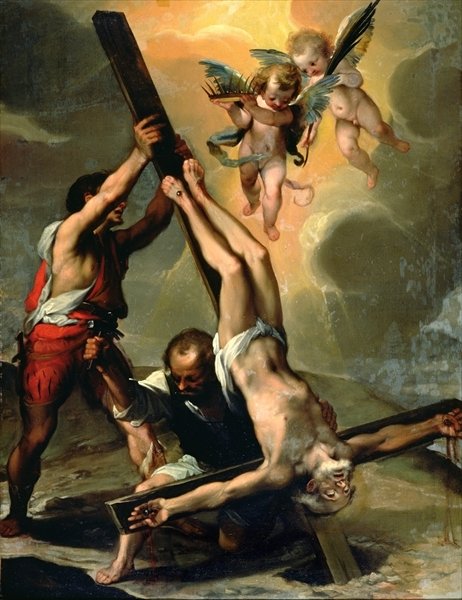
The most obvious one is that if you go with this theology, then to be consistent you must also believe that the Apostle Peter was either ignorant of the scripture or didn’t have the faith necessary to claim himself out of being martyred upside down on a cross.


aii135312


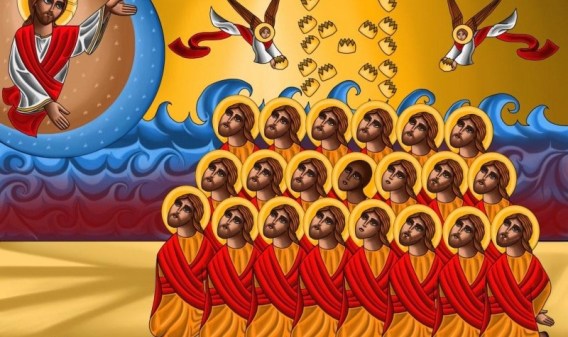
That would apply to modern martyrs as well.  What of the Christians in the Middle East who are being Martyred right now?  What of the Coptic Christians recently martyred as depicted in the icon below?


B-d6yZ9IMAAlR-z.jpg-large-800x500


I guess that promise in Jeremiah 29:11 just doesn’t extend to them does it?  Maybe they didn’t have enough faith…..

I say these things mockingly because the bad theology twisting this verse in Jeremiah needs to be mocked.  This false theology leads people to despair and apostasy.  What are you supposed to do if you or a loved one gets cancer?  Is it your fault that you didn’t have enough faith in the promise of Jeremiah 29:11?  If they are healed is it because of you and how awesome your faith was?

I hope what is becoming obvious in this line of reasoning is the difference between a Theology of Glory and a Theology of the Cross.  This is terminology that Martin Luther coined many years ago.  Essentially, the idea is that a Theology of Glory tries to make the scripture all about the reader and how they reach upward in power and faith while magnifying themselves.  A Theologian of the Cross however understands that the Bible is about Jesus and what he has done, and how he has saved those who do not deserve it.


Okay…. So what does Jeremiah 29:11 actually mean?


Now I have presented what the verse does not mean, let’s put it in context and see what it is actually saying.  This time I will use a more scholarly version than the one which it is so often quoted in and pull in the surrounding prophetic narrative.


“4 Thus says the Lord of hosts, the God of Israel, to all who were carried away captive, whom I have caused to be carried away from Jerusalem to Babylon:…


Well!  Isn’t that nice!  It sure helps to know who is being spoken to doesn’t it?  Notice we have from Jeremiah a promise of God directed to a very specific group of people.  Let’s put it this way, if you’re not living in old covenant Israel during the captivity then this doesn’t apply to you or anyone you know.


“5 Build houses and dwell in them; plant gardens and eat their fruit. Take wives and beget sons and daughters; and take wives for your sons and give your daughters to husbands, so that they may bear sons and daughters—that you may be increased there, and not diminished. And seek the peace of the city where I have caused you to be carried away captive, and pray to the Lord for it; for in its peace you will have peace….”


The three verses above look simple enough to me.  They are being directed to live out their lives as normally as possible in the new reality that has defined it.


“8 For thus says the Lord of hosts, the God of Israel: Do not let your prophets and your diviners who are in your midst deceive you, nor listen to your dreams which you cause to be dreamed. 9 For they prophesy falsely to you in My name; I have not sent them, says the Lord…”


This is a warning given frequently in scripture, don’t listen to the false prophets.  If you or I were living back then it might be a good idea to listen to Jeremiah.  He had just prophecied the fall of Jerusalem and nobody believed him.


10 For thus says the Lord: After seventy years are completed at Babylon, I will visit you and perform My good word toward you, and cause you to return to this place. 11 For I know the thoughts that I think toward you, says the Lord, thoughts of peace and not of evil, to give you a future and a hope.” Jeremiah 29:4-11 NKJV


Notice that Jeremiah 10 is also very helpful in understanding the context.  If you’re ever breaking this down for someone quickly, that’s as far as you really need to go.  I just took it one step further in this post to make the point extra clear.  Essentially what you have is a 70 year prophecy that God will return the people of Israel to Jerusalem.  This is referenced by Daniel many years later as he is the one looking to the fulfillment of that time.

The point is, that the promises in Jeremiah 29:11 don’t even apply to the people hearing them in the first place.  Instead it only applies to their grandchildren.  In this context, the word “you” is being used in a broad sense to apply to the people of Israel.  Specifically, their line is promised to be preserved and returned to Jerusalem.  Notice that the NKJV doesn’t include the prosperity promise that we saw in the NIV either.


Conclusion


Does this mean that the verse means nothing to us at all?  Of course not!  The promise we have in this verse is even better than the fiction foisted upon us by TV preachers.  In this bleak moment thousands of years ago it looked to anyone with a brain that the throne of David had failed.  Which would also mean the promised Messiah would not come,  the covenant of Israel had been broken, and there was no hope.

But as we know this is not the end of the story.  God promised to preserve them, and in doing so he fulfilled his promise to bring in the Messiah.  He even gave them their city and homes back to boot.

For us, what we can learn is that God keeps his promises.  No matter how bleak it gets in any age we know that he has promised to return.  No war, calamity, famine, or bad presidential election can change that.  Christ has come and taken away our sins and we look to see him return again.  We know that promise will be fulfilled and that one day we will be able to look back on the eschaton just as we do now on Jeremiah.

The trust of this verse is better than the fiction.  Take comfort in the victory Christ won for you on the cross.  Even if your life ends in a grisly fashion like Peter or those Coptic Martyrs, know that Jesus’s promise still stands.

Posted in Armchair Lounge, Frequently Twisted Passages | Tagged | 2 Comments

Baptism: Immersion vs Sprinkling

baby

I recommend that you read my series on Baptism before engaging in this post.  You can find it by clicking HERE.

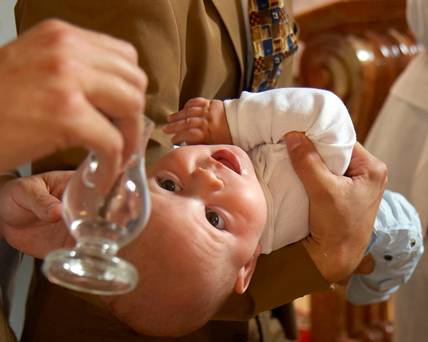
By the time I even started looking into this I had already been convinced by scripture that Baptism is real.  Specifically, I do not see it as a symbolic act that that does nothing.  I believe that Baptism is a means of Grace by which God kills and raises us in Christ.  Once you have accepted this after coming from a more Baptist background, the whole sprinkling vs dunking thing is kind of a non-issue.  In my opinion the Baptist fixation here is a distraction, and when we engage in the narrative it assumes the false premise.

That said, I am going to devote one post to this topic.  My goal here is to Biblically present why I believe it doesn’t matter how much water is used or how much of the body is covered in it.

What does Baptism Mean?

The word “Baptism” comes to us from the Greek word “Baptizo“.  I find that different sources will define the word differently depending on the theology of the one providing the definition.  I have seen some sources define it in ways that allow sprinkling and others that seem to try to scratch that out.  Not being educated in Greek myself, I try not to rely too much on those, and instead focus on how the word is used in scripture.

What I have found is that it works like the word “wash” in English.  The quantity of water seems to depend on the context.  Here is an example of what I mean.

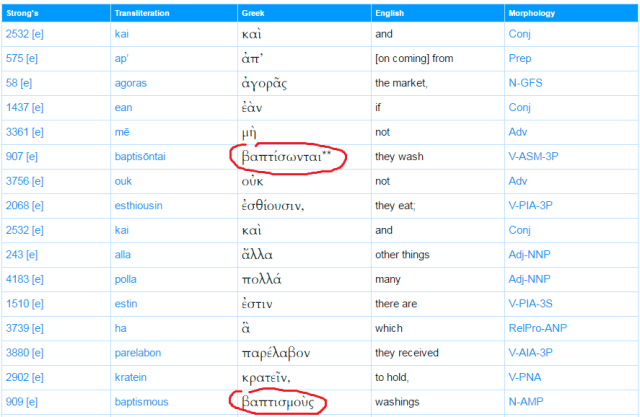
“4 And when they come from the market, except they wash, they eat not. And many other things there be, which they have received to hold, as the washing of cups, and pots, brasen vessels, and of tables.” Mark 7:4 KJV 

Notice in the above verse Mark is using the word “wash” to talk about cleaning dishes, tables, and other such household things.  Some Versions use the word “couch” in there too.  In English this has been translated wash, but in the Greek you will see he simply uses the Word Baptize.

Untitled

Even the most staunch Southern Baptist would have to concede that at least one place in scripture uses the root word “Baptizo”  in a sense that allows for sprinkling.  Unless of course, you’re going to insist that all first century Jews immersed their couches and tables on a regular basis.

Even today, the English word “wash” can mean either immersion or sprinkling.  It depends on the context and the one performing the washing can do it however they like, the amount of water isn’t definitional, it’s the presence of it that is.

What about the Trinitarian Baptism?

With those who advocate for immersion only Baptism, the argument generally goes something like this…

Though the Bible does use the word Baptizo differently, when it is talking about a Trinitarian Baptism it only means immersion.  To back this up examples from Descriptive Historic Narrative will be used along with photographic evidence, like the Baptism of Jesus below.

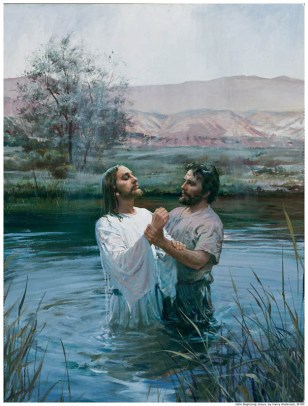
baptism-of-jesus-christ

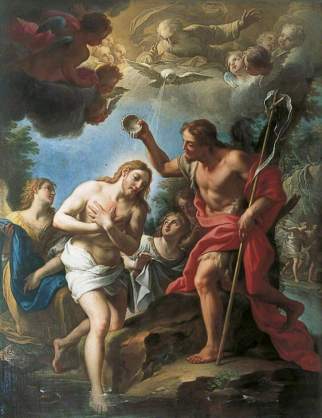
Jokes aside, I realize nobody claims that this is actual photographic evidence.  But in American Baptistic-Christian Culture this is the image you are accustomed to seeing.  So when you read the narrative in scripture, this is what you imagine.  The fact of the matter is that such narratives are not that specific.  The words “going” down into and coming “up” out of can just as easily mean walking down into the water and walking up out.  Besides, older Christian art conveys a very different picture does it not?

wyl_lmg_128876_large

For the record I have a personal connection to both of these pictures.  While I think the latter is of much higher quality and I identify with it as part of my journey in leaving adventism, the former I remember seeing growing up.  And honestly, because of this it is the picture that I personally think of when I read the narrative in the Bible.

There are several narratives in scripture that describe Baptism being performed.  I’ll pick out two of them below.

“And as they were going along the road they came to some water, and the eunuch said, “See, here is water! What prevents me from being baptized?” ; And he commanded the chariot to stop, and they both went down into the water, Philip and the eunuch, and he baptized him.  And when they came up out of the water, the Spirit of the Lord carried Philip away, and the eunuch saw him no more, and went on his way rejoicing.” Acts 8:36-39 ESV 

Notice the text above has both men going down into the water and both men coming back up.  If you’re going to insist that going down and up means immersion then you must also believe that Philip immersed himself!

Does that mean the Eunuch was immersed or sprinkled?  Either are possible, the point is that going down into and coming up out of doesn’t definitively mean anything in relation to the baptism other than the fact that water was necessary.

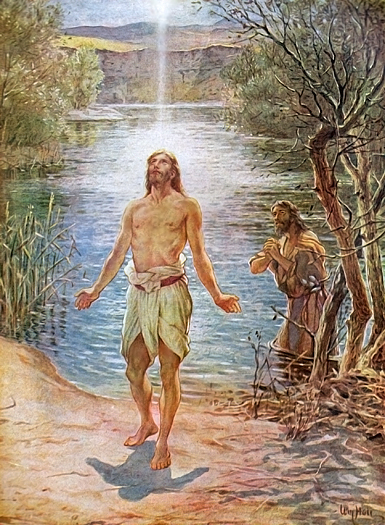
And when Jesus was baptized, immediately he went up from the water, and behold, the heavens were opened to him, and he saw the Spirit of God descending like a dove and coming to rest on him” Matt 3:16 ESV 

The above verse can be read either way.  You can insist that baptism preceded going “up” in the chain of verbs, thus the baptism was complete by the time he “went up”.  This would mean that the heavens opening occurred as Jesus walked out of the water rather that emerging from the water.  Like in the image below:

william_hole_the_baptism_of_jesus_525

If you want to be dogmatic about it you could insist that the verbs are connected and coming up out of the water conveys immersion baptism.  Thus the opening of the heavens would have occurred as Jesus emerged from the water.  I don’t personally think it matters as either way would be a baptism.  The text is simply not specific enough for us to be dogmatic in my assessment.

The fact that must be conceded is that the scripture doesn’t teach ONLY immersion or ONLY sprinkling, asserting otherwise establishes a false dichotomy.

That said, the main point that blows all of this out of the water  is that what we are dealing with here is descriptive historic narrative.  Even a Baptist would tell a Pentacostal not to base their understanding of tongues out of the book of Acts.  Historic narrative lends itself well to eisegesis and must be understood through the lens of systematic prescriptive works, like the writings of Paul.  And on all topics save baptism, a conservative baptist would likely agree with me on that.

What about the Symbolism Conveyed in Immersion Baptism?

One of the arguments for immersion only baptism is that it better conveys the symbolism taught in the following passage.

“Do you not know that all of us who have been baptized into Christ Jesus were baptized into his death?  We were buried therefore with him by baptism into death, in order that, just as Christ was raised from the dead by the glory of the Father, we too might walk in newness of life.” Romans 6:3-5 ESV

The idea is that going fully into the water conveys an image of death and burial while the coming up out of the water is a picture of the resurrection.

The problem with this framework is that the passage isn’t teaching something symbolic it’s teaching something literal.  Notice the verbs in the passage above are being performed by God not by Man.  You are not being symbolically baptized into the death of Christ, you are literally receiving it.  The scripture calls this the circumcision without hands.

“In him also you were circumcised with a circumcision made without hands, by putting off the body of the flesh, by the circumcision of Christ, having been buried with him in baptism, in which you were also raised with him through faith in the powerful working of God, who raised him from the dead.” Colossians 2:11-12 ESV

Notice that Paul specifically states that this is the “working of God”.  Baptism is not symbolic at all.  It’s real.

I would argue that focusing on the symbolism of immersion is a denial of what is actually happening and sends the wrong message.  For this reason and this reason only I think that in the era we currently live in sprinkling is preferable immersion in the western churches.   I say this because it sends a message that you actually believe in baptism.

What would convince me to believe in immersion only?

I am going to be fair and set the same standards for others that I do for myself in proving something from scripture.  If I were to be convinced immersion only is a thing then I would need to see the following proven from scripture:

  • Prove that Baptism is a work of Man, not of God
  • Prove that Baptism is Law, not Gospel
  • Demonstrate a prescriptive command to immerse only
  • Demonstrate a prescriptive command not to sprinkle


Even if one could prove that every case of Baptism in the Bible was immersion that wouldn’t cut it, because I am not denying that immersion baptism is a thing.  I am simply contesting the word “only”.

Is that standard not fair?  I think that it is absolutely fair!  I am very careful when claiming “only” anything in the Bible.  Read my post on Justification, notice that I present very clear prescriptive passages teaching Justification by Faith and not by works.  Anytime you are going to claim the word “only” you need to back it up with solid clear scripture that presents the either/or juxtaposition on it’s own.  Eisegeting the historic narrative just doesn’t cut it.


Conclusion

I of course believe that any Trinitarian Baptism applies the blessings promised in scripture.  The amount of water simply isn’t the issue.  The real flaw here is that so many see Baptism as Law instead of Gospel.  This of course doesn’t remove the heavenly promise that comes with it, but it does remove the comfort and knowledge that you have been forgiven in your baptism.

This is why I find the immersion debate irrelevant and generally don’t bring it up, this will likely be my only post on it.  The issue that actually matters is the efficacy of Baptism, though water is necessary the amount of it just isn’t.

Posted in Armchair Lounge, Soteriology | Tagged | 15 Comments

Clear Word vs Bible: The Wrath of God

download

A few years ago I was up at a Men’s Retreat in Leoni Meadows with my father.  It was right about the time that I was seriously questioning and comparing SDA teaching to the Bible.  While I was there, they had a popular SDA speaker who was preaching through a series on the sermon on the mount.  His name is Herb Montgomery, maybe you have heard of him.

After one of his sermons I pulled Herb Montgomery aside and asked him something that had bugged me about one of his sermons.  My question was, “Are you saying that God has no Wrath at all?”.  It was an honest question to ask in the context of the sermon he was giving.  I noticed that he backed up and got really uncomfortable, then he told me that he wouldn’t answer that question.

Why would SDA be uncomfortable with the doctrine of the Wrath of God?  As usual this post isn’t really going to dig into that concept.  I have covered this theme theologically in my series on the Great Controversy, which I recommend that you read if you have not already.  Today I am going to present a comparison between the Wrath of God in the Holy Bible with that of the Clear Word.  Did the SDA feel the need to change any of these verses?  If so why would they?


The Holy Bible The Clear Word
“36 He that believeth on the Son hath everlasting life: and he that believeth not the Son shall not see life; but the wrath of God abideth on him.” John 3:36 KJV “That’s why obeying God’s Son is so important.  Those who keep on believing in Him will have eternal life, but those who do not believe and obey will perish in their sins.”


Notice that both verses above compare the disposition of believers to unbelievers with regards to eternal life.  But the Clear Word leaves out the Wrath of God abiding on those who do not believe in God.  This is likely because the idea of something abiding on someone that doesn’t exist doesn’t really make any sense.  Which is one of the reasons why annialiationism doesn’t make very much sense Biblically speaking.  Obviously the concept had to be removed entirely from the Clear Word.

Also notice that Wrath though isn’t even a thing in the Clear Word, that gets pencil whipped out of the text altogether.


The Holy Bible The Clear Word
“21 For, behold, the LORD cometh out of his place to punish the inhabitants of the earth for their iniquity: the earth also shall disclose her blood, and shall no more cover her slain.” Isaiah 26:21 KJV “The Lord is coming from his dwelling place in the heavens to vindicate His name and to carry out justice.  The murders that were committed in secret will be made known.  The earth will no longer conceal the bodies of her slain.”


Notice that the Clear Word adds in this concept of God needing to vindicate his name.  What kind of puny idol needs to be vindicated? Who could remove God almighty from his throne to such a degree that vindication is even warranted?  And if such were possible would not the one that knocked him down be more powerful?

Also notice that punishing man for iniquity is removed and replaced with a vague notion of carrying out justice.  All I am saying here is that the latter lends itself to a wider degree of interpretation than the former.  What kind of Justice?  Social justice?  Civil Justice?  The Holy Bible is very clear as to the kind of Justice being administered, but the Clear Word seems to seek to obfuscate that clarity.


The Holy Bible The Clear Word
“17 And I will execute great vengeance upon them with furious rebukes; and they shall know that I am the LORD, when I shall lay my vengeance upon them.” Ezekiel 25:17 KJV “I will punish Philistia and they will know that I am the Lord when they feel the extent of my great displeasure.”


In the Holy Bible we see that God defines himself and his actions by carrying out his great vengeance.  In the Clear Word we see that this is dialed down to great displeasure.  On the one hand you have the Wrath of Almighty God and on the other you have someone in tears having a temper tantrum.  These two different books are not teaching us about the same Being.


The Holy Bible The Clear Word
“2 God is jealous, and the Lord revengeth; the Lord revengeth, and is furious; the Lord will take vengeance on his adversaries, and he reserveth wrath for his enemies.” Nahum 1:2 KJV “The Lord does not tolerate evil.  He is jealous for that which is good and punishes the wicked.  The Lord takes action on His adversaries and rages against His enemies.”


Let’s just be honest, the Holy Bible is giving us a much clearer picture here.  Also, we see again that the Clear Word has deleted the word “wrath” altogether.  I guess that wrath might simply be a no-no word in Adventism.  

The Holy Bible The Clear Word
“6 Who can stand before his indignation? and who can abide in the fierceness of his anger? his fury is poured out like fire, and the rocks are thrown down by him.” Nahum 1:6 KJV “Who can stand against Him?  Who can survive His displeasure?  He is like a burning fire; even the rocks shatter at His presence”


Here we see that word displeasure again, it’s almost like the writer of the Clear Word just wants to dial down the wrath of God as someone would a thermostat.


The Holy Bible The Clear Word
“11 God judgeth the righteous, and God is angry with the wicked every day.” Psalms 7:11 KJV  “He is a righteous Judge who will reward the righteous and punish the wicked.”


Looks like the anger of God just had to be pencil whipped right out of the Psalms, we can’t have that now can we!  

The Holy Bible The Clear Word
“Now go and smite Amalek, and utterly destroy all that they have, and spare them not; but slay both man and woman, infant and suckling, ox and sheep, camel and ass.1 Samuel 15:3 KJV “Go and attack them and completely destroy everything they have.  That’s the only way to stop them from attacking my people again.  Let nothing live.  Put to death men, women, infants, children, cattle, sheep, oxen, camels and donkeys.  That will make a statement to other nations to leave Israel alone.”


In the above passage, in the Holy Bible, you have God’s righteous judgement on a wicked people.  In the Clear Word you have an idol doing the best he can to stop another nation from attacking Israel again.  He is like a mob boss trying to send a message or something.

How ridiculous!  

Notice that in the Holy Bible no such excuses are given, and that is because God doesn’t need an excuse!

God is righteous and just to condemn and judge sin any time he sees fit to do so.  In this story in 1 Samuel we see types and shadows of the judgement day to come.  In the Clear Word we have another temper tantrum of a tear faced and scratchy voiced idol doing the best he can to stop the amalakites from harming Israel.

The Holy Bible The Clear Word
“4 For thou art not a God that hath pleasure in wickedness: neither shall evil dwell with thee.; 5 The foolish shall not stand in thy sight: thou hatest all workers of iniquity.; 6 Thou shalt destroy them that speak leasing: the Lord will abhor the bloody and deceitful man.” Psalms 5:4-6 KJV “You are not a God who finds crime and violence entertaining.  Evil finds no place in your presence.  Pride is offensive to you and you recoil at the sight of wickedness.  You do not give the gift of eternal life to liars, to the violent or to those who are deceptive.”


God does not recoil at the sight of wickedness, but rather it is wickedness that is damned the sight of God.  Notice that the Clear Word reverses this concept altogether and makes God bend to the wicked rather than the other way around.  We see God’s power and wrath burning in the Holy Bible against evil, and in the Clear Word we see God recoiling and turning his nose up instead.

These texts are not talking about the same Deity.  One is the God of the Bible and the other is an idol.  Which do you serve?


The Holy Bible The Clear Word
“18 For the wrath of God is revealed from heaven against all ungodliness and unrighteousness of men, who hold the truth in unrighteousness” Rom 1:18 KJV “God’s displeasure is shown from heaven against all who suppress the truth about Him by their ungodly and wicked lives.”


We can’t just leave the word “wrath” alone can we?  That has to go no matter the context.  Displeasure and wrath are not interchangeable words.  Why would we want an idol that is  merely displeased by murder and rape?  It’s almost as if the author of the Clear Word just doesn’t think God cares about these things.


The Holy Bible The Clear Word
“3 Among whom also we all had our conversation in times past in the lusts of our flesh, fulfilling the desires of the flesh and of the mind; and were by nature the children of wrath, even as others.” Eph 2:3 KJV “All of us in times past felt Satan’s wicked influence.  We lived to please ourselves and did whatever our sinful bodies and minds wanted us to do.  [DELETED BY SDA] We were no different than anyone else and deserved God’s punishment for what we did.”


Notice that the Holy Bible teaches that we are by our very nature under the Wrath of Almighty God.  This is inescapable on your own.  Each of us need the Blood of Jesus to cover and wash away our sins, for which we rightly deserve God’s present and eternal wrath.

In the Clear Word it’s not even there as an afterthought.  He doesn’t even bother to water it down for us, the author just nixes the teaching out of existence.


Conclusion

Whether they use the Clear Word or not the doctrine of the Wrath of God isn’t really a thing in Adventism.  The Holy Bible teaches the Holiness, Wrath, and Love of God as these three infinities.  God is Holy and perfect in an infinite sense, and because of this aspect regarding his nature his just Wrath burns against sin.  To say that his wrath is less than eternal would be to also say that he is less Holy for the scripture equates the two in many places.

Without the Wrath of God one cannot theologically understand the Love of God.  For just as his Holiness and Wrath are eternal and infinite so is his Love which he expressed on the Cross.  This is why in SDA theology the Love of God becomes rather vague and ill defined.  In removing the Wrath of God you also remove the other two, your source can no longer be the scripture and you end up defining the Nature of God philosophically instead.

All of that is getting a little deeper than I intended to go in this post, but since I have touched on it before I think it is a fair wrap up.  Clearly though SDA are quite uncomfortable with the Wrath of God, were they not then there would have been no need to remove it from so many clear passages as seen above.


Posted in Leaving Adventism, The Clear Word | Tagged , , | 1 Comment

Submit to Governing Authorities

23-target-language-government-vision-v


This is probably every US Citizen’s least favorite passage in scripture.  Our country is pretty much founded on the exact opposite of what it is teaching, thus a healthy disregard for the government is part of our culture.

As with other posts in my series on difficult passages, I am going to present the scripture itself.  After that I am going to post commentary from an array of sources that I think are edifying.  Then I will weigh in on my own, at the end I ask the reader to listen with an open Bible and practice good discernment.


“1 Let every person be subject to the governing authorities. For there is no authority except from God, and those that exist have been instituted by God. ; 2 Therefore whoever resists the authorities resists what God has appointed, and those who resist will incur judgment. ; 3 For rulers are not a terror to good conduct, but to bad. Would you have no fear of the one who is in authority? Then do what is good, and you will receive his approval, ; 4 for he is God’s servant for your good. But if you do wrong, be afraid, for he does not bear the sword in vain. For he is the servant of God, an avenger who carries out God’s wrath on the wrongdoer. ; 5 Therefore one must be in subjection, not only to avoid God’s wrath but also for the sake of conscience. ; 6 For because of this you also pay taxes, for the authorities are ministers of God, attending to this very thing. ; 7 Pay to all what is owed to them: taxes to whom taxes are owed, revenue to whom revenue is owed, respect to whom respect is owed, honor to whom honor is owed.” Romans 13:1-7 ESV


Commentaries


“The apostle now, in his exhortation, shows the duties which every person owes the government, and in which the Christians will lead all others with a cheerful sense of duty. Since this is the only place in which Paul treats at greater length of the duties toward civil authorities, it is probable that circumstances made it necessary for him to include this information at this point, either to curb the spirit of the Jewish Christians or to prepare all the Christians of Rome for the treatment which they afterward received at the hands of the tyrant Nero. Paul’s statements are very general, and find their application in all ages of the world; they indicate exactly the divine right and the divine dignity of the government, but, at the same time, limit the functions of the civil authorities to matters pertaining to this world, to the physical well-being of the subjects and to the duties of citizenship.

The apostle’s words are all-inclusive: Let every soul subject itself to authorities existing above it. Every person, without exception, within a community, state, or country is spoken of and addressed in this command. He should be subject to, submit himself willingly, without the application of force or restraint, to the existing powers or authorities, to the persons that are invested with power, to the incumbents of the governmental office. The governmental powers vested in these people by virtue of God’s providence or permission gives them a position in which they excel us in dignity and authority; they are our superiors in the sense of the Fourth Commandment. This is expressly brought out: For there does not exist an authority except by God; but those that exist are ordained by God. If a government is actually in power, whether tyrannical or otherwise, its existence cannot be explained but by the assumption that it is due to God’s establishment, either by His providence or by His permission. It would be impossible for any government to keep evil in check if the almighty hand of God were not the sustaining power. “Not only is human government a divine institution, but the form in which that government exists, and the persons by whom its functions are exercised, are determined by His providence. All magistrates of whatever grade are to be regarded as acting by divine appointment; not that God designates the individuals, but that, it being His will that there should be magistrates, every person who is in point of fact clothed with authority, is to be regarded as having a claim to obedience, founded on the will of God.” (Hodge.) This being the case, therefore, whosoever, every one that, resists the power resists the institution of God. If any person refuses obedience to the government to which he is subject in any point left free by God’s express command or prohibition, he rebels, not only against the lawful authority of the government, but incidentally against God Himself, who established government. And they that resist will receive to themselves judgment, the sentence of condemnation. Not only will they make themselves liable to prosecution and punishment on the part of the government, but they will be looked upon and treated as rebels by God, who will not have the authority vested by Him disregarded. History shows that the visitations of God upon rebellious peoples have been very severe.

The apostle now brings another reason for the duty enjoined in the first verse: For the authorities, those that rule, are a terror, a cause for fear, not to the good work, but to the evil. That is the purpose for which God has established government: it is to be a matter of fear, its power is to strike terror into the hearts of the rebellious, just as its dignity is to cause reverence and respect in the minds of all subjects. It is only he that does evil who must fear the civil authorities, not he that does good. He that transgresses the laws of the country, and refuses to live in accordance with the demands of civil righteousness, must expect to be treated as his behavior merits. If, then, a person does not want to live in continual fear of the government in the rightful discharge of its duties, he should be concerned about doing good, about living up to the laws of the country, about doing his duty as a citizen. Then he will have praise from the authority, or government; he will be recognized and treated as a good, dutiful citizen. For the magistrates, the persons in authority that are actually conscious of the responsibility and power vested in them, will then act so that the government will be the servant of God to every good citizen for good. For that purpose the government is established and upheld by God, for the benefit of the citizens that are law-abiding, to protect and defend them against wrong, to seek the welfare of society in every way. But if some one will do wrong, will deliberately transgress the laws of the city, state, or country in which he lives and whose protection he enjoys, then he should fear. Far the government nowhere bears the sword, the symbol of authority, in vain; it is not for nothing that the civil authorities are invested with the right to punish, if necessary, by administering the condemnation of death upon the transgressors of the law. God’s minister the government’s power is, both in protecting and in punishing, and, in the latter case, avenging unto anger, manifesting and exercising revenge and wrath upon him that makes it a practice to do evil. Thus the government, according to God’s will, is the guardian of law and order, including external morality. And this reason is sufficient to keep the Christians peaceful and law-abiding, no matter under what form of government they are living, no matter if the persons in authority are morally corrupt. If the members of God’s kingdom can but lead a quiet and peaceable life in all godliness and honesty and build up the Church of Christ, they are duly thankful to God. And if a hostile government uses tyrannical measures to suppress the work of the Church, Christians will not assume a rebellious attitude, but will try to gain their object by legitimate means, by invoking the statutes and the constitution of their state or country. It is only when the government demands anything plainly at variance with the revealed will of God that the Christians quietly, but firmly refuse to obey, Acts 5, 29.” – Kretzmann Commentary


Romans 13

* Quoted from the ESV Study Bible

What Does it Mean?

The simple answer is that this passage is pretty straight forward, it means what it says.  If you don’t like that because you think rebellion is awesome then this might be a piece of law you should consider praying about and submitting to.  God has instituted Government for a good reason.

The obvious question though is what does this mean about evil governments?  If you or I lived in Nazi Germany does that mean we would have been bound by scripture to murder the Jews?  Both of the commentaries handled this aspect in detail, so I won’t repeat it.  But the short answer is no.  We are to obey the government except when doing so means violating the Law of God.  Below is a proof-text from Acts which is commonly used as a cross reference for Romans 13.  I think this balances that question out nicely.

“But Peter and the apostles answered, “We must obey God rather than men.” Acts 5:29 ESV 


Here is the idea, the Government is instituted by God for his overall purposes across the span of human history.  Thus, in periods of a wanton evil government such as Nazi Germany, it is good for us to remember that there is a scope to their authority.  When they overstep that scope and command citizens to violate the Law of God then it is no longer a sin to disobey or even form a new government and rebel against them.

What is that scope precisely?  I would argue that the safest way to define that scope is the Word of God.  If a command by the government is not forbidden in scripture then it is okay for the government to make whatever laws they like to promote good order and safety.


Reflection/Speculation


I am going to speculate a bit and draw some logical conclusions from what I have presented above.  Feel free to let me have it if you believe that I am wrong.  If I seem unteachable please comment anyways for others who may be reading.  But due to the nature of this topic I am going to do something I rarely do with my blog, I am going to get touch on politics.  I will be careful to avoid partisan politics out of respect for the subject matter though.  Bear in mind my thoughts are specific to the United States where I live.

Abortion:  Is it Biblically permissible for the Government to allow abortion?  I don’t believe so, the scripture is very clear that this is murder, an issue I address HERE.  Fortunately in America abortions are not yet being forced though so we can praise God for that.  At the time of this writing you can simply not have the procedure done without incurring legal consequences.  There are other countries though where this is not the case.

Loss of Free Speech:  Our government is circumventing the first amendment by making it illegal, or at the very least, cost the citizen a great deal to speak out against sexual sin.  If this only results in loss of tax exempt status for Churches or losing the ability to hold government employment I am not too concerned.  I am certainly willing to pay more and have a little less, and I count myself lucky if that is the only persecution I see in my lifetime.  But history and even scripture tells us to expect this beast to grow in time.  Because of that I’m concerned how this will evolve in the coming generations.

Right to Bear Arms:  I am bringing this up more to make a point.  Don’t get me wrong, I fully support the Second Amendment and I am glad we have it.  Furthermore, I think it is something worth fighting to keep.  One caveat though, I would distinguish between Church and State when it comes to fighting for the second amendment.  There is no scripture forbidding government to outlaw weapons.  As Americans though we are part of the governing process and it is here that we should make our stand.  Don’t claim that the right to bear arms is in the Bible, it just makes you look dumb.


Conclusion


The bottom line is that we as Christians are bound to obey the government.  Even laws that you find tedious or taxes that you prefer not to pay, remember that the government was established by God, and we should be good citizens.

That’s all I feel a desire to comment on with this post.  Romans 13 is a dynamic text though with more to it than I presented here.  Maybe in the future I will dig into it again.  What are your thoughts?  Feel free to relate it to society today if you like.  I would really like to know.


Posted in Armchair Lounge, Difficult Passages | Tagged , | 5 Comments

What’s the deal with the Nephilim?

angel-waiting

This post was published 8/1/16, recently (9/3/17) I’ve come across some information that indicates my interpretation may be wrong, or at the very least incomplete.  I’m going to leave it posted as one possible way of interpreting these passages.  In the future maybe I’ll blog on some of the things I am learning.


***********

This is one of the most popular Biblical topics out there, which is kind of sad because it can be a distraction.  But I will devote this one post to it.  The bottom line is we don’t know for sure, but there are some passages that I believe are helpful.  As with other difficult verses I will present the passage, some professional commentary, and then I will weigh in on my own.


“4 The Nephilim were on the earth in those days, and also afterward, when the sons of God came in to the daughters of man and they bore children to them. These were the mighty men who were of old, the men of renown.” Gen 6:4 ESV 


Commentaries


“The conditions before the Flood are further characterized. Wild, lawless men, tyrants there were on the earth in those days, offspring of marriages that did not meet with God’s approval, children of wild passion, men that defied order and authority and became mighty men, whose names were mentioned with bated breath as those of unparalleled champions and heroes. The whole earth was full of outrage and violence. Cp. Matt. 24, 38. 39. This is a picture of our own days, of the period immediately preceding the final Judgment, full of the most impressive warning for all that will heed the signs of the times.” – Kretzmann Commentaries


“The Nephilim (“fallen ones, giants”) were the offspring of sexual relationships between the sons of God and daughters of men in Genesis 6:1–4. There is much debate as to the identity of the “sons of God.” It is our opinion that the “sons of God” were fallen angels (demons) who mated with human females or possessed human males who then mated with human females. These unions resulted in offspring, the Nephilim, who were “heroes of old, men of renown” (Genesis 6:4).” –GotQuestions


“There were giants in the earth – נפלים nephilim, from נפל naphal, “he fell.” Those who had apostatized or fallen from the true religion. The Septuagint translate the original word by γιγαντες, which literally signifies earth-born, and which we, following them, term giants, without having any reference to the meaning of the word, which we generally conceive to signify persons of enormous stature. But the word when properly understood makes a very just distinction between the sons of men and the sons of God; those were the nephilim, the fallen earth-born men, with the animal and devilish mind. These were the sons of God, who were born from above; children of the kingdom, because children of God. Hence we may suppose originated the different appellatives given to sinners and saints; the former were termed γιγαντες, earth-born, and the latter, ἁγιοι, i.e. saints, persons not of the earth, or separated from the earth.

The same became mighty men – men of renown – גברים gibborim, which we render mighty men, signifies properly conquerors, heroes, from גבר gabar, “he prevailed, was victorious.” and אנשי השם anshey hashshem, “men of the name,” ανθρωποι ονομαστοι, Septuagint; the same as we render men of renown, renominati, twice named, as the word implies, having one name which they derived from their fathers, and another which they acquired by their daring exploits and enterprises.

It may be necessary to remark here that our translators have rendered seven different Hebrew words by the one term giants, viz., nephilim, gibborim, enachim, rephaim, emim, and zamzummim; by which appellatives are probably meant in general persons of great knowledge, piety, courage, wickedness, etc., and not men of enormous stature, as is generally conjectured.” – Clarke Commentary


What Does it Mean?

I don’t think anyone can definitively declare what the Nephilim were.  There simply isn’t enough clear scripture, and at one point or another speculation is going to have to form a critical component of any framework, even mine.  Unlike many others though I will point out where I need to speculate.

I would first categorically rule out the Nephilim as being children of fallen angels.  God created the bearing of Children as something synonymous with marriage.  One exists for the purpose of the other.  And we find in Matthew that Angels do not get married, therefore it is fair to say that they likely would not be capable of having children either.  To assert otherwise, you either have to believe that God created beings who could have children but were barred from doing so,  or you just have to start making stuff up, both of which I am not comfortable with.

Below is the narrative where Jesus teaches angels cannot marry or be given in marriage.  I am including the whole narrative for context.

“23 The same day Sadducees came to him, who say that there is no resurrection, and they asked him a question, 24 saying, “Teacher, Moses said, ‘If a man dies having no children, his brother must marry the widow and raise up offspring for his brother.’ 25 Now there were seven brothers among us. The first married and died, and having no offspring left his wife to his brother. 26 So too the second and third, down to the seventh. 27 After them all, the woman died. 28 In the resurrection, therefore, of the seven, whose wife will she be? For they all had her.” 29 But Jesus answered them,“You are wrong, because you know neither the Scriptures nor the power of God. 30 For in the resurrection they neither marry nor are given in marriage, but are like angels in heaven. 31 And as for the resurrection of the dead, have you not read what was said to you by God: 32 ‘I am the God of Abraham, and the God of Isaac, and the God of Jacob’? He is not God of the dead, but of the living.” 33 And when the crowd heard it, they were astonished at his teaching.” Matt 22:23-33 ESV

I believe I can fairly say that the Nephilim were most likely only of human DNA.  This removes all the fun out of it, so my apologies for that.  I know a lot of people like their legends and all.  That said, what are we left with?

The Nephilim are mentioned by name twice in the Old Testament.  The first time is in Genesis and then once again they are brought up in Numbers.

“32 So they brought to the people of Israel a bad report of the land that they had spied out, saying, “The land, through which we have gone to spy it out, is a land that devours its inhabitants, and all the people that we saw in it are of great height. 33 And there we saw the Nephilim (the sons of Anak, who come from the Nephilim), and we seemed to ourselves like grasshoppers, and so we seemed to them.” Num 13:32-33 ESV

The plainest understanding of the Nephilim based on the above passage is that it is a genetic thing.  Some people are Nephilim and some people are not.  I would compare it to being genetically Jewish, British, or Jamaican.  Nephilim is simply an ancient ethnicity.  Apparently it seems to come with some stereotypical traits, one of which is being really tall.

Though the word isn’t uses specifically in this next passage we can see a very similar theme being conveyed.  Take a look:

“11 (For only Og the king of Bashan was left of the remnant of the Rephaim. Behold, his bed was a bed of iron. Is it not in Rabbah of the Ammonites? Nine cubits was its length, and four cubits its breadth, according to the common cubit.)” Deu 3:11 ESV 

“Rephaim is a Hebrew word for giants. Deut. 3:11 declares that his “bedstead” (translated in some texts as “sarcophagus”) of iron is “nine cubits in length and four cubits in width”, which is 13.5 ft by 6 ft according to the standard cubit of a man.” –Wikipedia

 _
Keep in mind that just because his bed was 13.5 feet tall that doesn’t mean he was as well.  It does mean that he was likely tall enough to need such a bed though.  We have tall people like this today who would likely have enormous beds just like King Og.


See below a picture of the tallest man in the world.  His name is Sultan Kosen, he is 8’3″ tall and would have grown even more if it wasn’t for a surgery that he received to stop growing.  There have been others documented to be as tall as 8’11”.


sultan-kosen_2166776b

I am not saying he is a Nephilim, but I am pointing out that extreme height is a thing in the human genome.  It is not unreasonable to suspect that there was an ancient ethnic tribe marked by this trait many thousands of years ago.  If you want to know where my hermeneutic gets speculative on identifying the Nephilim though then you just found it.  This is the piece I am bringing in from my mind, although I do think there is legitimate reason to go here from the text.  Let me know in the comments if you think I am wrong here.

In the Biblical passages preceding the Nephilim in Genesis 6 we have two chapters detailing the lineage after Adam.  I would recommend that you skim them real quick (Gen 4)(Gen 5).  Notice one lineage is from Cain, very wordly and earthy, and then the other is from Seth.  The line of Seth is marked as those who “called upon the name of the Lord”.

“26 To Seth also a son was born, and he called his name Enosh. At that time people began to call upon the name of the Lord.” Gen 4:26 ESV 

I would mark the Nephilim as those who came from the line of Cain in chapter 4.  This is because when we get to 6 we see the following:

“1 When man began to multiply on the face of the land and daughters were born to them,  2 the sons of God saw that the daughters of man were attractive. And they took as their wives any they chose. 3 Then the Lord said, “My Spirit shall not abide in man forever, for he is flesh: his days shall be 120 years.” 4 The Nephilim were on the earth in those days, and also afterward, when the sons of God came in to the daughters of man and they bore children to them. These were the mighty men who were of old, the men of renown.” Gen 6:1-4 ESV 


I am arguing that contextually, the sons of God and man are not the same groups of people.  The referent for “Man” would be the worldly line of Cain described in chapter 4, and the Sons of God are those who called upon the name of the Lord.  They are the more noble line of Seth.  You could call them the Christians of this era.

It looks like this breaks down though when those of Seth start marrying into the line of Cain.  One of the things that came about was likely a genetic trait of great height, and likely strength too.  Not long after that the flood comes and wipes everything out.  Clearly there has to be more going on in the text than is actually stated.  But that is what I am putting together.  It does seem clear though that these traits of height and strength still carried to one degree or another through the line of Noah.  Perhaps one of the girls his sons married was related to the Nephilim, which is why we see it later in the land of Canaan.

Is it possible that Goliath was the last Nephilim wiped out by David?  I like the Christological typology that would imply but it’s not something I would be dogmatic about.


Conclusion

The reason I prefer the general understanding that I conveyed at the end is because it is the only rendering I have seen that relies on the most scripture and the least amount of assumptions.  It does still have a fair amount of assumptions though, more than I am comfortable with anyways.  So I hold to it in a state of reverent speculation.

Do I think that other theories are totally wrong?  What about the nifty legends of men born from angels with superpowers?  What about all the stories from the book of Enoch?  Well these stories are fun but they are apocryphal.

I won’t condemn them as heresy but I don’t think they are correct either.  Such tales are based more on assumption than scripture, and with what I have presented I think I am able to rely on the scripture more and assumptions less so.  What do you think about the Nephilim?  Let me know in the comments if you want to.


Posted in Armchair Lounge, Difficult Passages | Tagged | 11 Comments

Clear Word vs Bible: Michael the Archangel


captura-de-pantalla-2015-10-23-a-las-11-25-22

One of the distinctives of the Seventh Day Adventist Church is that they believe all accounts of Micheal the Archangel are pre-incarnate appearances of Jesus Christ.  Another term for this is “theophany”.  Early in the SDA Church they took this one step further and taught that Michael was a created angel who ascended to equality with God at a point in time before the Creation of Earth.

In my opinion they hold to theophany today out of a desire to confess the Deity of Christ and the teachings of Ellen White at the same time.  This is a concept I delved into in an older post which you can find HERE.

Below I am going to present a sample of proof-texts that SDA use as their strongest Biblical case for Michael the Archangel actually being Jesus.  I am going to put the Clear Word verses right next to the ones from the Bible.  Let’s see whether or not the Seventh Day Adventists felt the need to change the Biblical text in order to support their doctrines.


The Holy Bible

The Clear Word

“At that time shall arise Michael, the great prince who has charge of your people. And there shall be a time of trouble, such as never has been since there was a nation till that time. But at that time your people shall be delivered, everyone whose name shall be found written in the book.” Daniel 12:1 ESV “Gabriel continued, “At that time, Michael, the Great Prince who protects God’s people, will finish His work in heaven and bring all things to an end.  But before He comes, there will be a time of trouble such as there never has been since there first were nations, even up to that time.  That’s when God’s people will be delivered, everyone whose name is written in His book.”


What I want to point out in the Clear Word version on the right is that the author is using a capital “H” for all the singular male pronouns.  This is a unique feature consistent throughout the Clear Word.  The author has done this anytime that he is referencing God.  In and of itself this is fine, especially for a paraphrase.  The problem is that this verse in Daniel isn’t talking about God it is talking about Michael the Archangel.  For whatever, reason, the author felt the need to add the teaching of Michael being God in here.  Why would he want to make such an addition?


The Holy Bible

The Clear Word

“But when the archangel Michael, contending with the devil, was disputing about the body of Moses, he did not presume to pronounce a blasphemous judgment, but said, “The Lord rebuke you.” Jude 1:9 ESV “In contrast to these ungodly men is the Lord Jesus, also called Michael the Archangel, for he is over the entire angelic host.  When he was challenged by Satan about his intentions to resurrect Moses, he didn’t come at Satan with a blistering attack, nor did he condemn him with mockery.  He simply said “God rebuke you for claiming Moses’ body”.


Notice in this verse the author of the Clear Word felt the need to add the phrase “the Lord Jesus, also called Michael the Archangel” instead of just saying “archangel Michael”.  If SDA actually believed that this passage taught that Michael the Archangel was in fact Jesus why did they need to add those words into the text?

What is up with this new story about Moses being resurrected during this transaction?  The Bible doesn’t have a bodily resurrection of Moses account.  If anything it teaches the opposite, Jesus Christ is the first fruits of the Bodily Resurrection of all believers, not Moses (1 Cor 15:22-23).


The Holy Bible

The Clear Word

“5 So Moses the servant of the Lord died there in the land of Moab, according to the word of the Lord, ; 6 and he buried him in the valley in the land of Moab opposite Beth-peor; but no one knows the place of his burial to this day.”Deu 34:5-6 ESV “So Moses, the servant of God, died in the land of Moab on top of Mount Nebo as the Lord had told him he would.  The angels of the Lord buried him on top of the mountain in the land of Moab, opposite Beth Peor.  But no one knows where his grave is, because soon after he was buried the Lord came down and raised him from the dead and took him to heaven


Changing the “Lord” buried him to the “angels of the Lord” is not a big deal in my opinion.  Just because God may have delegated doesn’t mean he didn’t do it either, both statements can be true.  This would make sense especially when read alongside Jude 1:9 above.  In all likely-hood Michael was the one who was burying Moses body when he had some words with the Devil.

There is however no resurrection account here in Deuteronomy.  The Bible never teaches a bodily Resurrection of Moses.  He simply died and went to heaven like anyone else in Christ.


The Holy Bible

The Clear Word

“16 For the Lord himself will descend from heaven with a cry of command, with the voice of an archangel, and with the sound of the trumpet of God. And the dead in Christ will rise first.”1 Thes 4:16 ESV “When Christ descends from heaven as the Archangel, He will give a shout like a trumpet, which is God’s call to the dead, and those who died in Christ will rise first.”


Notice in the Holy Bible we have different nouns assigned to different verbs.  We see the Lord descent with a cry of command.  Alongside him his the voice of an Archangel, and it looks like someone else is blaring on the trumpet.  The most likely verb causing the dead to rise is the command of God.  Everything else is simply attending angels praising the Glory of God and the event at hand.  There is no reason in the text to assume that the voice of the archangel or the sound of the trumpet is raising the dead.  Every time that the dead have been raised in scripture it has been by God’s command anyways.

In the Clear Word this verse has been completely reconfigured.  Notice that the words “as the archangel” have replaced “with the”.  The Clear Word is directly referring to the Archangel as Jesus where as the Holy Bible does not.  The Clear Word also equates the shout, trumpet, and command as being the same thing rather than leaving them as a separate verbs.


Conclusion

I don’t believe that Michael the Archangel is Jesus.  I certainly believe he is a highly placed created angel that is delegated tasks that are in line with his position in heaven.  But the case for him being Theophany isn’t strong enough when one only relies on the Bible.  Because of that I don’t see the need to speculate or to draw any hard and fast conclusions.

SDA cannot hold this doctrine in speculation though, it has to be dogma.  The reason is because if they give it up they would have to either leave Ellen White or become fully Arian.  Because of this they have a strange certainty about believing that Michael is theophany.  Clearly, based on the above they feel so strongly about this that they had to alter the Bible to support it.  If the Bible were clearly teaching that Michael was Jesus then it would be as firm on the doctrine as the Clear Word is.


Posted in Leaving Adventism, The Clear Word | Tagged | 2 Comments

Baptism of the Eunuch


gg3354_083a


Before proceeding I would recommend you read through my series on Baptism, which you can find HERE, if you have not already.  When people contest the Biblical teaching of baptism they usually hover in the Book of Acts.

One of the most commonly quoted proof-texts for believer baptism is Acts 8:37.  For clarity and context I will be including the surrounding verses.  Most should be familiar with this passage though.


“35 Then Philip opened his mouth, and began at the same scripture, and preached unto him Jesus.; 36 And as they went on their way, they came unto a certain water: and the eunuch said, See, here is water; what doth hinder me to be baptized?; 37 And Philip said, If thou believest with all thine heart, thou mayest. And he answered and said, I believe that Jesus Christ is the Son of God.; 38 And he commanded the chariot to stand still: and they went down both into the water, both Philip and the eunuch; and he baptized him.” Acts 8:35-38 KJV 


As with other posts in my series on difficult passages I am going to present some sound Biblical commentary and then I will weigh in at the end.


Commentaries

“We may well imagine the scene: a fine autumn day, the comparatively uninhabited plain extending on either side, the driver of the chariot half-dozing over his lines, the two men poring over the sacred roll. Note that Luke refers to the contents of the passage of Scripture as of a fixed quantity, a book which was known by that name to all the Jews. Having read the passage in question together once more, the eunuch asked Philip whether the prophet was here speaking of himself or referring to some one else. His knowledge of prophecy and the teaching he had had did not enable him to decide this important point. And Philip, full of the joy of the missionary when he finds an eager inquirer after the truth, opened his mouth for a long discourse. He could hardly have found a more suitable text to expound his great topic, for his subject was Jesus and the wonderful message concerning Him. Beginning with the many clear and beautiful texts of the Old Testament, he had a fine opportunity of showing the fulfillment of prophecy in the case of Jesus of Nazareth. And he undoubtedly spoke also of the great commission of the Lord which He had entrusted to His disciples, “to teach all nations, baptizing them in the name of the Father and of the Son and of the Holy Ghost,” Matt. 28, 19. And while Philip was still picturing the glories of the Christ in glowing colors, the chariot came near one of the small streams or pools which, even in the dry season, may contain some little water. And the eunuch, half in eagerness and half in fear, points to the water and asks whether there would be anything in the way of his being baptized. Philip thereupon put the question which is fundamental in every true formula for baptizing, saying that his wish may very well be granted if he believes with all his heart. And the eunuch, filled with the sweetness and beauty of the Gospel proclamation which he has just heard, utters his confession: I believe that Jesus Christ is the Son of God: a short, but comprehensive formula, amounting to a confession in the Triune God. The officer then commanded the chariot to halt, and both Philip and the eunuch went down to, or into, the water, where the latter was baptized, the method not being indicated, though it was probably either by pouring or by immersion. No weight attaches to the method or form of baptism, so long as water is used and applied with the words of institution. But when they came up out of the water, the Lord, the Spirit of the Lord, performed a miracle by suddenly removing Philip from the side of the eunuch and out of his sight.” – Kretzmann Commentaries

“This whole verse is omitted by ABCG, several others of the first authority, Erpen’s edit. of the Arabic, the Syriac, the Coptic, Sahidic, Ethiopic, and some of the Slavonic: almost all the critics declare against it as spurious. Griesbach has left it out of the text; and Professor White in his Crisews says, “Hic versus certissime delendus,” this verse, most assuredly, should be blotted out. It is found in E, several others of minor importance, and in the Vulgate and Arabic. In those MSS. where it is extant it exists in a variety of forms, though the sense is the same.” – Clarke Commentary

“This verse is missing in a very large number of manuscripts (Mill), and has been rejected by many of the ablest critics. It is also omitted in the Syriac and Ethiopic versions. It is not easy to conceive why it has been omitted in almost all the Greek mss.” – Barnes Commentary

Why isn’t Acts 8:37 in the ESV?

There are a few things that I would like to comment on about Acts 8:37.  First of all, it should be mentioned that this particular verse is apocryphal.  If you look for it in a modern Bible like the ESV you will see that Acts 8:37 isn’t included.  Why is that?  The answer is because in all likelihood this verse wasn’t in the original copy of Acts.

Does that mean it isn’t true?  Of course not.  It is entirely possible that Acts 8:37 was something that was part of the oral tradition but just didn’t get written down in the book itself when it was first circulated.  That doesn’t in and of itself mean that this part of the story isn’t true.  But it does mean that the verse is shaky ground to use as a proof-text for anything.  For the same reason, I don’t use Mark 16:16 to argue for Baptismal Regeneration even though Luther did quite frequently.

If you want a breakdown on this concept then I recommend taking a look at a fair article I found on it for you HERE.  Delving into textual criticism is far beyond the scope of this post.  That said, every student of scripture should have at least a cursory understanding of it.  So do read through that if you are unfamiliar.  To be fair, I linked to a Baptist source  just so show that there is ecumenical unity on the apocryphal origins of this verse.

All that said, how should we understand this passage?  Well to be completely fair I am going to address the verse as if it was in the Bible.

What Does it Mean?

One thing that needs to be stated is that this passage is descriptive, not prescriptive.  We are seeing a story of a conversion and then a Baptism.  We see Philip preaching the Word (Acts 8:35), and in this act we would expect the Eunuch to receive faith as prescriptively taught elsewhere (Rom 10:17)(Eph 2:8-9).  At this moment the Eunuch is confessing faith and requests Baptism (Acts 8:36-37) and then in verse 38 the Baptism is performed.

It should be stated that there is nothing wrong with doing it this way.  Scripturally, the only significant thing about means of grace in the odro saludis (order of salvation) is that it precedes receiving of faith.  By that I mean, since the Eunuch heard the preaching of the Word first then this is the means he received faith from first.  Had Philip led with Baptism and then preached the Word it would have been just as efficacious for the creation of faith in the Heart of the Eunuch.

Simply stated, this verse isn’t tricky for Lutherans.  Baptism is one means of Grace.  The thief on the cross is a good example of someone who was saved by the Preaching of the Word only.

An important thing to understand is that Baptism and the teaching/preaching of the Word are something that should be connected together.

“19 Go therefore and make disciples of all nations, baptizing them in the name of the Father and of the Son and of the Holy Spirit, ; 20 teaching them to observe all that I have commanded you. And behold, I am with you always, to the end of the age.” Matt 28:19-20 ESV 

Notice that Baptizing comes first, and then after that we see teaching.  Ideally this should be the general norm of the Christian life.  Obviously Babies are too young to be taught the scripture so you baptize them first and teach them later.  Narrative is not normative though, and in the case of the Eunuch he wanted to be taught first.  Baptism is Gospel not Law, thus it shouldn’t be looked at legalistically.   The Eunuch is in the kingdom, that’s what matters.

Conclusion

Like I said above, even if this verse is included in the canon, it is not difficult for Lutheran theology.  Baptism is only one means by which the literal death burial and Resurrection of Christ is poured on the Believer.  In practice what is generally done is that Babies are baptized and then taught while adults are taught and then baptized.  Though both means of Grace are independently efficacious at the time of application we are taught by Christ to connect the two throughout the Christian life.  In the preaching of the Word we continually remember our Baptism, our salvation in Christ, and where we stand with him.

Posted in Armchair Lounge, Difficult Passages | Tagged | 2 Comments