The Holiness, Wrath, and Love of God

wrathsatisfied400wtt

A few weeks ago I put together a post demonstrating both the existence of Hell and the truth of Eternal Conscious Torment.  You can read that by clicking HERE.

What my post did not address is to answer the logical question of why God casts sinners into Hell.  The answer to this I believe is more complex and more important theologically as it touches on the study of God.  To that end I am going to present a short study on the doctrines that I believe are connected to the answer of ‘Why Hell?’.

  1. The Holiness of God
  2. The Wrath of God
  3. The Love of God
The Holiness of God

 “…I saw the Lord sitting upon a throne, high and lifted up; and the train of his robe filled the templeAbove him stood the seraphim. Each had six wings: with two he covered his face, and with two he covered his feet, and with two he flew. And one called to another and said:

Holy, holy, holy is the Lord of hosts;
the whole earth is full of his glory!”

And the foundations of the thresholds shook at the voice of him who called, and the house was filled with smoke. And I said: “Woe is me! For I am lost; for I am a man of unclean lips, and I dwell in the midst of a people of unclean lips; for my eyes have seen the King, the Lord of hosts!” Isaiah 6:1-5 ESV

Here we have one of the most vivid displays of the Holiness of God in the Bible.

 “Holy, holy, holy”

This is also stated by the same creatures in Revelation 4:8, its called the “trihagion”.  Rather than repeat the work done by others on this three fold repetition of “Holy” I am going to quote the work of those smarter than myself.  This below excerpt is taken from a Got Questions essay available for free to anyone online.

“The repetition of a name or an expression three times was quite common among the Jews. In Jeremiah 7:4, the Jews are represented by the prophet as saying, “The temple of the Lord” three times, expressing their intense confidence in their own worship, even though it was hypocritical and corrupt. Jeremiah 22:29, Ezekiel 21:27, and 2 Samuel 18:33 contain similar three-fold expressions of intensity. Therefore, when the angels around the throne call or cry to one another, “Holy, holy, holy,” they are expressing with force and passion the truth of the supreme holiness of God, that essential characteristic which expresses His awesome and majestic nature.”

In addition, the trihagion expresses the Triune nature of God, the three Persons of the Godhead, each equal in holiness and majesty. Jesus Christ is the Holy One who would not “see decay” in the grave, but would be resurrected to be exalted at the right hand of God (Acts 2:26;13:33-35). Jesus is the “Holy and Righteous One” (Acts 3:14) whose death on the cross allows us to stand before the throne of our holy God unashamed. The third Person of the trinity—the Holy Spirit—by His very name denotes the importance of holiness in the essence of the Godhead.”
To summarize my understanding, not only is the Holy Trinity in view here, but the Holiness is identified as perfect and complete, to restate this mathematically I would use the word infinity.  The Holiness of God is infinite and quite beyond human comprehension or explanation outside of the Word.

The Wrath of God

“4 For you are not a God who delights in wickedness; evil may not dwell with you. 5 The boastful shall not stand before your eyes; you hate all evildoers. 6 You destroy those who speak lies; the Lord abhors the bloodthirsty and deceitful man.” Psalms 5:4-6 ESV

“evil may not dwell with you”

This would seem to indicate that  sin is not permitted in the presence of God.  It is not dust that one would casually brush of their shoulder.  It is reprehensible to him and incurs his righteous wrath.

“2  but your iniquities have made a separation between you and your God, and your sins have hidden his face from you so that he does not hear. 3 For your hands are defiled with blood and your fingers with iniquity; your lips have spoken lies;” Isaiah 59:2-3 ESV

I believe that this speaks of every one of us as “all of sinned and fall short of the glory of God” (Romans 3:23).  So that would mean that our wicked sins have literally separated us from God.  This ties into his Holiness because sin cannot be in his presence.

“5 This is the message we have heard from him and proclaim to you, that God is light, and in him is no darkness at all. 6 If we say we have fellowship with him while we walk in darkness, we lie and do not practice the truth. 7 But if we walk in the light, as he is in the light, we have fellowship with one another, and the blood of Jesus his Son cleanses us from all sin.” 1 John 1:5-7 ESV

“18 For the wrath of God is revealed from heaven against all ungodliness and unrighteousness of men, who by their unrighteousness suppress the truth.” Romans 1:18 ESV

“36 Whoever believes in the Son has eternal life; whoever does not obey the Son shall not see life, but the wrath of God remains on him.” John 3:36 ESV

“11 God is a righteous judge, and a God who feels indignation every day. 12 If a man does not repent, God will whet his sword; he has bent and readied his bow;  13 he has prepared for him his deadly weapons, making his arrows fiery shafts.” Psalms 7:11-13 ESV

22 Indeed, under the law almost everything is purified with blood, and without the shedding of blood there is no forgiveness of sins.  Hebrews 9:22 ESV

What I see is that these verses, and many others, clearly teach  that just as The Holiness of God is divine and infinite so too is his wrath.  This is because the Wrath of God against sin is directly related to and because of his Holiness.  Therefore one can logically conclude that the Wrath of God is as infinite and perfect as the Holiness of God.

This is the ultimate Biblical explanation of why Eternal Conscious Torment is just.  Sins that to our wicked flesh don’t seem like a big deal, really are a big deal.  The only reason that we believe we are good people is because we are so marinated in wickedness that we don’t know the difference.

Even one sin separates us from God, but none of us have only committed one sin.  The Bible says we are born spiritually dead sinners:

“1 … you were dead in the trespasses and sins 2 in which you once walked, following the course of this world, following the prince of the power of the air, the spirit that is now at work in the sons of disobedience— 3 among whom we all once lived in the passions of our flesh, carrying out the desires of the body and the mind, and were by nature children of wrath, like the rest of mankind.” Ephesians 2:1-4 ESV

The Love of God

In every sense that the Bible teaches that the Holiness and Wrath of God exist, it also teaches that the Love of God is real and meaningful.

“16 “For God so loved the world, that he gave his only Son, that whoever believes in him should not perish but have eternal life. 17For God did not send his Son into the world to condemn  the world, but in order that the world might be saved through him. 18 Whoever believes in him is not condemned, but whoever does not believe is condemned already, because he has not believed in the name of the only Son of God.” John 3:16-18 ESV

“4 But God, being rich in mercy, because of the great love with which he loved us, 5even when we were dead in our trespasses, made us alive together with Christ—by grace you have been saved—6and raised us up with him and seated us with him in the heavenly places in Christ Jesus, 7 so that in the coming ages he might show the immeasurable riches of his grace in kindness toward us in Christ Jesus.” Ephesians 2:4-7 ESV

“9 In this the love of God was made manifest among us, that God sent his only Son into the world, so that we might live through him. 10 In this is love, not that we have loved God but that he loved us and sent his Son to be the propitiation for our sins.” 1 John 4:9-10 ESV

Read this last verse I just posted very carefully and analyze the chain of love to the very end.

“The Love of God was made manifest among us”

“That we might live through him”

“his son to be the propitiation of our sins.”

This chain demonstrates the expressed purpose and application of God’s Love manifest among us.  Just as The Holiness of God is perfect and infinite, so is The Wrath of God perfect and infinite.  Just as the Wrath of God is perfect and infinite, so is the Love of God wherewith he provides the propitiation, the sacrifice of God, on the Cross for us.  In this manner satisfying the perfect Wrath that his Holiness demands.

“24 He himself bore our sins in his body on the tree, that we might die to sin and live to righteousness. By his wounds you have been healed.” 1 Peter 2:24 ESV

“21 For our sake he made him to be sin who knew no sin, so that in him we might become the righteousness of God.” 2 Corinthians 5:21 ESV

The Love of God is not a squishy malleable concept that means whatever you want it to mean.  There is clearly defined theological meaning of the Love of God.  He loves us so much that he provided the perfect sacrifice demanded by his perfect wrath and holiness.

This renders a common question moot:

“Why would a loving god send sinners to hell?”

The reason this is moot is that it is the very Love of God that saves sinners from hell.  And any deviations from this abrogates the other Biblical attributes of God, thus committing the sin of idolatry.
Posted in Christianity 101 | Tagged , , , , , , , , | 7 Comments

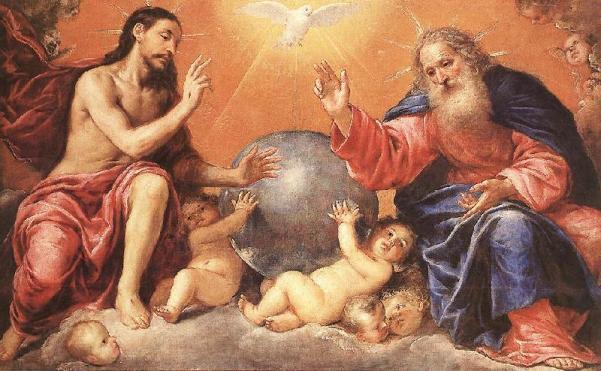
The Holy Trinity

PEREDA, Antonio de-843423

Can the doctrine of the Holy Trinity be proven Biblically?  It is my finding that this is the only Biblical doctrine.  In fact, the scripture is so clear on this that if one holds to another confession they are simply in rebellion to the Word.

Before getting started it is fair to ask what the historic teaching on the Trinity actually is.  To answer this I am going to appeal to the Athanasian Creed.  The meat and potatoes of this creed is within the first few lines:

“We worship one God in Trinity and Trinity in Unity, neither confusing
the persons nor dividing the substance”

To read it in its entirety please click HERE.

If you do read the creed you will see that they go on much further to put all debate to rest, painfully stating every conceivable dot and tittle of their position in what I consider an effort to eliminate any ambiguity from which future generations could re-interpret.  How were they so sure though?  Where did they get this teaching? Was it from scripture or did they make it up?

I believe that they got it from accepting all teachings of scripture as true.  With the doctrine of the Trinity you have three fundamental theses taught:

  1. One Being
  2. Three Divine Persons
  3. Same Substance

One Being

The first claim of the thesis is an unabashed confession of monotheism.  Can this be supported by Scripture?  Let’s take a look and see how clear scripture is on this:

“Hear, O Israel: The Lord our God is one Lord” Deut 6:4 KJV

“In the beginning God created the heaven and the earth.” Gen 1:1 KJV

“Unto thee it was shewed, that thou mightest know that the Lord he is God; there is none else beside him.  Know therefore this day, and consider it in thine heart, that the Lord he is God in heaven above, and upon the earth beneath: there is none else.” Deut 4:35-39 KJV

“See now that I, even I, am he, and there is no god with me: I kill, and I make alive; I wound, and I heal: neither is there any that can deliver out of my hand.” Deut 32:39 KJV

” As concerning therefore the eating of those things that are offered in sacrifice unto idols, we know that an idol is nothing in the world, and that there is none other God but one.” 1 Cor 8:4 KJV

To attempt to believe in the Bible word for word and confess polytheism simply doesn’t work.  Furthermore it wont even support belief in demi-gods like the cults teach, as it is clear with the use of a lower case “g” in verses like Deut 32:39 that “there is no god with me”.

Three Divine Persons

The doctrine of the trinity teaches that there are three distinct persons in the singular being of God.  For this to be accurate we would have to be able to find clear language in the Bible that specifies all three persons of the Trinity.

“The grace of the Lord Jesus Christ, and the love of God, and the communion of the Holy Ghost, be with you all. Amen.” 2 Cor 13:14 KJV

“Go ye therefore, and teach all nations, baptizing them in the name of the Father, and of the Son, and of the Holy Ghost:” Matt 28:19 KJV

“And Jesus, when he was baptized, went up straightway out of the water: and, lo, the heavens were opened unto him, and he saw the Spirit of God descending like a dove, and lighting upon him:  And lo a voice from heaven, saying, This is my beloved Son, in whom I am well pleased.” Matt 3:16-17 KJV

Notice in the above verse that we see all three persons of the Trinity expressed separately at the same time

“Elect according to the foreknowledge of God the Father, through sanctification of the Spirit, unto obedience and sprinkling of the blood of Jesus Christ: Grace unto you, and peace, be multiplied.”1 Peter 1:2 KJV

“8 In that day shall the Lord defend the inhabitants of Jerusalem; and he that is feeble among them at that day shall be as David; and the house of David shall be as God, as the angel of the Lord before them…. 10 And I will pour upon the house of David, and upon the inhabitants of Jerusalem, the spirit of grace and of supplications: and they shall look upon me whom they have pierced, and they shall mourn for him, as one mourneth for his only son, and shall be in bitterness for him, as one that is in bitterness for his firstborn.” Zec 12:8-10 KJV

In the above passage we see the word LORD being used in the KJV, this signifies the word Yahweh for God.  Notice that he himself as being “pierced” and that they will “mourn” for him.  I believe this is an example of Yahweh is identifying himself as Jesus Christ, pre-incarnate, the coming messiah.

“And now, O Father, glorify thou me with thine own self with the glory which I had with thee before the world was.” John 17:5 KJV

I would recommend reading each verse in John 17 very carefully on this topic as it not only teaches the one being of God but the separate persons very clearly.  In verse 5 specifically we see Jesus talk about himself before the incarnation and how he was “with” the father even before creation.

“Let this mind be in you, which was also in Christ Jesus:  Who, being in the form of God, thought it not robbery to be equal with God:  But made himself of no reputation, and took upon him the form of a servant, and was made in the likeness of men:  And being found in fashion as a man, he humbled himself, and became obedient unto death, even the death of the cross.  Wherefore God also hath highly exalted him, and given him a name which is above every name:  That at the name of Jesus every knee should bow, of things in heaven, and things in earth, and things under the earth;  And that every tongue should confess that Jesus Christ is Lord, to the glory of God the Father.” Php 2:5-11 KJV

Notice in the above passage that “humbled himself” happens chronologically after “being in the form of God”.  That proves that Christ was in existence as God, a person of the Trinity, prior to the incarnation.  The exaltation also comes chronologically after, this sheds light on verses where Christ refers to the Father as “greater” (John 14:28), greater because Christ had humbled himself and was then after the resurrection in a position from which to be exalted.

Please notice in all the verses cited above that three separate persons of the Trinity are named.  Thus, for ones doctrine to be in line with the teaching of scripture both monotheism are true and separate persons of one being must also be true.

Same Substance

Though there is one being and three persons, you cannot divide the persons into three bodies as the cults do.  The Bible teaches unequivocally that God is Spirit (John 4:24), I also further argue that God is one substance, not a divided substance.  Read the below passages very carefully:

“I and my Father are one.” John 10:30 KJV

Notice that it doesn’t say one in purpose, or like one, but that they are one.  In every such clarity as Deut 6:4 teaches that there is one God.  The only logical explanation that accepts both verses as true is same substance of being but separate persons.

“In the beginning was the Word, and the Word was with God, and the Word was God.” John 1:1 KJV

How can the Word (Christ) be both with God and be God at the same time?  Again, same substance same being, different person of the Trinity.

“And God said, Let us make man in our image, after our likeness: …” Gen 1:26 KJV

In Genesis 1:1 it refers to God in the singular, but later God says “us” in reference to himself.  Some argue that he is speaking to angels, but if that were the case then he would be sharing the creative work of making man with angelic beings.  The only Biblical explanation is that the Trinity is in view here very early in the Old Testament.

“For there is one God, and one mediator between God and men, the man Christ Jesus;” 1 Tim 2:5 KJV

The above verse not only argues for the Trinitarian teaching of one substance, but also for the inseparable dual natures of Christ as fully God and fully Man.  This is because it affirms monotheism, cites Christ as sole mediator in the heavenly council of God, and then references the human nature of Christ.

“For who is God save the LORD? or who is a rock save our God?” Psa 18:31 KJV

Notice in the above verse, by checking the Biblehub.com screen cap below, that Elohim and Yahweh are utilized interchangeably.  I see this as another view of the Trinity in the Old Testament, again same substance as both are one God, but two persons of the Trinity in view as they are cited separately.

Picture

“Take heed therefore unto yourselves, and to all the flock, over the which the Holy Ghost hath made you overseers, to feed the church of God, which he hath purchased with his own blood.”  Acts 20:28 KJV

Notice that the Holy Ghost is not only referred to as God, but Jesus Christ as well via the statement “purchased with his own blood”.  This is a clear example of the Holy Ghost being the same substance of God and Christ even though Christ is also flesh of man.

“God is a Spirit: and they that worship him must worship him in spirit and in truth.” John 4:24 KJV

Beware lest any man spoil you through philosophy and vain deceit, after the tradition of men, after the rudiments of the world, and not after Christ.  For in him dwelleth all the fulness of the Godhead bodilyCol 2:8-9 KJV

The “him” it speaks of here is Christ.  This is teaching that Christ is God, not part of God but all of God.  One being, same substance but still a different person of the Trinity.

Verses like this is why we say that Jesus Christ is fully God and fully man.  The words clearly state “fullness of the Gohead bodily”.  Every bit of God is every bit of Christ and visa versa, meaning that this goes both ways.  This is why the doctrine of the Holy Trinity teaches “same substance”.

Attributes of God

At this point I feel confident that I have Biblically proven:

  1. One Being: one God in Trinity and Trinity in unity,
  2. Three Divine Persons: neither confusing the persons
  3. Same Substance:  nor dividing the substance

I have researched opposing views to this doctrine and my assessment is that they will place one of the above thesis of the doctrine of the Trinity as abrogating one or more of the others.  I have also found that their reasoning for doing so is not based on the canon of scripture, but rather comes from extra biblical revelations or their own logic and philosophy.  To believe in the Trinity, one must take all of the Biblical teachings of God in the Bible as true accepting them word for word.  This not only gives us the greatest theological revelation the Bible has to offer, but also gives us a walk through on the plenary word for word method by which we are to understand the inspiration of the canon of scripture.

To drive my point home though I am going to give you a graph of the attributes of God.  One of the amazing things about scripture is that it credits each person of the Trinity as being God.  See below:

Divine Attributes Father Son Holy Ghost
Eternal Psa 90:1-17; Jhn 17:5 Rev 1:17-18; Jhn 17:5 Heb 9:14
Omnipresent 1 Kings 8:27 Eph 1:23 Psa 139:7
Omniscient 1 John 3:20 John 21:17 1 Cor 12:11
Creator Gen 1:26 Col 1:16 Psa 104:30
Posted in Armchair Lounge, Christianity 101, Nature of God | Tagged , | 3 Comments

Gospel to SDA

Jesus-On-The-Cross-jesus-24749131-1024-768


The gospel is very simple, Paul details the true pure Gospel of Jesus Christ in 1 Corinthians 15:


“1 Now I would remind you, brothers, of the gospel I preached to you, which you received, in which you stand, 2 and by which you are being saved, if you hold fast to the word I preached to you—unless you believed in vain.

3 For I delivered to you as of first importance what I also received: that Christ died for our sins in accordance with the Scriptures, 4 that he was buried, that he was raised on the third day in accordance with the Scriptures” 1 Cor 15:1-4 ESV


We are not to add to this and we are certainly not to contradict it (Gal 1:8).  That said, sometimes we do have to take a page out of Pauls book and meet people where they are at like he did the Greeks on Mars Hill (Acts 17:22-34).  When I share the gospel with SDA I have found it helps to contrast it with the false SDA gospel so that they can see the difference for themselves.


In person I try to go into greater detail, but below I’ve pasted a short simple post I use on the internet from time to time:


The reason SDA are wrong is that they teach a false gospel. See Gal 1:8, SDA teach if you fail to keep the sabbath after probation you’re damned and have the mark of the beast.


The bible says we are not saved by works of the law (Rom 3:20). Jesus died carrying our sins to the grave and rose on the third day. Conquering sin and death.


Repent and be baptized for the forgiveness of your sins and place your trust in Christ and Christ alone.


The Sabbath will not give you salvation.

The Sabbath will not give you extra assurance for the end times.

The Sabbath is no different than circumcision. The Bible says the Sabbath is obsolete.

(Col 2:16)(Heb 9:1, 4)(Heb 8:7, 13)(Gal 3:10)(Eph 2:8-10)(1 Cor 15:1-6)(2 Cor 3:4-15)(2 Cor 5:21)

Please leave a comment and tell me what you think.  If you wish to use this then go for it, the more the merrier.  If you have advice or a better blurb you wish to share, by all means please do so.


Posted in Leaving Adventism | Tagged | 6 Comments

Hell

MemlingJudgementOpen

Over time I intend to cover other related doctrines on Hell, however this post will be focused on answering only a few basic questions.  As a Seventh Day Adventist (SDA) I was taught and believed that hell didn’t exist.  I was taught that it was a fictitious imaginary doctrine concocted by the Pope centuries ago, and that all early Christians were Annialationists.  SDA do teach that there will be a lake of fire for a short period of time after judgement day, but that once the fires conclude burning the damned will cease to exist body and soul.  For myself, studying this topic and finding out what the Bible really teaches was a big deal.  Which is why I am going to focus my first Hell post on the following questions:

  1. Does Hell Exist today and in the future?
  2. Is Hell eternal or temporal?

Question 1: Does Hell Exist today and in the future?

I believe that it does and this is largely due to the clarity of language in the following verses, for example, we can see that angels exist in Hell now.

For if God spared not the angels that sinned, but cast them down to hell, and delivered them into chains of darkness, to be reserved unto judgment;  And spared not the old world, but saved Noah the eighth person, a preacher of righteousness, bringing in the flood upon the world of the ungodly;  And turning the cities of Sodom and Gomorrha into ashes condemned them with an overthrow, making them an ensample unto those that after should live ungodly; 2 Peter 2:4-6 KJV

Notice the words “but cast them down to hell”.  This string of words is in the past tense, and to cast someone or something into a noun implies that said noun exists.

We can also see that people, not just angels, are currently in Hell now:

” By which also he went and preached unto the spirits in prison;  Which sometime were disobedient, when once the long suffering of God waited in the days of Noah, while the ark was a preparing, wherein few, that is, eight souls were saved by water.” 1 Peter 3:19-20 KJV

The “He” in the above verse is speaking of Christ.  This is why I believe the Apostles Creed states “He descended into Hell”.  I don’t believe we are to speculate on what specifically Christ was doing in Hell beyond the words in this short verse.  That said, its clear that he went there and preached to them.  No matter what you take from that, the fact that this “prison” or Hell exists as a location cannot be soundly refuted, also the fact that people who lived in the days of Noah are there now is also beyond question.  I believe it follows logic that other souls after the days of Noah would be there as well because it cites their disobedience as cause.

“And shall cast them into the furnace of fire: there shall be wailing and gnashing of teeth.” Matt 13:50 KJV

Again, notice that they are being “cast..into the”.  Therefore it follows basic logic that the definite article refers to a noun which would have to exist.  It doesn’t say they are being cast into nothing.

Though I will not post it here in its fullness as its rather long, I encourage you to read Luke 16:19-31 by clicking HERE.  This is the famous Rich man and Lazarus story recorded by Luke.  I have read compelling conservative arguments for this text being either a parable or a literal story.

Those who argue for this to be a literal story will cite that Lazarus is a named individual, which is irregular among the parables of Christ.  Those who argue it is a parable cite how the rich man “lifts his eyes” in verse 23, the argument being that a spirit does not have eyes to lift therefore parable.

I would argue that whether this be parable or literal it is still true.  Why would Christ use a falsehood to teach a truth? Nobody takes the Parable of the Good Samaratin and argues that it’s not about helping your neighbor because it’s a parable, that would be silly.  There are truths clearly conveyed in any parable, you simply look at the language and see what Christ is talking about.

I searched high and wide and found no sane reading of Luke 16 that can possible assert that it is not about hell.  If its not about hell then what is it about?  The language is just too vivid to be ignored:

“being in torments”…

“cried… have mercy on me”…

“I am tormented in this flame”…

Go ahead and try to make that about something else without leaving the text and importing outside ideas into it.  Clearly, we can assert that at the very least this teaches Hell exists even in the time of Christ, which was many years after Noah.  This would place the burden of proof that it does not exist today on anyone making the claim.

What of the different names of hell?  for an article on this please click HERE as it is beyond the scope of my post and is in my opinion irrelevant to the issues of primary concern.  Based on the passages quoted above, I would argue that no matter what name is being used for “hell” in the new or old testament the same people are going there and the torments are always described as being similar in nature.

One can make a strong argument that there is a distinction between the hell that exists now and the one that exists after Judgement Day.  That said there is no Biblical reason to distinguish between the torments of the two, instead the more relevant point is that you don’t want to go to either.  If anything, I would argue the only Biblical distinction with any meaning is that one precedes the Judgment and the other follows.


Question 2: Is Hell eternal or temporal?

There is a strong argument out there today, not just in SDA, that Hell is temporal.  This argument is called Annialationism, they call Hell the consuming fire and state that it burns up the wicked entirely and that they cease to exist, at which point the fire snuffs out.  I confess this is a tempting view, I once held it and my argument was why would a loving God burn sinners forever and ever?  That question though is more a reflection on my own depravity and a want of understanding than it was as an argument against the eternal conscious torment of hell.

The following scriptures are very clear, just read them as very little commentary is necessary:

“And the smoke of their torment ascendeth up for ever and ever: and they have no rest day nor night, who worship the beast and his image, and whosoever receiveth the mark of his name.” Revelation 14:11 KJV

“And the devil that deceived them was cast into the lake of fire and brimstone, where the beast and the false prophet are, and shall be tormented day and night for ever and ever.” Revelation 20:10 KJV

Some will argue that the above verses don’t say “forever and ever” but actually only say ‘for an age’.  They argue that the above is a miss translation of the original Greek.  I find it telling that every Bible version I look this up in says “forever and ever”.  Even the message paraphrase is consistent with this and that is supposed to be the favorite of the universalists.


For me it is enough to trust all of the Bible translators that ever existed.  But for some who wish to rebel against the text this isnt the case so I will quote an analysis of the original Greek.  My source is Christian Apologetics and Research Ministry.

“Is the English phrase, “forever and ever,” a proper translation of the Greek? Does it mean without end? Is it ever used of something not eternal? Does it refer to eternal torment? These questions are important because the universalist position denies the eternality of Hell fire. Universalists take the literal Greek phrase of “eis tous aionas ton aionon,–into the age of the ages” which is commonly translated as “forever and ever,” “forevermore,” and state that it refers to an age of time, a finite period of time.

It is true that the basic root of “aion” means age. But it is not true that all words derived from that root mean a finite duration of time. The phrase means “unlimited duration of time, with particular focus upon the future–‘always, forever, forever and ever, eternally.”‘

Additionally, the phrase is used to describe both God’s eternal attributes and His eternal nature as well as eternal torment.”

Follow the link to their article above if you are interetested.  What I quoted is just their analysis, they also provide scripture references to other times that the Greek phrase is used.  The closest English translation is certainly “forever and ever”.

“And if thy hand offend thee, cut it off: it is better for thee to enter into life maimed, than having two hands to go into hell, into the fire that never shall be quenched:    Where their worm dieth not, and the fire is not quenched.    And if thy foot offend thee, cut it off: it is better for thee to enter halt into life, than having two feet to be cast into hell, into the fire that never shall be quenched:    Where their worm dieth not, and the fire is not quenched.    And if thine eye offend thee, pluck it out: it is better for thee to enter into the kingdom of God with one eye, than having two eyes to be cast into hell fire:    Where their worm dieth not, and the fire is not quenched.” Mark 9:43-48 KJV

The above verses forced me to believe in an eternal conscious torment of hell.  They are very vivid, and one has to practice eisegesis to force them to say anything else.  Also, when I compared these to the verses that Annialationists use, what i find is that they quote verses off the topic of hell.  This I believe is poor theology, if you are going to make an argument for a belief on something you need to assemble all of the clear verses that are speaking on topic.  That forms the hermenuetic for how you are to understand unclear verses, or ones that only make a passing reference to the issue at hand.

The most convincing verse in the whole Bible, for me though, in the eternal nature of Hell is the following:

“Then shall he say also unto them on the left hand, Depart from me, ye cursed, into everlasting fire, prepared for the devil and his angels” Matt 25:41 KJV

The reason this is so compelling is the word “Everlasting” or  αἰώνιον (aiōnion) in Greek is the same word used to describe the following:

Matt 29:19 “and shall inherit everlasting life”

Mat 25:46  “but the righteous into eternal life”

1 Tim 6:16 “and power everlasting. Amen.” [Speaking of God]

Rev 14:6 “having the everlasting gospel”

1 Peter 5:10 “unto his eternal glory by”

Source: Biblehub.com

Simply put, if hell can be temporal then so can everything else above.  I am not prepared to assert that God is temporal, or that his glory is temporal, or that everlasting life is temporal, or that the gospel is temporal….. etc etc

The only logical conclusion, is that Hell and its associated torments exist, and are as eternal as everything else on that list.  Some try to use the word “age” or epoch to deny this.  I would argue that this would mean the eternal nature of God only exists for an age, or that the everlasting life of the elect is for an age.  You can’t have it both ways, if one is eternal they all are.  The most important part is, it doesn’t matter how you interpret this either.  Hell is still hell defined by the Word and will remain as such regardless of what anyone asserts.

Posted in Armchair Lounge, Eschatology, Leaving Adventism | Tagged , , | 26 Comments

Baptismal Regeneration

Infant-Baptism-610x351

I subscribe to the Biblical teaching of Baptismal Regeneration.  The below blog post is not my attempt to explain or even defend this doctrine.  I think the scripture actually does that on its own.  My goal is to explain how I came to this understanding as one who used to believe more in line with the Baptists (Believer Baptism).


Just to put some clarifications out there on the common objections to Baptismal Regeneration:


  1. The Bible does not teach you have to be baptized to be saved.
  2. The Bible does teach that baptism saves you, not a contradiction keep reading.
  3. The immersion vs sprinkling issue is a distraction.  The truth is the word “Baptizo” can actually be used to mean either, just a fact.  However circling your wagon on this misses the whole point of what Biblical Baptism is.


Below are the verses that I use to argue my position on Baptism. I’m not going to explain my understanding in detail. I actually have full faith that anyone can get the idea just from reading them.


“Go therefore and make disciples of all nationsbaptizing them in the name of the Father and of the Son and of the Holy Spirit” Matt 28:19 ESV

Jesus answered, “Truly, truly, I say to you, unless one is born of water and the Spirit, he cannot enter the kingdom of God. John 3:5 ESV

And Peter said to them, “Repent and be baptized every one of you in the name of Jesus Christ for the forgiveness of your sins, and you will receive the gift of the Holy Spirit. For the promise is for you and for your children and for all who are far off, everyone whom the Lord our God calls to himself. Acts 2:38-39 ESV

And now why do you wait? Rise and be baptized and wash away your sins, calling on his name.’ Acts 22:16 ESV

For as many of you as were baptized into Christ have put on Christ. Galatians 3:27 ESV

Baptism, which corresponds to this, now saves you, not as a removal of dirt from the body but as an appeal to God for a good conscience, through the resurrection of Jesus Christ, I Peter 3:21 ESV

Do you not know that all of us who have been baptized into Christ Jesus were baptized into his death?  We were buried therefore with him by baptism into death, in order that, just as Christ was raised from the dead by the glory of the Father, we too might walk in newness of life. Romans 6:3-5 ESV

There is one body and one Spirit—just as you were called to the one hope that belongs to your call one Lord, one faith, one baptism, one God and Father of all, who is over all and through all and in all. Ephesians 4:4-6 ESV

“Husbands, love your wives, as Christ loved the church and gave himself up for her,  that he might sanctify her, having cleansed her by the washing of water with the word, so that he might present the church to himself in splendor, without spot or wrinkle or any such thing, that she might be holy and without blemish.” Ephesians 5:25-27 ESV

In him also you were circumcised with a circumcision made without hands, by putting off the body of the flesh, by the circumcision of Christ, having been buried with him in baptism, in which you were also raised with him through faith in the powerful working of God, who raised him from the dead. Colossians 2:11-12 ESV

But when the goodness and loving kindness of God our Savior appeared, he saved us, not because of works done by us in righteousness, but according to his own mercy, by the washing of regeneration and renewal of the Holy Spirit, whom he poured out on us richly through Jesus Christ our Savior, so that being justified by his grace we might become heirs according to the hope of eternal life. Titus 3:4-7 ESV


Based on the above I argue the following points:

  1. Baptism does something
  2. A symbol in and of itself doesn’t do anything.
  3. Therefore baptism is not a symbol.


I realize that’s a syllogism, but I think its well supported by the scriptures I posted. Just look at the verses I gave you in Titus and 1 Peter one more time and I think you will agree.


Baptists argue the following

  1. Baptism is a work
  2. We are not saved by works
  3. Therefore all the verses that teach baptism saves us must be speaking symbolically.


Tey generally won’t break it down into a tidy syllogism for you but that’s my assessment of their refutation on baptismal regeneration.  To that I would respond that baptism is not a work of man but rather a work of God. All the verses I posted above seem clear to me that God is the one working in baptism, look closely at the nouns and verbs at play in baptism.  Who is the noun performing the verb of baptism?  Who is the noun receiving the verb?


“by the washing of regeneration and renewal of the Holy Spirit”

“circumcision made without hands,”

“buried with him in baptism, in which you were also raised with him through faith”

“whom he poured out”

“working of God”

“Baptism, which corresponds to this, now saves you“… as an appeal to God for a good conscience, through the resurrection of Jesus Christ”


Showing that baptism is Gods work, not mans work, is how I would address the major premise of believer baptism thus rendering their conclusion moot.  Furthermore baptists say that baptism totally does nothing and is a public display to show one has made a decision for Jesus. No verse says this at all.  In fact, simply demonstrating that baptism does something reveals that the doctrine of believer baptism has some flaws in its reasoning.  If baptism is doing anything at all, soteriologically speaking,  then it means that it cannot simply be a public display of confession.


I have come to believe that baptism saves in a similar manner to the word of God in the unregenerate Let me explain.


Ephesians 2:8 says the following:


“For by grace you have been saved through faith. And this is not your own doing; it is the gift of God” Eph 2:8 ESV


Which is the gift? Faith or grace?

Examine the verse carefully and I think you will agree the only possible grammatical referent for gift is both faith and grace. My meaning is that these are not things we come to the table with for justification. God gives them to us. I don’t believe this is an infused mystical transaction. The bible teaches there are means of grace by which God creates faith in the unregenerate heart. See below:


“How then will they call on him in whom they have not believed? And how are they to believe in him of whom they have never heard? And how are they to hear without someone preaching? And how are they to preach unless they are sent? As it is written, “How beautiful are the feet of those who preach the good news!” But they have not all obeyed the gospel. For Isaiah says, “Lord, who has believed what he has heard from us?” So faith comes from hearing, and hearing through the word of Christ. Rom 10:14-17 ESV


I posted the preceding text so that you may see the context of the hearing of the word. Here Paul is teaching that the preaching of the word creates faith. This is a means by which the gift of faith unto grace is given


I think the most biblical and lucid understanding of baptism is that the same work is being done. Its another means of grace by which faith is created in the heart of the unregenerate.  This does not mean you have to be baptized to be saved. It is only one means of grace.


This does not mean that all who are baptized are saved. I’m sure we all recognize that not all who hear the gospel preached are saved either. They are both simply means by which God has promised to save his elect.  I find it helpful to liken baptism to preaching the word. I’m no theologian, but to me this is the plainest understanding of scripture. I can take the words at face value and believe them.


Infant Baptism


The reason that I support infant baptism is the same reason that I support forcing your kids to go to church, especially when they are older.  Just as a teenager needs to hear the word of God preached for faith to be created in their heart, so must a Baby be baptized for faith to be created in theirs.  Just as I would not deny an older child to attend Church and hear the word, so would I not deny a Baby, especially my own, from receiving the gift of Baptism.


Baptists will often use verses in Acts describing people who are being baptized and point out that none were babies.  Its fair to point out that all were hearing the gospel for the first time ever. Lots of adults were the primary focus of the historic narrative. However, there were whole households baptized (Acts 16:33) and it’s fair to point out that households generally have babies and or small children in them. Also Jesus says to baptize all nations (Matt 28:19) and it is fair to assert that babies are part of any nation


Either way, one should not rely on descriptive historical narrative to interpret clear prescriptive theologically focused Pauline teachings. In fact, we should interpret the narrative through the understanding of those teachings.  Believer Baptism (only) is a new doctrine, we don’t find strong evidence for it in the early Church, and Church fathers can easily be demonstrated to have interpreted the above verses that I posted in line with the Doctrine of Baptismal Regeneration.  In my opinion, believer baptism was born out of a disdain for Roman Catholic teachings and distinctives.  They wanted to throw everything out that they could, which is understandable as reformers were suffering great persecution at the time.  In this case though I believe that they threw the baby out with the bathwater, no pun intended.


What I found most compelling is that there are no solid proof texts for baptism being a symbol and a great deal of proof texts to the opposite.  Furthermore, baptists and others will break their own rules of hermeneutics that they generally espouse to defend believer baptism.  They will weigh in heavily on historic narrative, use a great deal of philosophy and rationalization, and lastly they discount all the texts that teach that something wonderful truly does take place in Baptism.


In sharing my views on baptism with others the strongest criticism I’ve received is that I’m reading Paul too literally. I don’t really have a problem with that accusation.


Below are some resources that you can use if you want to study this topic further.


Click HERE for a PDF that details many of the verses I posted and how the earliest Christians who thought and dreamed in Koine Greek interpreted them:

Click HERE for a good YouTube video on the topic.

Click HERE for a podcast on the topic by a Lutheran Pastor


Posted in Armchair Lounge, Soteriology | Tagged , | 18 Comments

James 2 – Sola Fide Sola Gratia

Sola

This is the 10th post in a series, for the previous post please click HERE.

I have already addressed the common SDA prooftexts, but I have found since then that there remain a few that need some individual attention.  A big one is James 2,  this is their theological magnum opus,  it is my experience that SDA use this chapter as authoritative over the entire cannon of scripture.  Even to the point of causing blatant contradictions in their own teachings.

I am going to point out before starting that the word Sabbath is never mentioned once in the entire chapter.  That should pretty much end the discussion right here, however this chapter is abused by many to deny salvation by Grace alone through Faith alone.  And to be quite honest, to the casual reader, this could cause confusion as it appears to contradict other very clear passages.  With a careful reading and comparison of other scripture this clears up easily.

 Was not Abraham our father justified by works when he offered up his son Isaac on the altar?  You see that faith was active along with his works, and faith was completed by his works;  and the Scripture was fulfilled that says, “Abraham believed God, and it was counted to him as righteousness”—and he was called a friend of God.  You see that a person is justified by works and not by faith alone. James 2:21-24 ESV

 What then shall we say was gained by Abraham, our forefather according to the flesh?  For if Abraham was justified by works, he has something to boast about, but not before God.  For what does the Scripture say? “Abraham believed God, and it was counted to him as righteousness.” Now to the one who works, his wages are not counted as a gift but as his due.  And to the one who does not work but believes in him who justifies the ungodly, his faith is counted as righteousness Rom 4:1-5 ESV

In Romans the singular referent is Genesis 15:6 while in James the referent is both Genesis 15:6 and Gen 22:16-18.  I think that it is fair to note that the events in Gen 15 precede those in Gen 22.  I realize that is kind of obvious, but you would be surprised how few out there actually pick up on this subtlety.

James is not negating that we are justified by Grace alone through Faith alone.  In verse 22 James states “faith was active along with his works”.  Be referencing both passages of Genesis James is illustrating that works was a product of the faith and grace that had already transpired.  I would say that works can thus be a subjective means of evidencing that divine faith and grace are present in one’s life.  I say subjective for two reasons.

  • James does not reference a specific sin that will not be present in the Justified, wherewith one could be used as a litmus test.
  • James does not state that all laws must be obeyed perfectly to be justified however he maintains that in breaking one we have broken all.

Below are the referents in Genesis that James and Paul allude to for your review:

And he believed the Lord, and he counted it to him as righteousness. Gen 15:6 ESV

“By myself I have sworn, declares the Lord, because you have done this and have not withheld your son, your only son, 17 I will surely bless you, and I will surely multiply your offspring as the stars of heaven and as the sand that is on the seashore. And your offspring shall possess the gate of his enemies, 18 and in your offspring shall all the nations of the earth be blessed, because you have obeyed my voice.” Gen 22:16-18 ESV

Below I will explain how James 2 fits in to Ephesians 2.

 and the Scripture was fulfilled that says, “Abraham believed God, and it was counted to him as righteousness”—and he was called a friend of God. James 2:23 ESV

It is primarily because of the above verse that I understand James 2 as an exposition of Ephesians 2:10.  See below for this verse in its context.

8 For by grace you have been saved through faith. And this is not your own doing; it is the gift of God,

9 not a result of works, so that no one may boast. 10 For we are his workmanship, created in Christ Jesus for good works, which God prepared beforehand, that we should walk in them. Ephesians 2:8-10 ESV

In Ephesians we get a step by step outline of Justification by Grace and Faith unto good works.  It is clear that the works are a miracle in and of themselves because the referent for “it” in verse 8 is both Grace and Faith.  Saving Grace and Faith are both gifts from God.

There is nothing that YOU do to earn them.  This is a mystery, some say that you have to accept the gift (Rom 10:9), some say that It’s God who chooses you because we are predestined from the foundations of the world (Eph 1:4).  I think scripture supports both views on this.  I don’t see this as contradictory teachings, but rather an acknowledgement of divine paradox that is beyond our comprehension and can only be read about in scripture.  When we apply philosophy to reconcile this mystery I think it does more harm than good.

That said, the works come after this miracle of Justification.  This is why James links the two together.  If someone is wholly impenitent but declares that they have faith it is entirely likely that they are lying or at the very least mistaken with regards to their faith.  Knowledge of God is universal (Rom 1:20) but penitent faith is divine (Matt 22:14).

Something I want to make clear though is that one does not have to repent of breaking the old covenant Sabbath.  As I have made clear in previous posts the Sabbath pointed to Christ and is now obsolete.  When an SDA reads James 2 they are trained to imagine the word “Sabbath” in almost every single verse even though it is contained in none of them.  This is a very important and tragic fact that one must keep in mind when they are speaking to an SDA about James 2.

Posted in Leaving Adventism, New Covenant | Tagged , , | 2 Comments

State of the Dead

resurrection-1

This is the 15th post in a series, for the previous post please click HERE.

As an SDA I was always taught that there is no soul.  I was taught that we are a soul.  That the equation of man is:

Body + Breath of God = Soul

I once believed this adamantly.  I believed that at the time of death we are no more, that we click off like a light and cease to exist until the resurrection.  This is no longer my belief, the word of God has forced my  position to change on this.  It is now my opinion that the only reason that the SDA have this belief is due to the investigative judgement.  Logically one cannot be redeemed and in heaven already if their name has not come up in judgement yet, so the SDA adopted the soul sleep doctrine.   Later in this blog I will cover the SDA prooftext that is the foundation of their beliefs on soul sleep.  First though I would like to address what the Bible really teaches that happens to us when we die in Christ.

The verses that changed my view on this forever are 2 Corinthians 4:7-18 continuing on to 2 Corinthians 5:1-9.  I encourage you to read them all carefully right now:

“7 But we have this treasure in jars of clay, to show that the surpassing power belongs to God and not to us. 8 We are afflicted in every way, but not crushed; perplexed, but not driven to despair; 9 persecuted, but not forsaken; struck down, but not destroyed; 10 always carrying in the body the death of Jesus, so that the life of Jesus may also be manifested in our bodies. 11 For we who live are always being given over to death for Jesus’ sake, so that the life of Jesus also may be manifested in our mortal flesh. 12 So death is at work in us, but life in you. 13 Since we have the same spirit of faith according to what has been written, “I believed, and so I spoke,” we also believe, and so we also speak, 14 knowing that he who raised the Lord Jesus will raise us also with Jesus and bring us with you into his presence. 15 For it is all for your sake, so that as grace extends to more and more people it may increase thanksgiving, to the glory of God. 16 So we do not lose heart. Though our outer self is wasting away, our inner self is being renewed day by day. 17 For this light momentary affliction is preparing for us an eternal weight of glory beyond all comparison, 18 as we look not to the things that are seen but to the things that are unseen. For the things that are seen are transient, but the things that are unseen are eternal.” 2 Cor 4:7-18 ESV

Take another look at verse 7 and 16:

“we have this treasure in jars of clay”

“Though our outer self is wasting away, our inner self is being renewed day by day”

When I read the above I see that the treasure in Jars of Clay is the inner self (treasure) that is in the outer self (Jars of Clay). It is clear to me that Paul is using imagery to convey the existence of the Human Soul. He is not referring it as being the same substance as the flesh, but rather a treasure inside of it.

Lets continue:

“1 For we know that if the tent that is our earthly home is destroyed, we have a building from God, a house not made with hands, eternal in the heavens. 2 For in this tent we groan, longing to put on our heavenly dwelling, 3 if indeed by putting it on we may not be found naked. 4 For while we are still in this tent, we groan, being burdened—not that we would be unclothed, but that we would be further clothed, so that what is mortal may be swallowed up by life. 5 He who has prepared us for this very thing is God, who has given us the Spirit as a guarantee. 6 So we are always of good courage. We know that while we are at home in the body we are away from the Lord, 7 for we walk by faith, not by sight. 8 Yes, we are of good courage, and we would rather be away from the body and at home with the Lord. 9So whether we are at home or away, we make it our aim to please him.” 2 Cor 5:1-9 ESV

Breaking this section of scripture down we can see the following:

“Tent that is our earthly home is destroyed, we have a building from God”

What jumps out to me here is that it its referring to our body as a tent. A dwelling that logically has dwellers. Meaning to me that our Soul dwells within our body. And that the Body, or tent, can be destroyed and we still exist. This is because we presently “have” and building from God (presumably in heaven). The word “have” is in the present tense, it doesn’t say will have or had, this is something that we can count on right now.

“in this tent we groan”

As we get older this is a more present reality day by day.

“we would rather be away from the body and at home with the Lord. 9 So whether we are at home or away, we make it our aim to please him”

This is clearly teaching that it is possible to be absent from the body. This isn’t even a complicated reading of the text, it requires no interpretation one just has to read what it says and accept it as fact. Something to point out though is that it says we are to “make it our aim to please him”. It says this in the context of being either home or away from the body. To be pleasing it implies rather clearly that one must exist, at the very least. So it is therefore logical that while away from the body we do exist.

“For to me to live is Christ, and to die is gain. If I am to live in the flesh, that means fruitful labor for me. Yet which I shall choose I cannot tell. I am hard pressed between the two. My desire is to depart and be with Christ, for that is far better. But to remain in the flesh is more necessary on your account. Convinced of this, I know that I will remain and continue with you all, for your progress and joy in the faith,” Php 1:21-25 ESV


“to die is gain”

To me this is clear that something is gained at death. Logically one must be in existence to gain anything.

“My desire is to depart and be with Christ, for that is far better”

I don’t even have to comment on this, the text explains itself. Paul is stating that when he “departs” he is going to “be with Christ”. To be anywhere at all implies existence, and quite likely consciousness too. Especially since it is “far better”.

If none of that convinces the reader here is the strongest text I’ve seen on this subject:

“25 Jesus said to her, “I am the resurrection and the life. Whoever believes in me, though he die, yet shall he live, 26 and everyone who lives and believes in me shall never die. Do you believe this?” Jhn 11:25-26 ESV

“shall never die”

Yeah that about says it right there, the only question left is whether or not you the reader believe what Jesus Christ said in John 11 is true. There is no way of reading this verse sideways, it says what it says. There is a lot more I could go into on this chapter but that will be for another post on another day.

However, while I was SDA I always Quoted Ecclesiastes 9:5. It was the strongest proof text for Adventism beliefs on the state of the dead.

Before pasting it I am going to mention a bit about Solomon. He wrote this book towards the end of his life. He spoke a great deal about the pointlessness of life. Whether one is rich or poor, good or evil we all get buried in the dirt. That is true, and this perspective should level our view on how we see and treat others. I have underlined a few of the words in the verses below to make my point on the context of the passage:

“But all this I laid to heart, examining it all, how the righteous and the wise and their deeds are in the hand of God. Whether it is love or hate, man does not know; both are before him. It is the same for all, since the same event happens to the righteous and the wicked, to the good and the evil, to the clean and the unclean, to him who sacrifices and him who does not sacrifice. As the good one is, so is the sinner, and he who swears is as he who shuns an oath. This is an evil in all that is done under the sun, that the same event happens to all. Also, the hearts of the children of man are full of evil, and madness is in their hearts while they live, and after that they go to the dead. But he who is joined with all the living has hope, for a living dog is better than a dead lion. For the living know that they will die, but the dead know nothing, and they have no more reward, for the memory of them is forgotten. Their love and their hate and their envy have already perished, and forever they have no more share in all that is done under the sun.” Ecc 9:1-6 ESV


I absolutely agree that the dead know nothing and have no part under the sun. Christians do not believe in Ghosts of the past haunting your house or visiting you in your sleep. The dead have no part in this life, they have moved on to the next as clearly stated in the New Testament passages.

To hold a position of soul sleep one must interpret the New Testament with the Old Testament. As students of the Bible we are actually supposed to do the opposite of that. While the Old Testament does not contradict the New, it needs to be understood that the understanding of the resurrection was not clear until the fullest revelation given by Christ to the Apostles.


Now I want to point out a small piece of scripture in 1 Thessalonians Chapter 4. This is the famous rapture passage. SDA call this the second coming, either way you slice it this is certainly the resurrection. SDA will point out that verse 16 which states that “the dead in Christ rise first”. This is true, but they will skim right past verse 14 without even a thought.


“14For since we believe that Jesus died and rose again, even so, through Jesus, God will bring with him those who have fallen asleep.” 1 Thess 4:14 ESV


“bring with him”

Yes, they are there with him right before they are given glorified bodies in the resurrection. I believe that concludes all I have to say on this today. If you have any questions feel free to drop a comment below.

Posted in Leaving Adventism | Tagged , | 29 Comments

The Virgin Birth

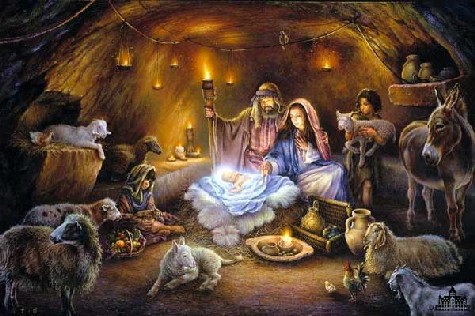
nativity1 (1)

I wish a very Merry Christmas to anyone reading this pot.  Today I am going to blog about the theological significance of the Virgin Birth.  Though I have always believed in it personally, until recently I would have just chalked it up as another miracle that proves the deity of Christ not unlike walking on water.  The doctrine of the virgin birth actually goes much deeper than that and is considered foundational to Christianity by scholars around the world.  For example, the Nicene Creed reads as follows:

“…For us and for our salvation he came down from heaven: by the power of the Holy Spirit he became incarnate from the Virgin Mary, and was made man….”

That was written close to 325 AD so there is no doubt that this is a very old Christian doctrine.

Born of a Virgin

The first place that the virgin birth is prophesied is at the very beginning in Geneses 3:15

“And I will put enmity between thee and the woman, and between thy seed and her seed; it shall bruise thy head, and thou shalt bruise his heel.” Gen 3:15 KJV

You will miss it there if you’re not paying attention.  Notice three key points:

  • First where God is talking about Eve
  • Second he mentions HER seed
  • Her seed shall bruise the head of the snake

I am no physician, but in the anatomy course that I took it’s not possible for a woman to bear offspring of their own seed without help.  However, the one time that this does happen per Gen 3:15 we see someone (Jesus) who crushes the head of the serpent (Satan).  This verse is regarded by Christian theologians over the ages to not only be the first messianic prophecy in the Bible, but the first prophecy of the virgin birth.  Messianic prophecies are littered throughout all of the Old Testament, some of them referencing a single point, and others going into great detail.  We don’t see the virgin birth again though until Isaiah Chapter 7.

“Therefore the Lord himself shall give you a sign; Behold, a virgin shall conceive, and bear a son, and shall call his name Immanuel.” Isa 7:14 KJV

This verse is later interpreted in the New Testament where Matthew delves into greater detail:

“Behold, a virgin shall be with child, and shall bring forth a son, and they shall call his name Emmanuel, which being interpreted is, God with us.” Matt 1:23 KJV

So we can see that Moses, Isaiah, and Matthew inspired by the Holy Ghost are all in agreement that the messiah was to be brought forth from a virgin.  This is significant because there is some controversy over the word used for Virgin in Isaiah.  It is important to remember that these texts were not all originally written in English.  Many Jewish scholars today will argue that the word found in Isaiah 7:14 is Almah, which means maiden or young woman, rather than virgin.  They argue that if the prophet had intended a virgin he would have used the word “Bethulah” instead.

I am no expert on ancient Hebrew but even without being one it is possible to argue against this with two key points:

  • First, Almah is used more consistently to refer to a virgin throughout the Old Testament than Bethulah. See Joel 1:8 and Esther 2:8-17, though the world Almah is used there is no question that a virgin is being referred to by anyone.
  • Second, it goes without saying that a young Jewish maiden (Almah) would logically be a virgin. It hasn’t been until the past ten years or so that it is considered normal for 13 year old unmarried boys and girls to be sexually active.

Lineage of Christ

The lineage of Christ is found in two locations in the New Testament.  First is Matt 1 and the second is in Luke 3.  This is at first troubling for new scholars  as they do not read the same.   They both cite the lineage of Christ back to David as required by 2 Samuel  7:13

“He shall build an house for my name, and I will stablish the throne of his kingdom forever.” 2 Sam 7:13 KJV


They do not however match exactly.  For example, Luke 3:23 states the Joseph was the son of Heli and Matt 1:16 states that “Jacob begat Joseph”

“And Jesus himself began to be about thirty years of age, being (as was supposed) the son of Joseph, which was the son of Heli,” Luk 3:23 KJV


“And Jacob begat Joseph the husband of Mary, of whom was born Jesus, who is called Christ.” Matt 1:16 KJV


When I first caught on to this itconcerned me, however a little bit of research cleared it up.  It turns out that the Jerusalem Talmud  (Chag. 77,4) refers to Mary as the daughter of Heli.  Not only that, but in the language that Luke was writing in there was no word at the time for father in law.  It was something you either had to know or derive from the context.

So by putting the pieces together we can see that Jesus Christ was the seed of woman, who was related to David through Nathan.  Though Nathan was not the royal line, Jesus Christ still had a blood connection to David through his mother.

Curse of Coniah

Here is where it gets interesting, in Jeremiah 22 we find the following:

“As I live, saith the  Lord , though Coniah the son of Jehoiakim king of Judah were the signet upon my right hand, yet would I pluck thee thence;    And I will cast thee out, and thy mother that bare thee, into another country, where ye were not born; and there shall ye die.    But to the land whereunto they desire to return, thither shall they not return.    Thus saith the  Lord , Write ye this man childless, a man that shall not prosper in his days: for no man of his seed shall prosper, sitting upon the throne of David, and ruling any more in Judah.” Jer 22:24, 26-2, 30 KJV


This man was king right before Jerusalem was sent into captivity in Babylon.  Due to his sins and the sins of his fathers (Jer 22:9) the throne was removed from him and his entire line as you can see in the text above.  This is referred to by scholars and a “blood curse” on his line.  That means that the royal line which the Messiah was supposed to inherit had been cursed by God.  Ponder on this for just a moment, it doesn’t mean that he couldn’t have kids, it just means that none of them could inherit the throne promised to David’s line.

You can see other references to this man in the various lineages.  He goes by several names but in Jeremiah 22 he is referred to as Coniah.  If you follow the lineage of Jesus in Matt 1:11 and following you will see that Joseph follows the royal line through the same.  This means he could not be king nor pass it down to his kids.

Now we see why the virgin birth is so foundational to Christian doctrine.  Jesus Christ was both blood related to David through his mother, and he was able to inherit the throne of David through his earthly father via adoption.  In doing so Jesus Christ was and is the only one who could ever fulfill every role and prophecy concerning the Messiah.  Even if one were to be born today claiming lineage to David through Solomon he would still be cursed through Coniah.  And if such a man were bold enough to claim a virgin birth he would then have to show the line of his mother to David via another route than Solomon.  The odds are too long to be approached when the entirety of Scripture is considered which is why Jesus Christ was and is the Messiah.

Posted in Armchair Lounge, Christianity 101, Eschatology | Tagged , , | 5 Comments

SDA Prooftexts addressed

Paul

This is my 9th post in a series, for the previous post please click HERE.

Before getting started I want to define some terms. If you have ever heard anyone quote a verse to back up a belief then they are using a proof text. There is nothing inherently wrong with this, but such proof texts must be supported by sound hermeneutics. Both of the below definitions come from dictionary.com.

Proof Text:

  1. The practice of using isolated quotations from a document to establish a proposition. Using discrete quotations is generally seen as decontextualized. Critics note that such quotes may not accurately reflect the original intent of the author, and that a document quoted in such a manner may not in fact support the proposition for which it was cited when read as a whole.

Hermeneutics:

  1. science of interpreting texts: the science and methodology of interpreting texts, especially the books of the Bible
  2. theology of religious concepts: the branch of theology that is concerned with explaining or interpreting religious concepts, theories, and principles

Some SDA Proof-texts are presented in the KJV as that is the only version that can be used to read favorably for an SDA when misunderstood.  Cross reference with a recent translation and much of your study will be done for you.  That said, I will be addressing them in the KJV to demonstrate that my understanding isn’t dependent on any particular translation of scripture.

Jesus Kept the Sabbath

One of the first things that a Seventh Day Adventist will hit you with is that our Lord and Savior kept the Sabbath.  There are examples consistent with this assertion.

“And he came to Nazareth, where he had been brought up. And as was his custom, he went to the synagogue on the Sabbath day, and he stood up to read.” Luk 4:16 ESV


However, citing only this text poorly divides the word of God for a few reasons:

  • descriptive narrative,
  • Jesus was also circumcised,
  • happened early in Christ ministry before ceremonial laws started to fade.

Matt 5:17-20 ESV

John 19:30 ESV

Paul Kept the Sabbath

There are numerous verses where Paul attended services in the Synagogues just as Jesus did, in this case after the cross.  Let’s see what Paul says about it:

To the Jews I became as a Jew, in order to win Jews. To those under the law I became as one under the law (though not being myself under the law) that I might win those under the law. To those outside the law I became as one outside the law (not being outside the law of God but under the law of Christ) that I might win those outside the law. To the weak I became weak, that I might win the weak. I have become all things to all people, that by all means I might save some. I do it all for the sake of the gospel, that I may share with them in its blessings.1 Cor 9:20-23 ESV

It should be noted that every observance of Sabbath in the New Testament is connected with Jewish usage.  In the above passage we see that Paul does not identify with the Law associated with the Jews but rather with the Law of Christ.  He also clarifies that when he does anything associated with the Jews it is for the purposes of “become[ing] all things to all people, that by all means I might save some”.  With that in mind I believe Paul has spoken for himself just fine, so let’s move on.

Definition of Sin

 “Whosoever committeth sin transgresseth also the law: for sin is the transgression of the law.” 1 Jn 3:4 KJV

Below is a quote from Samuel Fisk addressing this Proof Text in Dialogue with a Seventh-Day Adventist on page 9

First let’s look at “Romans 2 where it speaks of those who ‘have sinned without the law,’ verse 12; and verse 14 speaks of ‘the Gentiles which have not the law.’ And Romans 5:13 says that ‘until the law sin was in the world.’ So sin does not depend upon the law”…”Furthermore, in 1 John 3:4, there is no definite article in the original before law, so it can be properly rendered, “sin is transgression of law.”  What law?  It could be any law or command then in vogue.  I see most of the scholarly translations now render it, “sin is lawlessness.”  But anyway, today we are told that we are under “the law of Christ”


 “Bear one another’s burdens, and so fulfill the law of Christ.Gal 6:2 ESV 


Commandments Last Forever

“The works of his hands are verity and judgment; all his commandments are sure.    They stand fast for ever and ever, and are done in truth and uprightness.” Psa 111:7-8 KJV

Other translations actually say “precepts”.  But if one wants to press it this way that would include everything, even the laws of the temple, feast days, and death penalty for breaking the Sabbath.  Such an interpretation would clearly be bad hermeneutics as it would cause multiple contradictions, for example; with the verses that says the “letters of stone” are “brought to an end” (2 Cor 3:5-14)  and “obsolete” (Heb 8:7,13).

Clearly David is referring to either the moral law only or “forever” is used in a similar sense as the Lamstands that were said to be forever, yet do not exist today.  Sometimes forever simply means a very long time. (Exo 27:20-21)

Keep the Commandments

“And by this we know that we have come to know him, if we keep his commandments.  Whoever says “I know him” but does not keep his commandments is a liar, and the truth is not in him,” 1 Jn 2:3-4 ESV  

“If you love me, you will keep my commandments.” Jhn 14:15 ESV  

“Then the dragon became furious with the woman and went off to make war on the rest of her offspring, on those who keep the commandments of God and hold to the testimony of Jesus. And he stood on the sand of the sea.” Rev 12:17 ESV

With the Ten Commandments being made obsolete at the CROSS these must specifically be referring to the Commandments and teachings of Jesus Christ.  Furthermore, each does use the Greek word “Entole” consistent with the teachings of Jesus as explained HERE.

Below is a quote from Samuel Fisk addressing these Proof Texts specifically in Dialogue with a Seventh-Day Adventist on Page 11 and 12:

“what commandments? It doesn’t say the Ten Commandments; it doesn’t say keeping the Sabbath.  But Revelation 12:17 combines keeping of the Commandments of God with having “the testimony of Jesus Christ.”  Similarly, chapter 14:12 combines keeping the commandments with “the faith of Jesus Christ.” So it must be Jesus’ New Testament Commandments, like that to love one another, etc.  And as to those references in Revelation, a number of Bible students believe they refer to the 144,000, as in that 14th chapter v. 1 and 3.  Early in their history, the SDAs believed they were to be the 144,000.  But as their number grew, they saw they were increasing beyond that figure, so they had to abandon that interpretation.  But in abandoning it, they failed to abandon that which was tied in with it!  However, the Ten Commandments are not in any of these references.  Once more, it could include ceremonial ones.  It would be just as logical for a Jew to start offering animal sacrifices today in order to “keep the Commandments of God.”

As stated above we keep the law and teachings of Christ under New Covenant Grace, Gal 6:2 and 1 Cor 9:21.

Sabbath in Heaven

The argument goes like this, since the Sabbath will be kept in heaven that means it should also be kept today.  The verse SDA will use is found in Isaiah.

“And it shall come to pass, that from one new moon to another, and from one sabbath to another, shall all flesh come to worship before me, saith the Lord.” Isaiah 66:23 KJV

The most obvious problem here is their inconsistency.  For example, this verse includes “New Moons” with the Sabbath so by their logic we should be keeping those too.

An even more glaring issue is that this is actually a very long prophecy by Isaiah.  Most theologians agree that this verse and its surrounding context is about the millenium mentioned at the end of Revelation.  Even though many disagree on where to put the millennium or how literally it should be understood, everyone I have read identifies this prophecy in Isaiah as speaking of that period of time.  The reason this doesn’t work for SDA is that in the same prophecy Isaiah states that people will be dying.

“There shall be no more thence an infant of days, nor an old man that hath not filled his days: for the child shall die an hundred years old; but the sinner being an hundred years old shall be accursed.” Isaiah 65:20 KJV

So, contextually if you are going to argue that (Isa 66:23) is about the age to come then you must also accept that death exists in the age to come (Isa 65:20).  All major schools of thought do believe that death exists in the millennium, except for SDA of course.

Isaiah 8:20

Another common prooftext for SDA is a passage in Isaiah where he makes a declarative statement about the “law and the testimony”.

“To the law and to the testimony: if they speak not according to this word, it is because there is no light in them.” Isaiah 8:20 KJV

This one clears right up if you just put it in the ESV but rather than do that I’ll address their argument on the terms that they present it.  When I see SDA use this verse what they mean by it is that if you don’t keep the Sabbath that means there is no light in you and they don’t have to intellectually address any arguments you present.  It’s not just twisting God’s Word but it’s also an intellectual cop out.

The problem is that the Old Testament writers frequently refer to the “Torah” as the law.  Especially when he is saying “the law and to the testimony” the only logical meaning in our terms today would be “the Bible” or “the Word of God”.  There is no logical reason to assert that the law and testimony in view here is only the ten commandments.  In the context what I am saying here works, look at the preceding texts.

“13 Sanctify the Lord of hosts himself; and let him be your fear, and let him be your dread. 14 And he shall be for a sanctuary; but for a stone of stumbling and for a rock of offence to both the houses of Israel, for a gin and for a snare to the inhabitants of Jerusalem. 15 And many among them shall stumble, and fall, and be broken, and be snared, and be taken. 16 Bind up the testimony, seal the law among my disciples. 17 And I will wait upon the Lord, that hideth his face from the house of Jacob, and I will look for him. 18 Behold, I and the children whom the Lord hath given me are for signs and for wonders in Israel from the Lord of hosts, which dwelleth in mount Zion. 19 And when they shall say unto you, Seek unto them that have familiar spirits, and unto wizards that peep, and that mutter: should not a people seek unto their God? for the living to the dead? 20 To the law and to the testimony: if they speak not according to this word, it is because there is no light in them.” Isaiah 8:13-20 KJV

Contextually there is a war going on with the Assyrians.  It is a troubling time for Israel and during this conflict there are two groups.  One is holding to the covenant and the Word of God and the other is not and is instead turning to familiar spirits and wizards etc.  One group enjoys the Sanctuary where as another will stumble and fall.

This prophecy is rather specific to a particular group of people in a particular time.  The principles however certainly apply today.  If you submit to the Word of God and accept the New Covenant of grace that has been richly poured out in the Blood of Christ then you have his sanctuary, the Holy Spirit of promise which dwells within you.  Conversely if you want to reject God’s Word and embrace the mutterings of a seer, like Ellen White for example, then the curses of this passage can certainly be applied in that you will stumble and fall and be taken in a false Gospel (Gal 1:8) (1 Cor 15:1-4).

Here a little there a little

Many SDA have told me that the following verse gives them the direction to pick and choose which verses in the Bible that they will believe and ignore the ones that contradict the teachings of Ellen White.

“But the word of the Lord was unto them precept upon precept, precept upon precept; line upon line, line upon line; here a little, and there a little; …” Isaiah 28:13 KJV

There is a fundamental flaw with using this prooftext for that conclusion.  First of all it is a rather absurd notion just on the face of it.  Second in spirit with the spoken principle it ignores the rest of the verse.  Notice I only quoted half of the verse, the portion which SDA quote.  Let’s read the rest of it.

“But the word of the Lord was unto them precept upon precept, precept upon precept; line upon line, line upon line; here a little, and there a little; that they might go, and fall backward, and be broken, and snared, and taken.” Isaiah 28:13 KJV

Forgive me, but it appears that this verse is actually giving us a warning.  It is saying we shouldn’t do precisely what SDA are claiming this verse says were are to do.  How bizarre, the only people who could fall into this one are those who won’t actually look it up and read the whole thing.

Conclusion

I feel confident stating that proper hermeneutics can clarify any and all SDA proof texts.  Coming out of theology that was based on cherry picking proof texts and into theology that is based on a plain reading of scripture I find it easier to make sense of the Bible as a whole.

If your still not satisfied and want a sermon on this topic please click HERE.

Posted in Leaving Adventism, New Covenant | Tagged , , , | 8 Comments

Covenant Theology

jesus-disciples-passover-new-covenant

This is the 8th post in a series, for the previous post please click HERE.

The purpose of this post is to give a very brief overview of Covenant Theology.  In the Biblical narrative it can be seen that God has used multiple covenants with his people during different periods of time.

For context I have given references to a few below.  Each is different in its specifics but follows a similar structure.  The three distinct features we see in Biblical Covenants are the following:

  1. A Promise
  2. A Condition
  3. A Sign

You cannot argue that they are all one large covenant.  A good reason why they cannot be collated is that some covenants are conditional while others are unconditional.  I have posted some of the covenants below for your review and personal study.


Adamic Covenant

Promise: God promises the coming messiah who will crush the head of the snake.

Unconditional:  This is an unconditional covenant, dependent upon God’s promises.

Sign:  The messiah is to come by a virgin birth.  Notice the text says “seed of woman”.

Textual Support: (Genesis 3:15) (Isaiah 7:14)


Noahic Covenant

Promise:  God promised never to flood the Earth again.

Unconditional:  This is an unconditional covenant, dependent upon God’s promises.

Sign: The Rainbow

Textual Support:  (Genesis 9:8-17)(Genesis 9:8-11, 15)(Genesis 9:12-16)

Abrahamic Covenant

Promise:  Many offspring

Condition:  Righteousness imputed by Faith

Sign: Circumcision

Textual Support:  (Genesis 15:1-5)(Genesis 15:6)(Genesis 17:10-13)

Mosaic Covenant

Promise: A great land and nation

Condition: Obedience to the Law

Sign: The Sabbath

Textual Support:  (Exodus 2:24-25)(Exodus 19:7-8)(Exodus 20:8-11)(Exodus 31:12-18)

New Covenant

Promise: Eternal Life in Christ

Condition:  Perfect Obedience to the Law fulfilled by Christ and imputed to you by Faith

Sign: Baptism

Textual Support: (Luke 22:20)(John 11:26)(Matt 5:48)(2 Cor 5:21)(Php 3:9)(Col 2:11-12)

Here is the idea, the law as defined by the Torah was something that was added to the Mosaic Covenant.  It had a purpose and a function in this covenant.  We can even see that the Ten Commandments themselves were specific to this.

“And he declared to you his covenant, which he commanded you to perform, that is, the Ten Commandments, and he wrote them on two tablets of stone.” Deut 4:13 ESV 

Thus, to remove the Ten Commandments from the Mosaic Covenant and import them into the New Covenant is simply incorrect.  They are two different covenants altogether.  When Jesus institutes the New Covenant he makes the Old one Obsolete.

“20 And likewise the cup after they had eaten, saying, “This cup that is poured out for you is the new covenant in my blood.” Luke 22:20 ESV

“7 For if that first covenant had been faultless, there would have been no occasion to look for a second…. 13 In speaking of a new covenant, he makes the first one obsolete. And what is becoming obsolete and growing old is ready to vanish away.” Heb 8:7, 13 ESV

Conclusion

What I want the reader to understand is the need to think of Biblical Covenants in a categorical sense.  You cannot simply mix and match them as you see fit, the scripture does not present them in this fashion.  The scripture makes hard and fast distinctions, applying conditions to some and not others, making a covenant here obsolete and instituting a new one in it’s place.  Thus we should submit to that and accept such distinctions.

Posted in Leaving Adventism, New Covenant | Tagged , | 1 Comment