Babies and Faith

155009909_4x3

A question that often comes up when talking about baptism is:

“Can babies have faith?”

This post will build on concepts and theses presented in previous posts on Baptism and Faith.  Specifically, I recommend reading the following before going forward if you’re unfamiliar with the topic:

  1. Age of Accountability
  2. Faith

The Bible does in fact teach that Babies can have faith.  This actually isn’t a Biblical debate at all.  Those who assert otherwise usually rely on philosophy or an unbiblical understanding of faith.

“And when the chief priests and scribes saw the wonderful things that he did, and the children crying in the temple, and saying, Hosanna to the Son of David; they were sore displeased,  And said unto him, Hearest thou what these say? And Jesus saith unto them, Yea; have ye never read, Out of the mouth of babes and sucklings thou hast perfected praise?” Matthew 21:15-16 KJV 

One has to have faith in the first place for praise to be “perfected” as the only ones that can be counted perfect in any capacity are those covered by the blood of the Lamb.

“And they brought unto him also infants, that he would touch them: but when his disciples saw it, they rebuked them.  But Jesus called them unto him, and said, Suffer little children to come unto me, and forbid them not: for of such is the kingdom of God.   Verily I say unto you, Whosoever shall not receive the kingdom of God as a little child shall in no wise enter therein.”  Luke 18:15-17 KJV 

If a “little child” cannot have faith how can an adult if the above passage is taken seriously?  Is not a baby also a “little child”?

“But thou art he that took me out of the womb: thou didst make me hope when I was upon my mother’s breasts.” Psalms 22:9 KJV 

I like how the ESV renders “make me hope” in the above verse as “you made me trust you”.  In this case the psalmist is talking to God and referring to the hope / trust given to him as a baby.  We know from other passages that such things are to be expected when faith is present.

“Now faith is the substance of things hoped for, the evidence of things not seen.” Heb 11:1 KJV

“And now abideth faith, hope, charity, these three; but the greatest of these is charity.” 1 Cor 13:13 KJV

“And that from a child thou hast known the holy scriptures, which are able to make thee wise unto salvation through faith which is in Christ Jesus.” 2 Timothy 3:15 KJV

We don’t know how old Timothy was precisely.  But we can infer that the referent here is to a very tender age indeed.  In (2 Tim 1:5) we see that Paul refers to Timothy’s grandmother and mother passing faith to him.

“When I call to remembrance the unfeigned faith that is in thee, which dwelt first in thy grandmother Lois, and thy mother Eunice; and I am persuaded that in thee also.” 2 Tim 1:5 KJV

So I would answer that yes, the Bible does teach that Babies can have faith.  Just as important, there is nowhere in scripture teaching that Babies cannot have faith.


Are the above passages clear?  If you read my post on clarity you know how important it is to me.  I have to be honest and say though they all work together the only passage I would say is  clear specifically for babies is Psalm 22:9.  So if you disagree I would like to see how you disregard a connection between “hope” and “faith”.  In addition to that I would like to see some clear passages for the age of accountability.


What helps clear this up even more though is a Biblical understanding of faith which is why I made a post on it some time ago.  Please take a look if you have not already.  To summarize though, faith is a noun placed in you by God.  It is not a verb performed by man to reach God as many seem to teach these days without realizing it.  But rather, verbs like hope, love, belief, and trust seem to pop out of the noun of faith.


Since God is the one performing the work of creating faith, it logically doesn’t matter how old the recipient is.  An adult is just as helpless in obtaining faith as a Baby is, and that is the power of the gospel.  It is what Jesus did and what he does to you.  You can’t help him in this, not even a little bit.


Posted in Armchair Lounge, Soteriology | Tagged , , | 2 Comments

Water and the Spirit

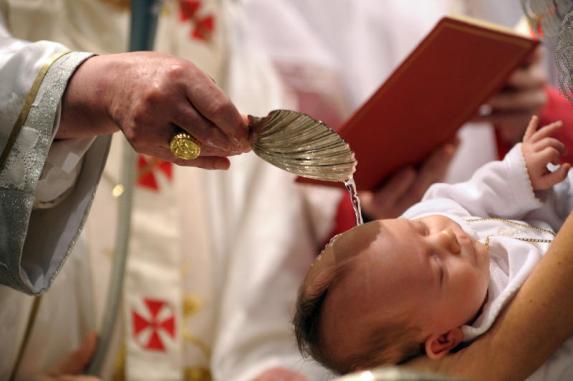
Pope Celebrates Baptism Of Children At The Sistine Chapel

VATICAN CITY, VATICAN – JANUARY 10: Pope Benedict XVI baptises a newborn baby in Michelangelo’s Sistine Chapel on January 10, 2010 in Vatican City, Vatican. Held on the same day as the Baptism of the Lord and started by John Paul II, this annual event celebrates the baptism of children and marks the end of the Christmas season. (Photo by L’Osservatore Romano-Vatican Pool via Getty Images)

“Jesus answered, Verily, verily, I say unto thee, Except a man be born of water and of the Spirit, he cannot enter into the kingdom of God.” John 3:5 KJV

What kind of water is Jesus speaking of in the above text?

How one interprets this will generally depend on the brand of systematic theology they are bringing to the table.  If you confess that baptism is a symbol, then a literal interpretation isn’t going to work for you.  In this post I will attempt to demonstrate that a literal understanding of water is the plainest reading of the verse.  First I will summarize and refute the two most common alternative renderings of the passage.

Body Fluids… Really??

The first thing most seem to do is to argue that the “water” isn’t actually referring to clean running water.  The two most common arguments I see for this is that it should be understood as either amniotic fluid or semen.  I cringe at the second the most but I know what they are getting at.  Those who read the text this way are saying that there are two chronological births in view in the above verse.  The first being a natural birth via human parents and then a second birth of the spirit.

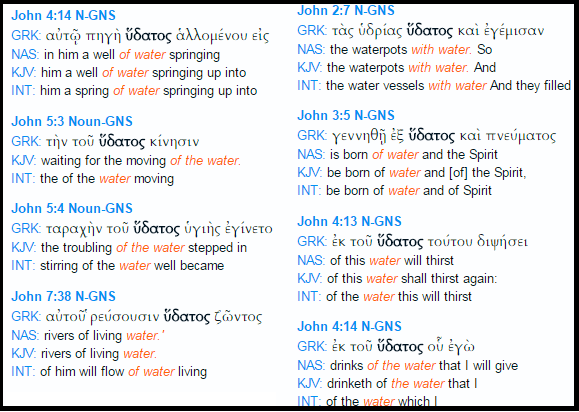
The problem with this view is two fold, first there is only a singular preposition for “born” in John 3:5.  Putting it another way, Jesus is only talking about being born again,  the natural birth which logically precedes it is not the direct referent.  This is further compounded by the fact that every time John uses the word “Hydatos” in his book it is used in the sense of clean water.  There is not a single usage referring to body fluids:

For a full listing off all Biblical uses of Hydatos please click HERE.

Water2

Water

Source: BibleHub.com

Figurative Rendering

The other common attempt is to understand the “water” in a figurative sense.  Specifically, they will read it as:

“Except a man be born of water Spirit and of the Spirit”

To support this view they will make two arguments.  The first is to assert that understanding “water” as baptism is anachronistic because Nichodemus would not have been aware of baptism.  Second they will argue that the water is antitype fulfillment of the transformed life found in scripture.  And that there are essentially two baptisms, one of the Spirit which is being born again, and then one of water baptism that symbolizes this rebirth.  When arguing for an antitype fulfillment ones who hold this position will generally use the following passages:

“17 And for an unclean person they shall take of the ashes of the burnt heifer of purification for sin, and running water shall be put thereto in a vessel: 18 And a clean person shall take hyssop, and dip it in the water, and sprinkle it upon the tent, and upon all the vessels, and upon the persons that were there, and upon him that touched a bone, or one slain, or one dead, or a grave: 19 And the clean person shall sprinkle upon the unclean on the third day, and on the seventh day: and on the seventh day he shall purify himself, and wash his clothes, and bathe himself in water, and shall be clean at even.” Num 19:17–19 KJV

“4 When the Lord shall have washed away the filth of the daughters of Zion, and shall have purged the blood of Jerusalem from the midst thereof by the spirit of judgment, and by the spirit of burning.” Isa 4:4 KJV

“15 Until the spirit be poured upon us from on high, and the wilderness be a fruitful field, and the fruitful field be counted for a forest.” Isa 32:15 KJV

For I will pour water upon him that is thirsty, and floods upon the dry ground: I will pour my spirit upon thy seed, and my blessing upon thine offspring” Isa 43:3 KJV

“1 Ho, every one that thirsteth, come ye to the waters, and he that hath no money; come ye, buy, and eat; yea, come, buy wine and milk without money and without price.” Isa 55:1 KJV

“28 And it shall come to pass afterward, that I will pour out my spirit upon all flesh; and your sons and your daughters shall prophesy, your old men shall dream dreams, your young men shall see visions: 29 And also upon the servants and upon the handmaids in those days will I pour out my spirit. 30 And I will shew wonders in the heavens and in the earth, blood, and fire, and pillars of smoke.” Joel 2:28–29 KJV

In that day there shall be a fountain opened to the house of David and to the inhabitants of Jerusalem for sin and for uncleanness.” Zech 13:1 KJV

“For I will take you from among the heathen, and gather you out of all countries, and will bring you into your own land.  Then will I sprinkle clean water upon you, and ye shall be clean: from all your filthiness, and from all your idols, will I cleanse you.  A new heart also will I give you, and a new spirit will I put within you: and I will take away the stony heart out of your flesh, and I will give you an heart of flesh.  And I will put my spirit within you, and cause you to walk in my statutes, and ye shall keep my judgments, and do them.” Eze 36:24-27 KJV

I would actually agree that these old testament verses are type and shadow, pointing to their antitype fulfillment in our water baptism in the death burial and Resurrection of Christ.

“pour”

“fountain”

“sprinkle”

“cleanse”

“clean water”

“pour water”

“pour spirit”

“running water”

“dip it in the water”

How can a sane person read all the above language and remove the water from it?  Clearly water is literal in every sense that the Holy Spirit is literal.  There is no reason to separate the two.

The assertion that a baptismal referent is anachronistic falls apart when one takes four truths into consideration.

  1. John the baptist had been performing baptisms for quite some time before Nichodemus interview with Christ.
  2. There were many forms of baptism in first century Jewish traditions that would have made such a concept familiar to Nichodemus.
  3. Jesus always expected his hearers, particularly scribes and pharisees, to be familiar with scripture.  Thus an understanding of messianic type and shadow would not have been expected to be beyond Nichodemus comprehension.
  4. Lastly, the intended audience of the Gospel of John was Christians around 90 A.D.  and after.  They were very familiar with baptism and would have read “water and of the spirit” as referring to such.  This claim can be proven through Patristic writings.  For an applicable listing please click HERE.

The ultimate problem with symbolic “water” in John 3:5 is that it teaches two baptisms.  The reason this falls apart is that the scriptures are clear that there is only one baptism.  And this is ultimately how we know that the Spirit comes by the word and the water.  One event, one act of God promised in the word.

“5 One Lord, one faith, one baptism,” Eph 4:5 KJV

Conclusion

With a singular referent for “born”, numerous relevant examples of Hydatos used as clean water, anachronistic objections addressed, types and shadows including water accepted, and a singular baptism defined by scripture it is fair to assert that the “water” Jesus speaks of in John 3:5 is the waters of our baptism.

I say praise the Lord for this as it is his work performed upon us.  You can mark the date of your baptism on a calendar.  It is an objective material fact that you can point to and know by the Word that the associated promises are true and efficacious.

3482621_orig

Posted in Armchair Lounge, Soteriology | Tagged , , , | Leave a comment

The Nature of Man

hands-drowning-sea

This is the seventh post in a series on the Great Controversy.  For the previous post please click HERE.  Each post builds on themes and arguments presented so if you have not read my others I recommend starting with the first by clicking HERE.

For the Great Controversy to work unregenerate man must posses a salvifically relevant free will.  By that I mean, such free will  must have the cosmic power to in some way assist in ones own salvation and alter or impact the divine Will of God.

Those familiar with this topic know how heated it can get philosophically. Rather than go there this post instead will focus on what has been revealed in scripture as compared to the teachings of SDA.

“It is necessary that the truth about God, Christ and Satan be made manifest. The real story of all three is involved in the cosmic controversy. The revelation of who they really are must be made so that all created beings, angelic (fallen and unfallen), humans (redeemed and lost) and the unfallen inhabitants of worlds afar, may all vote unanimously on who is right and who is wrong. Only one side can win, yet all from both sides must vote, and vote the same. This is done with complete freedom, and is done purely on the evidence given by both sides.” The Cosmic Controversy: World View for Theology and Life. , Norman R. Gulley, p. 85

Above you can see that the SDA teacher is stating we are choosing sides in this “Great Controversy”.  You pick the side that you want to be on and that it is a matter of free will.  Rather than God glorifying himself in salvation this presents a theology of glory on the part of man by choosing under our own power the right side of a cosmic conflict.

“Jesus employed no miraculous agency to compel men to believe in him. They were left to choose or reject him, of their own free will. No direct power was to force them into obedience, and destroy the free moral agency that God has given to man.” Ellen White, Redemption: or the Teaches of Christ, The Anointed One, Pg 83

Is it true that Jesus doesn’t use a miraculous agent to compel us?  What does the Bible say about this?  If we are left to our own free will one could logically argue that we are helping God save us.  As if to say that his death on the cross wasn’t enough and he needs our help to make up the difference.  I realize nobody actually confesses that in those words, but it is the logical conclusion of decision theology.

“Do you want to be healed from your sins? Heed the invitation of Christ. Come to Him of your own free will, and put yourself under the care of this mighty Healer. Then Christ can say to you as He did to the poor paralytic, “Thy sins be forgiven thee.” “Rise, take up thy bed, and walk.” Ellen White, Letter 77 (May 1, 1889)

This quote above is teaching that when you do use this self regenerating power of free will then Christ has the ability to operate in a miraculous sense.  Is that really what the Bible teaches?  Is God’s power limited by our free will?

Spiritually Dead

Just to be clear, I am going to state that I do believe free will exists.  My argument is not that free will doesn’t exist. Instead my argument is that it is not relevant with regards to salvation.  It just doesn’t matter and certainly doesn’t help God save you.

“Who hath delivered us from the power of darkness, and hath translated us into the kingdom of his dear Son” Col 1:13 KJV

“1 And you hath he quickened, who were dead in trespasses and sins; 2 Wherein in time past ye walked according to the course of this world, according to the prince of the power of the air, the spirit that now worketh in the children of disobedience:; 3 Among whom also we all had our conversation in times past in the lusts of our flesh, fulfilling the desires of the flesh and of the mind; and were by nature the children of wrath, even as others.; 4 But God, who is rich in mercy, for his great love wherewith he loved us,; 5 Even when we were dead in sins, hath quickened us together with Christ, (by grace ye are saved;); 6 And hath raised us up together, and made us sit together in heavenly places in Christ Jesus:; 7 That in the ages to come he might shew the exceeding riches of his grace in his kindness toward us through Christ Jesus.” Eph 2:1-7 KJV

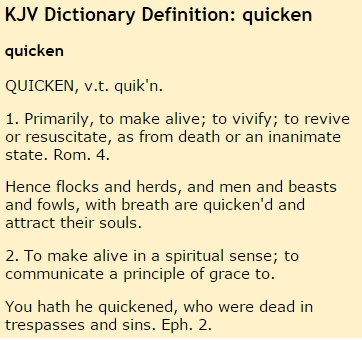
According to the 1611 KJV Dictionary “Quickened” means being made alive, especially in a spiritual sense:

Quicken

So to break this passage down, it is saying that those who are “quickened” now were once dead.  This is where the concept of spiritual death and life come into play.  In this state of spiritual death the scriptures describe us as:

[in] the power of darkness

dead in trespasses

walked according to the…spirit that now worketh in the children of disobedience

lusts of our flesh

children of wrath

After this Paul changes gears and describes the impact of God’s actions upon that state.

But God

delivered us from

hath quickened

hath raised

made us

shew the exceeding riches of his grace

Ask yourself this question, what state does the text say we are in before we are saved and who does it identify as the one changing that status?  Are those verbs attributed to you or to God?

Here is an analogy, have you ever seen a dead body before?  Most of us have, even if not a person it could have been a pet or animal.  If you plead and yell at the top of your lungs will the corpse get up?  No they are dead and cannot do anything.  Does this inability on the part of the corpse mean that they didn’t have free will?  No it doesn’t it means that their free will is irrelevant in a state of death.

Above Paul is teaching that we are spiritually dead.  Though you can move and speak and fulfill your vocation you cannot make a decision for Jesus.  Your body is alive but inside you are a corpse.  This corpse inside of you cannot get up and do anything in a spiritual sense except to be dead in sin.  No matter how sappy the music is in the altar call it cannot bring a sinner to penitent faith in Christ.  The scriptures teach that this is a miracle, a work of God.

But God…

“For by grace you have been saved through faith. And this is not your own doing; it is the gift of God, ; not a result of works, so that no one may boast.” Eph 2:8-9 KJV

Read the verse above, and notice that both the faith and the grace are a gift.  This is not something you are giving yourself, God is giving it to you.  it is logical then to ask how God gives that gift.  This is explained elsewhere in Paul’s writings.

“14 How then will they call on him in whom they have not believed? And how are they to believe in him of whom they have never heard? And how are they to hear without someone preaching? ; 15 And how are they to preach unless they are sent? As it is written, “How beautiful are the feet of those who preach the good news!” ; 16 But they have not all obeyed the gospel. For Isaiah says, “Lord, who has believed what he has heard from us?” ; 17 So faith comes from hearing, and hearing through the word of Christ.” Rom 10:14-17 KJV

Above in Romans we see that this gift of faith is given by the preaching of the Word.  This is one of the reasons why going to church is important and relevant.  It is not something you do for God, at church you receive faith as a gift from God through the preaching of his Word.  If the pastor isn’t rightly preaching the Word there is really no point, find another church!

 You can’t give this gift of faith to yourself, you can’t muster it up and strain hard to have it.  You cannot choose to have it,  it has to be given to you.

Conclusion

With a proper biblical understanding of the Nature of Man you cannot have free moral agents capable of choosing one side or the other in a Great Controversy.  Instead you have an Almighty God stepping into a lost and broken world saving mankind for his Glory.  He bled and died on the cross taking your sins to the grave so that you don’t have to.

“Now I would remind you, brothers, of the gospel I preached to you, which you received, in which you stand, ; and by which you are being saved, if you hold fast to the word I preached to you—unless you believed in vain.; For I delivered to you as of first importance what I also received: that Christ died for our sins in accordance with the Scriptures, ;  that he was buried, that he was raised on the third day in accordance with the Scriptures” 1 Cor 15:1-4 KJV

“He himself bore our sins in his body on the tree, that we might die to sin and live to righteousness. By his wounds you have been healed.” 1 Pet 2:24 KJV

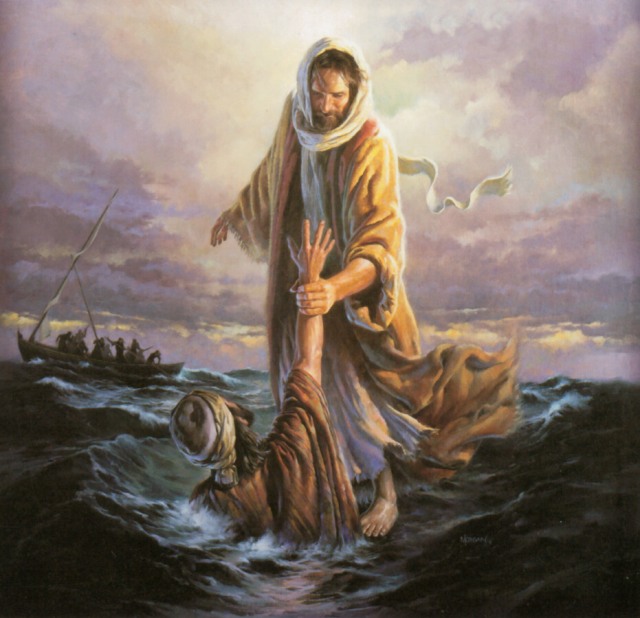
So, do we have free will?  Well the answer is yes, but it’s not relevant for salvation.  When it comes to salvation I would argue that our free will is like that of an ant in an ant farm.  Sure they can choose which tunnel they are gonna take but they can’t change their situation.  The variables to themselves and to their environment are simply too limited.  Instead, God steps into time and saves us like he did Peter.

That’s not a Great Controversy with equal players on a field of battle. That is the act of Creator God upon a creation subject to his will.

jesus-and-peter

Posted in Great Controversy, Leaving Adventism | Tagged , , , | 4 Comments

The Ten Commandments

10commandments_2425344b

What most don’t know about the Ten Commandments is that there are three different ways of numbering them.  In my opinion only one of these is technically correct if you’re going off the Exodus 20 Narrative.  I will list each and explain along with my own understanding Biblically.

Jewish/Talmudic Tradition

You can find a listing of the Jewish Ten Commandments at the source I am pulling from HERE.  This numbering system was developed in the third century by the Jews.

I

I am the Lord thy god, who brought thee out of the land of Egypt, out of the house of bondage. Exo 20:2

II

Thou shalt have no other gods before Me. Exo 20:3-6

III

Thou shalt not take the name of the Lord thy God in vain. Exo 20:7

IV

Remember the Sabbath day to keep it holy. Exo 20:8-11

V

Honor thy father and thy mother. Exo 20:12

VI

Thou shalt not murder. Exo 20:13
VII Thou shalt not commit adultery.

Exo 20:14

VIII Thou shalt not steal.

Exo 20:15

IX Thou shalt not bear false witness against they neighbor.

Exo 20:16

X Thou shalt not covet anything that belongs to thy neighbor.

Exo 20:17

The commandment that should stand out to you above would be the first.  Christians generally don’t consider this to be a commandment.  First and foremost because it is not telling you to do or not do something.  Second because it only applies to Jewish people.

One should keep in mind that the above is the modern Jewish tradition.  Back in Joesphus day the Ten Commandments were counted like protestants and the Greek Orthodox do today.  You can find a source on that HERE and HERE.

Christian – Augustine

I

Thou shalt have no other gods before Me. Exo 20:3-6

II

Thou shalt not take the name of the Lord thy God in vain. Exo 20:7

III

Remember the Sabbath day to keep it holy. Exo 20:8-11

IV

Honor thy father and thy mother. Exo 20:12

V

Thou shalt not murder. Exo 20:13

VI

Thou shalt not commit adultery. Exo 20:14
VII Thou shalt not steal.

Exo 20:15

VIII Thou shalt not bear false witness against they neighbor.

Exo 20:16

IX Thou shalt not covet thy neighbors house.

Exo 20:17

X Thou shalt not covet thy neighbor’s wife, nor his man-servant, nor his maid-servant, nor his cattle, nor anything that is his.

Exo 20:17

This is the Augustinian Christian numbering of the Ten Commandments. It was developed a century after the Talmudic version.  It is what is taught in Western traditions such as Lutheranism, and Roman Catholicism.  You can find a listing in the small catechism which is the source I am quoting HERE.

Notice that the first in the Talmudic tradition isn’t there which moves the list up.  To keep the number of “10” the last commandment has been split in two.  I would guess that the reasoning is to separate coveting lifeless possessions vs. coveting family and or livestock.

I don’t personally think that the distinction holds though as it is not the object of coveting that is being taught but the act or desire of coveting itself.  It seems telling that even Martin Luther combines the two in the Large Catechism.

Christian – Philonic

This is likely the most prevalent numbering of the ten commandments in the United States.  It is certainly the oldest.  As stated above it is the numbering that the first century Jews utilized as per records dating to that era.  You can find the sources I am pulling from HERE and HERE.

I You shall have no other gods before me. Exo 20:3-6
II You shall not make for yourself an idol. Exo 20:3-6
III You shall not misuse the name of the LORD your God. Exo 20:7
IV Remember the Sabbath day by keeping it holy. Exo 20:8-11
V Honor your father and your mother. Exo 20:12
VI You shall not murder. Exo 20:13
VII You shall not commit adultery. Exo 20:14
VIII You shall not steal. Exo 20:15
IX You shall not give false testimony against your neighbor. Exo 20:16
X You shall not covet. Exo 20:17

Above you will see that this numbering makes more sense with regards to the last commandment.  Like the Augustine version it also doesn’t have the first commandment found in the Talmudic version.  Here the commandment on worship and idolatry is listed as two different commandments.

Though there are three “thou shalts” in this commandment they all center around the same thing, which is worship.

Thou shalt have no other gods before me.;

Thou shalt not make unto thee any graven image, or any likeness of any thing that is in heaven above, or that is in the earth beneath, or that is in the water under the earth:;

Thou shalt not bow down thyself to them, nor serve them: for I the Lord thy God am a jealous God, visiting the iniquity of the fathers upon the children unto the third and fourth generation of them that hate me;” Exo 20:3-5 KJV

Which numbering is Correct?

Which numbering is the correct one?  I would argue that if we are basing the assessment solely off Exodus 20 it would be the Philonic version.  This is because the Ten Commandments are referred to as being “ten” in several places in scripture, and it is logical to presume that since this is the oldest tradition we know of it is the one being referred to.


“And he declared unto you his covenant, which he commanded you to perform, even ten commandments; and he wrote them upon two tables of stone.” Deu 4:13 KJV

Allow me to point out the obvious here, when you see “Ten Commandments” and “tables of stone” mentioned in scripture the logical referent is the older numbering that would have been in use at the time.

“9 There was nothing in the ark save the two tables of stone, which Moses put there at Horeb, when the Lord made a covenant with the children of Israel, when they came out of the land of Egypt. 21 And I have set there a place for the ark, wherein is the covenant of the Lord, which he made with our fathers, when he brought them out of the land of Egypt.; ” 1Ki 8:9, 21 KJV

Notice above that this same counting of the ten commandments is defined as being part of the Old Covenant.

“1 Then verily the first covenant had also ordinances of divine service, and a worldly sanctuary….; 4 Which had the golden censer, and the ark of the covenant overlaid round about with gold, wherein was the golden pot that had manna, and Aaron’s rod that budded, and the tables of the covenantHeb 9:1,4 KJV

Notice above that this inclusion of the Ten Commandments, logically with the Philonic numbering, is also identified as part of the Old Covenant.

“7 For if that first covenant had been faultless, then should no place have been sought for the second…. 13 In that he saith, A new covenant, he hath made the first old [obsolete]. Now that which decayeth and waxeth old is ready to vanish away.; ” Heb 8:7, 13 KJV

Newer versions use the word obsolete, I have added that in brackets above as I think it drives the point home.  Since the Ten Commandments were clearly part of the Old Covenant, which is now obsolete, it follows that Exodus 20 is not where a Christian should go to list or even number the Ten Commandments.  It is certainly the most convenient, but not necessarily the most theologically accurate method.

Even though it is a pain I think we should make it clear that the place we go to catechize the Ten Commandments should be the New Testament.  If you want a full list of verses and a walk-through of Biblical reasoning on this please click HERE.

New Covenant – Ten Commandments

Notice that 1 of the 10 commandments is not prescriptively taught in the New Covenant after the cross at all.

I

You shall have no other gods before me. Act 14:151Co 8:5, 6

II

You shall not make for yourself an idol. 1Co 10:7, 141Jn 5:21   

III

You shall not misuse the name of the LORD your God. Eph 6:2, Col 3:8

IV

Remember the Sabbath day to keep it holy. NONE

V

Honor your father and your mother. Col 3:20

VI

You shall not murder. Rom 13:9 ,  1Pe 4:15  
VII Thou shalt not commit adultery.

Rom 7:21Co 6:9  

VIII Thou shalt not steal.

Rom 13:9,  Eph 4:28

IX Thou shalt not bear false witness against they neighbor.

Eph 4:25Col 3:9

X Thou shalt not covet anything that belongs to thy neighbor.

Rom 13:9Heb 13:5

 Above I have listed the Ten Commandments according to the Philonic method with the corresponding new testament passages.  Take a look, you will see that each new testament passage either prescriptively issues the commandment or demonstrates gentile observance after the cross.

The fourth commandment is never commanded for gentiles and verses such as (Col 2:16-17) outright cancel it out.  I would argue that the Sabbath is now received in Gospel fulfillment along with all of the other Ceremonial Laws.

Really! Only 9 Commandments?!? 

Yeah that’s a sound Biblical conclusion to come to and if you want to sing that song I won’t say anything against you.  A more important thing to understand is that our prescriptive commands in the New Covenant are found in the Law of Christ that Paul speaks of in (1Cor 9:20-23).

Here is the punchline, they are not numbered in any kind of order in the New Testament.  You can arrange them however you like.  You can even divide them up so that they make ten if you want.  You can also teach the Sabbath command in a first table sense so that it comes out to 10 if you really like that number.  This is pretty much what Luther did in the Large and Small Catechisms.  Read them carefully, he is teaching them from a New Covenant perspective not an Old Covenant one.

Take a close look at his teaching on the Sabbath command in particular.  To summarize, Luther ties it to the first commandment to worship God.  He is clear that the holiness of the day is simply because that is the day the Church has set aside to preach the Word.  Which is a holy thing indeed and should not be despised.

The day is chosen in Christian freedom, something that is okay to establish tradition in.  Luther is very balanced and Biblical in his analysis and teaching.  Sadly many of the other reformers were not so clear and this has lead to a great deal of confusion.  I would argue that one of the many reasons that cults have been so able to flourish is due to the failure of so many reformers to rightly divide the word on the Commandments.  This is one of the many reasons that I have chosen to study under Luther.

Conclusion

I would argue that how one numbers the Ten Commandments is a matter of tradition.  There is no theologically correct or incorrect answer with regards to numbering if approached from a New Covenant perspective as they are not presented in any particular order by the Apostles.

Which numbering to I prefer?  Luther used the Augustine tradition and taught it from a New Covenant perspective.  So because of that, and the fact that I have the freedom to pick then I am gonna go with the way he taught it.  That said, it isn’t something I would argue over either.  If you prefer the Philonic method due to is age rock on.  As Augustine says:

“In Essentials Unity, In Non-Essentials Liberty, In All Things Charity” – St. Augustine


Posted in Armchair Lounge, Christianity 101 | Tagged , | 4 Comments

Vindication of God

jesus_christ__existence__by_richmondeleon-d5zkhlj

This is the sixth post in a series on the Great Controversy.  For the previous post please click HERE.  Each post builds on themes and arguments presented so if you have not read my others I recommend starting with the first by clicking HERE.

For the Great Controversy to be true it would need to be Biblically necessary for the character of God to be in question.  Also, the scriptures would have to teach that created beings are in some way standing in judgement over God at least in the same sense as a Jury does over a defendant in a court of law.

“Jesus was bearing the sin of the world; he was enduring the curse of the law; he was vindicating the justice of God. Separation from his Father, the punishment for transgression, was to fall upon him in order to magnify God’s law and testify to its immutability. And this was forever to settle the controversy between Satan and the Prince of heaven in regard to the changeless character of that law.” EGW, Signs of the Times, Feb. 13, 1896.

The Soveriegnty of God

In my last post in this series I demonstrated how the Bible teaches that God is Holy.  Are there people who call this into question today and shake their fist at God?  Yes of course there are.  The problem is that their rebellion is irrelevant.  The Great Controversy portrays a universe at risk.  One in which the only answer is for God to vindicate himself.  Scritpture does not teach this.  Instead it teaches something very clear which outright contradicts such a motif.

“Not unto us, O Lord, not unto us, but unto thy name give glory, for thy mercy, and for thy truth’s sake.; Wherefore should the heathen say, Where is now their God?; But our God is in the heavens: he hath done whatsoever he hath pleased.” Psa 115:1-3 KJV

Notice above that the verse essentially says God does what he wants.  This is true even when the heathen question him.  This passage does not portray God pleading with the heathen but rather their complaints are quite irrelevant to his actions.

“For I know that the Lord is great, and that our Lord is above all gods.; Whatsoever the Lord pleased, that did he in heaven, and in earth, in the seas, and all deep places.; He causeth the vapours to ascend from the ends of the earth; he maketh lightnings for the rain; he bringeth the wind out of his treasuries.” Psa 135:5-7 KJV

Notice this passage not only ascribes dominion of the universe to God, but it is clear that even things we would not think of him as being in control of he is.  Yes, God controls the weather.  That came as a shock for me, as an SDA I had more of a clockmaker picture of God in my head.  I assumed he created it as he wanted it to be and kinda let the universe do its thing most of the time.  Instead we see the Bible teaches he is sovereign over all.

Declaring the end from the beginning, and from ancient times the things that are not yet done, saying, My counsel shall stand, and I will do all my pleasure:; Remember the former things of old: for I am God, and there is none else; I am God, and there is none like me,” Isa 46:10-9 KJV

Read the above verse one more time, are you getting a picture of someone who is on trial?  Is he trying to prove his innocence here?  Think about it.

And all the inhabitants of the earth are reputed as nothing: and he doeth according to his will in the army of heaven, and among the inhabitants of the earth: and none can stay his hand, or say unto him, What doest thou?” Dan 4:35 KJV

That’s right, on a cosmic scale you and I are reputed as nothing.  This isn’t showing a picture of someone hoping to change everyone’s mind about himself.  Instead it says he “doeth according to his will”.

“Thou wilt say then unto me, Why doth he yet find fault? For who hath resisted his will?; Nay but, O man, who art thou that repliest against God? Shall the thing formed say to him that formed it, Why hast thou made me thus?;  Hath not the potter power over the clay, of the same lump to make one vessel unto honour, and another unto dishonour?” Rom 9:19-21 KJV

Above it rebukes one for even thinking they can argue against God.  If such a thing is to receive a heavenly rebuke why would we think a grand display of questioning God would be entertained in the courts of heaven?  There is no reason to think that at all unless one is pulling their theology from extra Biblical sources.

“The kings of the earth set themselves, and the rulers take counsel together, against the Lord, and against his anointed, saying,; Let us break their bands asunder, and cast away their cords from us.; He that sitteth in the heavens shall laugh: the Lord shall have them in derision.” Psa 2:2-4 KJV

Above we see kings and rulers questioning God.  What is his response?  Does it say that he pines away and plots a scheme to vindicate himself?  No instead it says he laughs and “shall have them in derision”.


“And said, O Lord God of our fathers, art not thou God in heaven? and rulest not thou over all the kingdoms of the heathen? and in thine hand is there not power and might, so that none is able to withstand thee?” 2 Chr 20:6 KJV

Above it says “none is able to withstand thee”.  Please notice, that would include Satan.  He cannot withstand God, he is certainly not a threat to God at all.  Certainly not a “great” controversy with no threat of failure if you ask me.

Above I have made my case for the power and sovereignty of God.  I chose to use clear passages that are not commonly quoted.  There is actually a great deal more depth to this doctrine if you wish to dig deeper.  If you want the list of verses I was pulling from though you can find them HERE.

But reason for yourself, we are talking about an un-created Being who is creator and sustain-er of all things.  Creation is not in any way on equal footing with him.  Its straight up blasphemous to think creation is judging him.  Furthermore he owes us nothing.  Everything we have is given to us by grace.

Look closely at the pictures below.  Which one do you think is a Biblical presentation?  Picture #1 I found on an SDA blog that was arguing for the Great Controversy.  Notice how it shows the Devil and Christ in an arm wrestle.  Each is on equal footing with the color scheme split equally indicating good vs evil.

On picture #2 I found a more accurate representation.  Notice how Christ stands above the devil.  In this Satan is nothing to him.  If I could have found a picture of Satan being crushed by the foot of God like a bug I would have used that instead.  Why am I going on and on over a few pictures?  The reason is because pictures are worth a 1000 words.

Make no mistake #1 is an SDA view of God and the devil and #2 is a Christian one.  Which of these do you confess?

GC

Posted in Great Controversy, Leaving Adventism | Tagged , , | Leave a comment

Efficacy of Baptism

babybaptism


“18 For Christ also hath once suffered for sins, the just for the unjust, that he might bring us to God, being put to death in the flesh, but quickened by the Spirit: 19 By which also he went and preached unto the spirits in prison; 20 Which sometime were disobedient, when once the longsuffering of God waited in the days of Noah, while the ark was a preparing, wherein few, that is, eight souls were saved by water. 21 The like figure whereunto even baptism doth also now save us (not the putting away of the filth of the flesh, but the answer of a good conscience toward God,) by the resurrection of Jesus Christ: 22 Who is gone into heaven, and is on the right hand of God; angels and authorities and powers being made subject unto him.” 1 Peter 3:18-22 KJV


Above is one of the passages that ultimately led to me becoming a Lutheran.  The reason is that they are the only ones I have seen that can seem to properly teach the passage in line with the normal rules of grammar and language.  Everyone else seems to twist it horribly.  That said, the passage wasn’t easy for me either and in this post I will explain my analysis of it past and present as I wrestled with the text.


When I first started examining this passage I was against the plain reading of it and was trying to find ways to force it to say something else.  The first thing that I did was focus on the phrase “like figure”.  The NKJV renders this as “antitype” which can mean symbol.  So I argued that it was saying baptism is a symbol of salvation.


The problem with that is it ignores the previous verse entirely.  Grammatically the anitype is the story of Noah and how eight were saved by water.  An antitype pointing to baptism, which the text says saves us.


After that I tried to understand appealing to God for a clean conscience as saving us.  Afterall, the text says we are not saved by the “putting away of filth from the flesh” but by “the answer of a good conscience toward God”.  I was happy with this reading for a while.


Unfortunately that doesn’t work either.  You are in effect saying that a request and appeal to God for a clean conscience is what saves you.  To understand the text this way would mean that we help God save us by appealing to him, thus adopting synergism by means of works righteousness.  Might as well become a Roman Catholic at that point.


There is only one other option to save Creedo Baptism as far as I saw it, and it is to confess that there are two (2) baptisms.  One of the Spirit and one of the Water.  In this model you would then argue that 1 Peter 3:21 must only be speaking of the Baptism of the Holy Spirit.  This framework helps for all those other pesky verses teaching a salvific baptism as well.  One can simply discern that when the Bible refers to baptism in an efficacious sense it is talking about the Baptism of the Holy Spirit (Matt 28:19) (John 3:5) (Acts 2:38-39)  (Acts 22:16)  (Gal 3:27) (Rom 6:3-5) (Eph 5:25-27) (Col 2:11-12)  (Titus 3:4-7).  And when one reads a verse saying that Baptism totally does nothing and its just a sign one has made a decision for Jesus they can understand it as water baptism (No Biblical Texts).


Ultimately the reason I reject the above hermeneutic, aside from the lack of a single text to support its thesis, is the fact that the Bible is clear there is only one Baptism.


“One Lord, one faith, one baptism” Eph 4:5 KJV


Lest there be any confusion Jesus Christ does in fact teach that water Baptism is Baptism.  This means one cannot simply delete water baptism from the Bible either.


“Go ye therefore, and teach all nations, baptizing them in the name of the Father, and of the Son, and of the Holy Ghost:;  Teaching them to observe all things whatsoever I have commanded you: and, lo, I am with you alway, even unto the end of the world. Amen.” Matt 28:19-20 KJV


So with only one (1) Baptism as an option, Jesus defining said Baptism, and Peter clearly stating Baptism saves you, there is no other option.  One must accept what the scripture says here or nullify it with a systematic theology that they impose over and against the text.


I simply refuse to do that


Posted in Armchair Lounge, Soteriology | Tagged , | 18 Comments

Example of Christ

Jesus Christ crown of thorns and nail

HEREThis is the fifth post in a series on the Great Controversy.  For the previous post please click HERE.  Each post builds on themes and arguments presented so if you have not read my others I recommend starting with the first by clicking HERE.

One of the key points of the Great Controversy teaching is that the ultimate purpose of the Cross and the life of Christ was to serve as an example of overcoming sin.  This is to teach and inspire us to vindicate the Character of God by also becoming sinless.

Once again, to prove I am not making this stuff up please see the below quotations.

“Satan had asserted that men could not keep the commandments of God. To prove that they could, Christ became a man, and lived a life of perfect obedience, an evidence to sinful human beings, to the worlds unfallen, and to the heavenly angels, that man could keep God’s law through the divine power that is abundantly provided for all that believe.”  EGW, Signs of the Times, May 10, 1899.

God’s law is given to men as a hedge, a shield.…To the obedient it is the pledge of eternal life, for it expresses the principles that endure forever. Christ came to demonstrate the value of the divine principles by revealing their power for the regeneration of humanity. He came to teach how these principles are to be developed and applied.” EGW, Education, pp. 76-77.

“By His life and His death, Christ proved that God’s justice did not destroy His mercy, but that sin could be forgiven, and that the law is righteous, and can be perfectly obeyed. Satan’s charges were refuted.” EGW, Desire of Ages pg 762

“In making His infinite sacrifice Christ would exalt and honor the law.” EGW, ibid., July 12, 1899.

“When Christ gave His life for you, it was that He might place you on vantage ground and impart to you moral power.” EGW, Manuscript Releases, vol. 14, p. 74.

“The glory of Christ is his character, and his character is an expression of the law of God. He fulfilled the law in its every specification, and gave to the world in his life a perfect pattern of what it is possible for humanity to attain unto by cooperation with divinity.” EGW, Signs of the Times, Dec. 12, 1895.

In summary,  Ellen White is teaching in the above quotes  that Jesus died on the cross so that we can know how to be perfect and sinless by following his example.  And in doing so, we vindicate the character of God.

Is this really why God of very God came incarnate in the flesh 2000 years ago?

This post will not be as straightforward as some of my previous ones on the topic of the Great Controversy.  I am going to attempt to Biblically prove line by line the very reason as to why God came in the flesh.  This is a task far too many tend to shy away from.  To do that I am going to Biblically define a few terms.

  1. The Holiness of God
  2. The Wrath of God
  3. The Love of God

Below is a modified excerpt from a blog post I did focusing on the above three theological terms, you can find that post by clicking HERE.  It wasn’t an SDA specific post though so if those are the only ones you read you may have missed it.


The Holiness of God
1… I saw also the Lord sitting upon a throne, high and lifted up, and his train filled the temple.; 2 Above it stood the seraphims: each one had six wings; with twain he covered his face, and with twain he covered his feet, and with twain he did fly.; 3 And one cried unto another, and said,

Holy, holy, holy, is the Lord of hosts: the whole earth is full of his glory.;

4 And the posts of the door moved at the voice of him that cried, and the house was filled with smoke.; 5 Then said I, Woe is me! for I am undone; because I am a man of unclean lips, and I dwell in the midst of a people of unclean lips: for mine eyes have seen the King, the Lord of hosts.” Isa 6:1-5 KJV

Here we have one of the most vivid displays of the Holiness of God in the Bible.

 “Holy, holy, holy”

This is also stated by the same creatures in Revelation 4:8, its called the Trihagion.   This was a new word for me, I had to look it up.  Below is an excerpt is taken from a Got Questions essay explaining the concept of the Trihagion.

“The repetition of a name or an expression three times was quite common among the Jews. In Jeremiah 7:4, the Jews are represented by the prophet as saying, “The temple of the Lord” three times, expressing their intense confidence in their own worship, even though it was hypocritical and corrupt. Jeremiah 22:29, Ezekiel 21:27, and 2 Samuel 18:33 contain similar three-fold expressions of intensity. Therefore, when the angels around the throne call or cry to one another, “Holy, holy, holy,” they are expressing with force and passion the truth of the supreme holiness of God, that essential characteristic which expresses His awesome and majestic nature.”

In addition, the Trihagion expresses the Triune nature of God, the three Persons of the Godhead, each equal in holiness and majesty. Jesus Christ is the Holy One who would not “see decay” in the grave, but would be resurrected to be exalted at the right hand of God (Acts 2:26;13:33-35). Jesus is the “Holy and Righteous One” (Acts 3:14) whose death on the cross allows us to stand before the throne of our holy God unashamed.

Thou art of purer eyes than to behold evil, and canst not look on iniquity: wherefore lookest thou upon them that deal treacherously, and holdest thy tongue when the wicked devoureth the man that is more righteous than he?” Hab 1:13 KJV

“This then is the message which we have heard of him, and declare unto you, that God is light, and in him is no darkness at all.” 1 Jhn 1:5 KJV

Based on the above I would argue that sin is not something that can simply co-exist in the presence of a Holy God.  It is not so trivial as we make it out to be in our day to day lives.  Sin is not dust that God simply brushes off his shoulder.  But rather it is something that literally cannot exist in the presence of a Holy God.
To summarize my understanding the Holiness of God is perfect and complete, to restate this mathematically I would use the word infinity.  The Holiness of God is infinite and quite beyond human comprehension or explanation outside of the Word.

The Wrath of God
Related to the Holiness of God is the Wrath of God.  This is not a topic that SDA like to bring up but it is a Biblical teaching that should not be avoided.  Rather one should accept the below passages on what they plainly state and then fit the pieces together.

“For thou art not a God that hath pleasure in wickedness: neither shall evil dwell with thee.;  The foolish shall not stand in thy sight: thou hatest all workers of iniquity.;  Thou shalt destroy them that speak leasing: the Lord will abhor the bloody and deceitful man.” Psa 5:4-6 KJV

neither shall evil dwell with thee

This would seem to indicate that  sin is not permitted in the presence of God.  But rather, it is reprehensible to him and incurs his righteous wrath.

“But your iniquities have separated between you and your God, and your sins have hid his face from you, that he will not hear.; For your hands are defiled with blood, and your fingers with iniquity; your lips have spoken lies, your tongue hath muttered perverseness.” Isa 59:2-3 KJV

I believe that this speaks of every one of us as “all of sinned and fall short of the glory of God” (Romans 3:23).  So that would mean that our wicked sins have literally separated us from God.  This ties into his Holiness because sin cannot be in his presence.

This then is the message which we have heard of him, and declare unto you, that God is light, and in him is no darkness at all.  If we say that we have fellowship with him, and walk in darkness, we lie, and do not the truth:  But if we walk in the light, as he is in the light, we have fellowship one with another, and the blood of Jesus Christ his Son cleanseth us from all sin.” 1 John 1:5-7 KJV

For the wrath of God is revealed from heaven against all ungodliness and unrighteousness of men, who hold the truth in unrighteousness;Romans 1:18 KJV

36He that believeth on the Son hath everlasting life: and he that believeth not the Son shall not see life; but the wrath of God abideth on him.John 3:36 KJV

God judgeth the righteous, and God is angry with the wicked every day.  If he turn not, he will whet his sword; he hath bent his bow, and made it ready.  He hath also prepared for him the instruments of death; he ordaineth his arrows against the persecutors.Psalms 7:11-13 KJV

“And almost all things are by the law purged with blood; and without shedding of blood is no remission.” Hebrews 9:22 KJV


What I see is that these verses, and many others, clearly teach that just as the Holiness of God is divine and infinite so too is his wrath.  This is because the Wrath of God against sin is directly related to and because of his Holiness.  Therefor one can logically conclude that the Wrath of God is as infinite and perfect as the Holiness of God.  This would also mean that to downgrade the Wrath of God would be to say that God is less Holy.

This means that sins which don’t seem like a big deal to our wicked flesh really are a big deal.  The only reason that we believe we are good people is because we are so marinated in wickedness that we don’t know the difference.

Even one sin separates us from God, but none of us have only committed one sin.  The Bible says we are born spiritually dead sinners:

“…who were dead in trespasses and sins; Wherein in time past ye walked according to the course of this world, according to the prince of the power of the air, the spirit that now worketh in the children of disobedience: Among whom also we all had our conversation in times past in the lusts of our flesh, fulfilling the desires of the flesh and of the mind; and were by nature the children of wrath, even as others. But God, who is rich in mercy, for his great love wherewith he loved us,Ephesians 2:1-4 KJV

And it is that last line in the above passage that leads us to our next Biblical Definition.  For just as the Wrath of God is proportionally related to the Holiness of God, so too is the Love of God.

The Love of God

In every sense that the Bible teaches that the Holiness and Wrath of God exist, it also teaches that the Love of God is real and meaningful.

For God so loved the world, that he gave his only begotten Son, that whosoever believeth in him should not perish, but have everlasting life.  For God sent not his Son into the world to condemn the world; but that the world through him might be saved.  He that believeth on him is not condemned: but he that believeth not is condemned already, because he hath not believed in the name of the only begotten Son of God.John 3:16-18 KJV

But God, who is rich in mercy, for his great love wherewith he loved us,  Even when we were dead in sins, hath quickened us together with Christ, (by grace ye are saved;)  And hath raised us up together, and made us sit together in heavenly places in Christ Jesus:  That in the ages to come he might shew the exceeding riches of his grace in his kindness toward us through Christ Jesus.Ephesians 2:4-7 KJV

In this was manifested the love of God toward us, because that God sent his only begotten Son into the world, that we might live through him. Herein is love, not that we loved God, but that he loved us, and sent his Son to be the propitiation for our sins.1 John 4:9-10 KJV

Read this last verse I just posted very carefully and analyze the chain of love to the very end.  Also notice the reason that “God sent his only begotten Son into the world” as that is what matters the most.  Some might wonder why I didn’t just start with this verse.  The reason is that before one can make sense of it the Love of God must be Biblically defined.

This chain demonstrates the expressed purpose and application of God’s Love manifest among us.  Just as The Holiness of God is perfect and infinite, so too is The Wrath of God perfect and infinite.  Just as the Wrath of God is perfect and infinite, so too is the Love of God wherewith he provides the propitiation, the sacrifice of God, on the Cross for us.  In this manner satisfying the perfect Wrath that his Holiness demands.

“Who his own self bare our sins in his own body on the tree, that we, being dead to sins, should live unto righteousness: by whose stripes ye were healed.” 1 Pet 2:24 KJV

“For he hath made him to be sin for us, who knew no sin; that we might be made the righteousness of God in him.” 2 Cor 5:21 KJV

The Love of God is not a squishy malleable concept that means whatever you want it to mean.  There is a clearly defined theological meaning of the Love of God.  He loves us so much that he provided the perfect sacrifice demanded by his perfect wrath and holiness.

Conclusion

The reason that Jesus Christ came manifest in the flesh was not to provide an example for us to follow as the SDA teach.  Nor was it to help with your 401K as prosperity teachers preach these days.

Rather it was to save you from being damned.  He has provided in his flesh the satisfaction his Holiness requires to make you perfect in the eyes of God through the shed blood of Jesus Christ.  The tragedy is that this is outright ignored and contradicted in the Great Controversy motif.  Instead, the Great Controversy overlooks the Biblical reason of Christ’s ministry and replaces it with a false gospel of moralism.


Posted in Great Controversy, Leaving Adventism | Tagged , , | Leave a comment

Burden of the Law

6a00d83455bea369e2019afffab89f970b-800wi

This is the fourth post in a series on the Great Controversy.  For the previous post please click HERE.

A critical component of the Great Controversy is that the contest is ultimately a dispute as to whether or not the Law of God can actually be kept and obeyed.  In order to vindicate the Character of God, ultimately, you and I need to follow God’s law and prove that Satan was wrong in his accusations on our inability to do so.

Below I am going to quote from the teachings of Ellen White and other SDA sources to prove my claims on their teaching.

“He [Jesus] came to this world to live the law in humanity, that Satan’s charge that man cannot keep the law might be demonstrated as false.” EGW, Signs of the Times, April 7, 1898.

“Those only who through faith in Christ obey all of God’s commandments  will  reach  the  condition  of sinlessness  in  which  Adam  lived  before  his transgression.”  Seventh-day  Adventist  Bible Commentary, Vol. 6, p. 1118.

“In order to let Jesus into our hearts, we must stop sinning.” EGW, Signs of the Times, March 3, 1898.

“To be redeemed means to cease from sin.” Review & Herald, September 25, 1900.

The problem with the above teachings is that the Bible is clear that the law cannot be kept by man at all.  You will never reach a state of sinnlessness no matter how hard you try.

“For all have sinned, and come short of the glory of God” Rom 3:23 KJV

“As it is written, There is none righteous, no, not oneThere is none that understandeth, there is none that seeketh after God.  They are all gone out of the way, they are together become unprofitable; there is none that doeth good, no, not one.” Rom 3:10-12 KJV

Above it is clear that all have sinned and none are righteous.  This would include those who are saved.  Romans 3:10 specifically doesn’t even allow provision for those who are sanctified to be righteous as it says “no, not one“.  Furthermore even the Apostle Paul admitted to being a sinner, I guess that means even he wasn’t able to vindicate the character of God either. (Rom 7:15) (1 Tim 1:15)

I praise the Lord that it is by his righteousness that I am saved, and not by my own in any respect.  This is because the standard of salvation is eternal perfection.  Read this next verse closely:

“Be ye therefore perfect, even as your Father which is in heaven is perfect.” Matt 5:48 KJV

Some try to water the above verse down, and say that it is a present state of sanctification.  The problem is that Jesus defines the word “perfect” as the perfection of the Father.  The Father is eternally perfect in word thought and deed.  We can never be eternally perfect, even if you were to clean up your act and stop sinning from this point forward you would still have the sins of your past weighing you down to the lake of fire.

The doors of heaven cannot be opened by man, only by God.  The good news is that Jesus meets the standard of eternal perfection.  The righteousness of God, not our own, is given to us in the death burial and resurrection of Christ.

For he hath made him to be sin for us, who knew no sin; that we might be made the righteousness of God in him.” 2 Cor 5:21 KJV

“Moreover, brethren, I declare unto you the gospel which I preached unto you, which also ye have received, and wherein ye stand; By which also ye are saved, if ye keep in memory what I preached unto you, unless ye have believed in vain. For I delivered unto you first of all that which I also received, how that Christ died for our sins according to the scriptures; And that he was buried, and that he rose again the third day according to the scriptures:1 Cor 15:1-4 KJV

“Who his own self bare our sins in his own body on the tree, that we, being dead to sins, should live unto righteousness: by whose stripes ye were healed.” 1 Peter 2:24 KJV

Christ hath redeemed us from the curse of the law, being made a curse for us: for it is written, Cursed is every one that hangeth on a tree” Gal 3:13 KJV

“For by grace are ye saved through faith; and that not of yourselves: it is the gift of God: Not of works, lest any man should boast. ” Eph 2:8-9 KJV

“Therefore we conclude that a man is justified by faith without the deeds of the law.” Rom 3:28 KJV

This doesn’t mean that we should go out and live like devils.  Rather the Gospel has ENTIRELY removed the curse of the law from you.  The law is a good thing and should be kept, not out of fear of hell but rather motivated out of joy and peace in the Gospel.  When we fail, and fail we shall, there is always repentance and forgiveness at the cross.

“If we say that we have no sin, we deceive ourselves, and the truth is not in us.; If we confess our sins, he is faithful and just to forgive us our sins, and to cleanse us from all unrighteousness.” 1 John 1:8-9

This Gospel truth undermines the whole premise of the Great Controversy.  According to that piece of heresy you are supposed to be vindicating the character of God right now by keeping the law with eternal perfection.  The only conclusion I can draw from this is that the character of the false god of the Great Controversy is forever tainted and shall never be vindicated (Rom 3:23).

Posted in Great Controversy, Leaving Adventism | Tagged , , | 7 Comments

The Nature of God

Jesus-Satan_1024x1024

This is the third post in a series on the Great Controversy.  For the previous post please click HERE.  Each post builds on themes and arguments presented so if you have not read my others I recommend starting with the first by clicking HERE.

Before getting started I am going to present the view of the Nature of God necessary for the Great Controversy correct.  If you are or used to be Seventh Day Adventist then you have heard of Pastor Doug Batchelor.

“The real risk in the redemption plan, besides the loss of man, was the breakup of the Godhead. Had Jesus sinned, He would have been working at cross-purposes with the Spirit and His Father. Omnipotent good would have been pitted against omnipotent evil. What would have happened to the rest of creation? Whom would the unfallen universe see as right? One sin could have sent the Godhead and the universe spinning into cosmic chaos; the proportions of this disaster are staggering. Yet the Godhead was still willing to take this fragmenting risk for the salvation of man.” The Trinity, By Doug Batchelor

Before analyzing the above I am going to post a few Ellen White quotes along the same lines so that you know Pastor Batchelor isn’t straying from the SDA narrative.

“The temptations to which Christ was subjected were a terrible reality. As a free agent He was placed on probation, with liberty to yield to Satan’s temptations and work at cross-purposes with God.” EGW, Selected Messages, Bk. 3, p. 131.

“For a period of time Christ was on probation. He took humanity on Himself, to stand the test and trial which the first Adam failed to endure. Had He failed in His test and trial, He would have been disobedient to the voice of God, and the world would have been lost.” EGW, Signs of the Times, May 10, 1899.

There is a few things that I want to make clear in the above quote.  First of all Pastor Batchelor is using the words “real risk” with regards to the outcome of the nature of God.  This would prove that he is actually entertaining the possibility and not simply speaking in a theoretical sense.

As a possible outcome of said “risk” Pastor Batchelor  includes the breakup of the Godhead, and even refers to Jesus Christ as “omnipotent evil”.

To analyze this framework Biblically there are a few questions that need to be asked and answered using clear scripture.

  1. Is Jesus Christ fully God?
  2. Is incarnate Jesus Christ fully God in every sense that he was pre-incarnate?
  3. Is it Biblically possible for the Trinity to breakup and no longer be one (1) being expressed in three (3) persons?
  4. Is it Biblically possible for God to be evil in any sense?


Is Jesus Christ fully God?

This topic comes up a great deal when studying SDA material.  It is common knowledge that Arianism was a prominent view in early SDA history.  We can see this reflected in the writings of Ellen White where she teaches a pre-incarnate exaltation.  I have covered this in detail HERE if you want to take a moment to dig into it.

Disregarding Ellen White for a moment, if we appeal to scripture we see that Jesus calls himself the very “I AM”, thus identifying himself as God speaking to Moses at the burning bush.

“And God said unto Moses, I AM THAT I AM: and he said, Thus shalt thou say unto the children of Israel, I AM hath sent me unto you.” Exo 3:14 KJV

“Jesus said unto them, Verily, verily, I say unto you, Before Abraham was, I am.” John 8:58 KJV


This is expounded upon in the letter to the Colosians where Paul identifies Jesus Christ as the creator and sustainer of all things.


“Who is the image of the invisible God, the firstborn of every creature: For by him were all things created, that are in heaven, and that are in earth, visible and invisible, whether they be thrones, or dominions, or principalities, or powers: all things were created by him, and for him: And he is before all things, and by him all things consistCol 1:15-17 KJV


So the answer to the question is yes, Jesus Christ is fully God.  The text clearly ascribes creation of all things to Christ.  If it were so that Christ was created then one would have to assert that Christ created himself.  This is stupid, for one to create themselves they would have to exist before their creation and by definition would be un-created.


Is incarnate Jesus Christ fully God in every sense that he was pre-incarnate?


SDA argue that Jesus gave up his divinity at least in some portion when he became flesh.  This is critical to the Great Controversy motif because you need a weakened and bound Christ to be at threat of defeat in the hands of the Devil.


The truth is that scriptures define the humbling of the incarnation as taking the form of a servant, not a lessening of Divinity.


“Let this mind be in you, which was also in Christ Jesus: Who, being in the form of God, thought it not robbery to be equal with God: But made himself of no reputation, and took upon him the form of a servant, and was made in the likeness of men: And being found in fashion as a man, he humbled himself, and became obedient unto death, even the death of the cross.” Phil 2:5-8 KJV

For one to argue that Jesus Christ was less Divine in the form of a servant they would have to then disagree with Christ when he says that the greatest among us is the greatest servant.

“But it shall not be so among you: but whosoever will be great among you, let him be your minister; And whosoever will be chief among you, let him be your servant: Even as the Son of man came not to be ministered unto, but to minister, and to give his life a ransom for many.” Matt 20:26-28 KJV


The greatest expression of the Divinity of Christ is in his sacrifice for our sin.  To lessen the Divinity of Christ post-incarnation would be to theologically void the greatest act of servitude.  Any created being can sacrifice themselves for a cause or person.  But only God in human flesh can ransom himself for the sins of the world past, present, and future.


We see incarnate Christ is omnipotent:

(John 11:38-44)(Matt 8:26-27)(Matt 28:18)(Luke 7:14-15)(Rev 1:8)

We see incarnate Christ knows everything:

(Matt 16:21) (Luke 11:17) (John 4:29)(John 21:17)

We see incarnate Christ is omnipresent:

(Acts 18:10)(Matt 18:20)(Matt 28:20)(Eph 1:23)

We see incarnate Christ is eternal both past and future:

(John 1:1) (John 8:58)(Rev 1:17-18)

If you’re interested in this topic I recommend studying the nature of Christ in depth.  Christians believe that Christ is fully God and fully Man.  He is not half and half or more of one than the other.  I will do a post focusing on this in the future.  But the Biblical answer is to not abrogate one with the other as SDA do in part, but rather to accept both natures of Christ as being fully true.

Is it Biblically possible for the Trinity to breakup and no longer be one (1) being expressed in three (3) persons?

To confess that the Trinity can break up into pieces is to confess polytheism.  This is because if one believes that it were possible for Christ to work at cross purposes with the Father and the Holy Ghost they would have to confess that Christ is on some level separate in being and or substance from the Father and the Holy Ghost.

The reason you have this confusion in SDA is mostly due to the stories Ellen White makes up about heaven.  She always describes the Father, the Son, and the Holy Ghost as separate characters in a play.  The Father and Son in particular have their own bodies and walk around heaven talking to angels or to Lucifer etc.

Since 1946 SDA have formally confessed the Trinity, and when you ask one to define it they will generally give you the Biblical answer.  That is, if properly educated in the SDA confessions they will confess one (1) being expressed in three (3) persons.  The problem is that SDA also believe EGW’s writings to be an authoritative source of truth.  Though she doesn’t come out and deny the Trinity in a formal capacity her teachings, particularly the stories of heaven, are not compatible with it.  This is one of the reasons why SDA prefer the term “Godhead” as in their dialogue it fits the concept of three beings united in purpose rather than substance.

The problem is that the Bible teaches that God is one in substance and being.  I dig into this concept in my post on the Trinity which you can find HERE.  But I will paste an excerpt from the section on substance below.

One in Substance

The Bible teaches unequivocally that God is Spirit (John 4:24), I also further argue that God is one substance, not a divided substance.  Read the below passages very carefully:


“I and my Father are one.” John 10:30 KJV


Notice that it doesn’t say one in purpose, or like one, but that they are one.  In every such clarity as Deut 6:4 teaches that there is one God.  The only logical explanation that accepts both verses as true is same substance of being but separate persons.


“In the beginning was the Word, and the Word was with God, and the Word was God.” John 1:1 KJV


How can the Word (Christ) be both with God and be God at the same time?  Again, same substance same being, different person of the Trinity.


“And God said, Let us make man in our image, after our likeness: …” Gen 1:26 KJV


In Genesis 1:1 it refers to God in the singular, but later God says “us” in reference to himself.  Some argue that he is speaking to angels, but if that were the case then he would be sharing the creative work of making man with angelic beings.  The only Biblical explanation is that the Trinity is in view here very early in the Old Testament.


“For there is one God, and one mediator between God and men, the man Christ Jesus;” 1 Tim 2:5 KJV


The above verse not only argues for the Trinitarian teaching of one substance, but also for the inseparable dual natures of Christ as fully God and fully Man.  This is because it affirms monotheism, cites Christ as sole mediator in the heavenly council of God, and then references the human nature of Christ.


“Take heed therefore unto yourselves, and to all the flock, over the which the Holy Ghost hath made you overseers, to feed the church of God, which he hath purchased with his own blood.”  Acts 20:28 KJV


Notice that the Holy Ghost is not only referred to as God, but Jesus Christ as well via the statement “purchased with his own blood”.  This is a clear example of the Holy Ghost being the same substance of God and Christ even though Christ is also flesh of man.


“For in him dwelleth all the fulness of the Godhead bodily.” Col 2:9 KJV


The “him” it speaks of here is Christ.  This is teaching that Christ is God, not part of God but all of God.  One being, same substance but still a different person of the Trinity.


Verses like this is why we say that Jesus Christ is fully God and fully man.  The words clearly state “fullness of the Gohead bodily”.  Every bit of God is every bit of Christ and visa versa, meaning that this goes both ways.  This is why the doctrine of the Holy Trinity teaches “same substance”.


To argue that Christ could work at cross purposes with the rest of the Trinity is a division of substance to the point where two God Beings are in view.  One substance Evil and the other Holy.  The very fact that this is considered possible in SDA theology means that they theologically divide the substance of God, and thus on some level are teaching polytheism while confessing monotheism.


Is it Biblically possible for God to be evil in any sense?

For a Controversy to be considered “Great” it follows logically that there exists a threat of failure.  This is why Pastor Doug Batchelor and other SDA mull over the possibility of Christ sinning and thus failing in his redemptive work.  Scripture doesn’t allow for such a weakness or character flaw in God.

“For thou art not a God that hath pleasure in wickedness: neither shall evil dwell with thee.;  The foolish shall not stand in thy sight: thou hatest all workers of iniquity.;  Thou shalt destroy them that speak leasing: the Lord will abhor the bloody and deceitful man.” Psa 5:4-6 KJV

“This then is the message which we have heard of him, and declare unto you, that God is light, and in him is no darkness at all.” 1 Jhn 1:5 KJV

In the face of clear scripture that teaches there is no darkness in God, there is found not a single passage teaching the possible failure or wickedness of God.  With no threat of God’s failure and no lessening of his Divinity in the incarnation there is no Controversy at all.  Satan simply loses end of story.

Furthermore, this was not something anyone had to wait around to find out. This is because the scriptures teach that Christ was slain from the very foundations of the world.

“And all that dwell upon the earth shall worship him, whose names are not written in the book of life of the Lamb slain from the foundation of the world.” Rev 13:8 KJV

God crushed Satan like a bug on the cross, there was never any controversy at all.  There were no angels biting their nails in Heaven hoping that Christ would pull it off.  He won and saved us from hell as it was always to be.  Without any threat of failure you don’t have a controversy at all, let alone a “great” one.



Posted in Great Controversy, Leaving Adventism | Tagged , , | 3 Comments

Aliens in the Bible?

image

This is the second post in a series on the Great Controversy.  For the previous post please click HERE. Each post builds on themes and arguments presented so if you have not read my others I recommend starting with the first by clicking HERE.

A key element of the Great Controversy is that we are not alone in the universe and that the on-going conflict between God and Satan is a cosmic affair.  The writings of Ellen White and other Church teachers make it obvious that this is one of the primary components of the Great Controversy motif.  To prove this I am going to quote a few reputable sources.

“It is necessary that the truth about God, Christ and Satan be made manifest. The real story of all three is involved in the cosmic controversy. The revelation of who they really are must be made so that all created beings, angelic (fallen and unfallen), humans (redeemed and lost) and the unfallen inhabitants of worlds afar, may all vote unanimously on who is right and who is wrong. Only one side can win, yet all from both sides must vote, and vote the same. This is done with complete freedom, and is done purely on the evidence given by both sides.” The Cosmic Controversy: World View for Theology and Life. , Norman R. Gulley, p. 85

“The inhabitants of the place were of all sizes; they were noble, majestic, and lovely. They bore the express image of Jesus, and their countenances beamed with holy joy…I asked one of them why they were so much more lovely than those on the earth. The reply was, “We have lived in strict obedience to the commandments of God, and have not fallen by disobedience, like those on the earth.” Ellen White, The Adventist Home, Review and Herald Publishing Assoc., p. 543.

“Men living in this little atom of a world are finite; God has unnumbered worlds that are obedient to His laws and are conducted with reference to His glory.”  Ellen White, Counsels to Parents, Teachers, and Students, Pacific Press Publishing Assoc., p.66.

“The inhabitants of heaven and of other worlds, being unprepared to comprehend the nature or consequences of sin, could not then have seen the justice and mercy of God in the destruction of Satan.” Ellen White, The Great Controversy, p. 498

To address this I am going to ask and then answer two questions.

  1. Does the Bible teach that aliens DO exist on far off worlds?
  2. Does the Bible teach that aliens DO NOT exist on far off worlds?

It is important to ask and answer both of these questions, if the Bible allows for other beings on far off worlds SDA could simply claim extra Biblical revelation.  This is another matter all in itself and not the focus of this post.  However, if the Bible excludes the possibility of aliens on other worlds then the belief in such would be objectively false at best and rebellion with the Word at worst.

Does the Bible teach that aliens DO exist on far off worlds?

Below is the preeminent proof-text used by SDA to prove that un-fallen beings exist on other worlds.  In fact, this was the very verse that I used as an SDA to make the argument with people who had never heard of it.

“Now there was a day when the sons of God came to present themselves before the Lord, and Satan came also among them.” Job 1:6 KJV

The term “sons of God” (beney elohim) is ultimately what is in question here.  Below is a breakdown of how the term is translated in various versions.

angels – NIV

angels – CEV

sons of God – ESV

members of the heavenly court – NLT

sons of God – YLT

Not a single translation renders this as “un-fallen beings on other worlds”.  Another popular place where we see this term is found in Genesis.

“There were giants in the earth in those days; and also after that, when the sons of God came in unto the daughters of men, and they bare children to them, the same became mighty men which were of old, men of renown.” Gen 6:4 KJV

There are a few more passages where the same term can be found.  What exactly does the “sons of God” mean?  Does the text identify this as un-fallen beings in other worlds?  To help answer this I am going to quote a reputable source.

“there is no indication in these passages that the sons of God are anything exotic. Satan was a fallen angel who was permitted to appear before the Lord with other angels, as he had always done. We know he was permitted because he had access to God’s presence on other occasions as well (Zech. 3:2) (Luke 10:18).

If the sons of God in the Old Testament are angels, we can make better sense of all the references to them. Knox’s alien beings get into trouble in Genesis 6:6, where “…the sons of God went to the daughters of men and had children by them.” White finds a more mundane identity for the Genesis beings, and states that the children of Seth who worshipped God intermarried with the worldly children of Cain. Probably most biblical scholars also believe the Genesis sons of God to be the sons of Seth; others hold that they were fallen angels, or that this was a general term for worshippers of God. There are arguments for each view, but the Christian commentaries don’t see the sons of God as physical beings from other worlds.

Other passages with sons of God also appear to describe angels. Deuteronomy 32:8 has an enigmatic statement in some translations, “…he fixed the bounds of the peoples according to the number of the sons of God.” Again, this is not likely a reference to residents of distant planets. We know that elsewhere in scripture angels with authority are called princes, principalities, authorities, powers, or rulers, as in Daniel 10 where Gabriel contends with the prince of Persia. In Daniel 3:25, the being who accompanied Daniel’s three friends in the furnace resembled a “son of the gods” and was later called an angel by king Nebuchadnezzar.

In the New Testament, the term “sons of God” very plainly refers to believers, since their new life created by the Spirit has no physical genealogy. In fact, in Luke 20:36, Jesus describes how humans in the life of the age to come “…neither marry nor are given in marriage; nor can they die anymore, for they are equal to the angels and are sons of God, being sons of the resurrection.” (NKJV). Lewis Chafer wrote that in the Old Testament terminology, angels are called sons of God while men are called servants of God. In the New Testament this identification is reversed. Angels are the servants and Christians are the sons of God.” Proclamation Magazine, Are Worlds Watching? Martin L Carey

I would argue that there is no reason from the text to understand the “sons of God” as aliens.  The only way to do that is to read Ellen Whites teachings into the text.  The very concept is foreign to scripture, I would go so far as to say that scripture teaches the opposite, there is no possibility of sentient life on other planets.

Does the Bible teach that aliens DO NOT exist on far off worlds?

On this the Bible is actually a great deal more clear.  While it is true that the concept of Aliens is never brought up, due to the teaching on the nature of man, the purpose of the Earth, and the fall it can be asserted with Biblical certainty that Aliens are a modern myth.

First of all the Bible teaches that our planet is unique among all of creation with the purpose of being inhabited.  This next verse alone makes void the whole SDA argument simply because we would expect to find other worlds un-inhabited.

“For thus saith the Lord that created the heavens; God himself that formed the earth and made it; he hath established it, he created it not in vain, he formed it to be inhabited: I am the Lord; and there is none else.” Isa 45:18 KJV

Second we see the pre-eminence of Earth in the eyes of God with regards to his creation.  This is the place that he calls his footstool and where God dwelt in the Tabernacle, and where he now dwells in us.

“Thus saith the Lord, The heaven is my throne, and the earth is my footstool: where is the house that ye build unto me? and where is the place of my rest?” Isa 66:1 KJV

In this next verse the scripture refers to the planet we live on as a gift that was given to us.

“The heaven, even the heavens, are the Lord’s: but the earth hath he given to the children of men.” Psa 115:16 KJV

It is fair to assert at this point that our planet is not only unique among all others in creation but it is the only one that is even inhabited.  This only gets easier going forward though.  The Bible teaches that ALL of creation was affected by the fall of man in Genesis 3.

“For we know that the whole creation groaneth and travaileth in pain together until now.” Rom 8:22 KJV

So even if there were other worlds with inhabitants we would expect to find them sinners impacted by the fall as well.  That would mean that the following verse would apply to them:

“For all have sinned, and come short of the glory of God” Rom 3:23 KJV

Read the above verse again, if you expand the scope of created sentient beings you expand the scope of the word “all” right along with it.

This would be a real problem for aliens on other worlds as the promise for salvation came through man not through any other sentient beings.


“Therefore as by the offence of one judgment came upon all men to condemnation; even so by the righteousness of one the free gift came upon all men unto justification of life.  For as by one man’s disobedience many were made sinners, so by the obedience of one shall many be made righteous.” Rom 5:18-19 KJV


“But this man, after he had offered one sacrifice for sins for ever, sat down on the right hand of God.” Heb 10:12 KJV

If it were true that Aliens exist they would not be descendants of Adam.  Because of this the promise associated with the lineage of Adam would not apply to them and they are going to hell.  I am not the only one who has come to this conclusion.  Ken Ham argues for this very well on his blog, he actually took a lot of public ridicule for this teaching but I agree with him 100%.

“And I do believe there can’t be other intelligent beings in outer space because of the meaning of the gospel. You see, the Bible makes it clear that Adam’s sin affected the whole universe. This means that any aliens would also be affected by Adam’s sin, but because they are not Adam’s descendants, they can’t have salvation. One day, the whole universe will be judged by fire, and there will be a new heavens and earth. God’s Son stepped into history to be Jesus Christ, the “Godman,” to be our relative, and to be the perfect sacrifice for sin—the Savior of mankind.

Jesus did not become the “God-Klingon” or the “God-Martian”!  Only descendants of Adam can be saved.  God’s Son remains the “Godman” as our Savior.  In fact, the Bible makes it clear that we see the Father through the Son (and we see the Son through His Word).  To suggest that aliens could respond to the gospel is just totally wrong.” Ken Ham, “We’ll find a new earth within 20 years, Answers In Genesis


To answer my question above the Bible is incredibly clear that there is no possibility of sentient life on far off worlds.  The preeminent purpose of heavenly bodies cited in scripture is that they were created for us.


“And God said, Let there be lights in the firmament of the heaven to divide the day from the night; and let them be for signs, and for seasons, and for days, and years” Gen 1:14 KJV

What would I do if a flying saucer landed in my town tomorrow?  To quote Luther I would go and plant an apple tree.  In my mind such a thing could only be a deception from hell.  This is because the scripture is so clear on teachings that exclude such a possibility.

Without un-fallen beings on other worlds the Great Controversy doesn’t work.  To hold to the Great Controversy without aliens SDA would have to confess that part of their belief system is untrue.  If such a significant cornerstone of the doctrine can be proven false what about the others?  Please keep reading my series on this as I continue my studies.

One final note for those that are interested.  There are many reasons not to believe in Aliens, not just Biblical ones.  A really good secular argument against the existence of Aliens is called Fermi’s Paradox.  It is not as popular as it should be which is probably because today secular science needs alien life to explain the origin of life on this planet.

I am not going to cover Fermi’s Paradox but if you want to read more I recommend a good blog post on the topic by a family member of mine which you can find HERE.

Posted in Great Controversy, Leaving Adventism | Tagged , , , | 18 Comments