Church Fathers on Sola Scriptura

6a00d834515c5469e201bb07a3a852970d

In my discussions online I have encountered many who claim that the Church Fathers did not teach Sola Scriptura.  The assertion is that the confession of Sola Scriptura was born out of the reformation and is a new teaching that should be rejected.  I don’t just get this from Roman Catholics either, a good deal of Liberal Protestants and Cultist appeal to this argument as well.

My goal in this post is to demonstrate the opposite.  I found the below collection of Patristic quotes HERE.  I have arranged them by order of birth date and provided my own analysis.

“Vainly then do they run about with the pretext that they have demanded  Councils for the faith’s sake; for divine Scripture is sufficient above all things.” -St. Athanasius,  Letter, De Synodis, Par. 6; 296 – 373 A.D.

“For concerning the divine and holy mysteries of the Faith, not even a casual statement must be delivered without  the Holy Scriptures; nor must we be drawn  aside by mere plausibility and artifices of speech.  Even to me, who tell you these things,  give not absolute credence, unless you receive the proof of the things which I announce from the Divine Scriptures. For this salvation  which we believe depends not on ingenious reasoning, but on demonstration of the Holy Scriptures.” St. Cyril of Jerusalem (Catechetical  Lectures,  IV:17, in NPNF, Volume VII, p. 23.) 313 – 386 A.D.


Notice above that you see St. Cyril juxtaposes “speech” and “reason” against the “Holy Scriptures”.  The latter of which we are to use to test the former.  This is placing the Word over tradition.  The first thing a Roman Catholic will tell you is that they do value Holy Scripture, but they place it equal with tradition.  It would see that Cyril was teaching otherwise.


“What is the mark of a faithful soul? To be in these dispositions of full acceptance on the authority of the words of Scripture, not venturing to reject anything nor making additions. For, if ‘all that is not of faith is sin’ as the Apostle says, and ‘faith cometh by hearing and hearing by the Word of God,’ everything outside Holy Scripture, not being of faith, is sin.” Basil the Great (The Morals, p. 204, vol 9 TFOTC). 330-379 A.D.


“everything outside Holy Scripture, not being of faith, is sin”.  You don’t get more Sola Scriptura than that.


“Let the inspired Scriptures then be our umpire, and the vote of truth will be given to those whose dogmas are found to agree with the Divine words.” St. Gregory of Nyssa (On the Holy Trinity, NPNF, p. 327). 335 – 394 A.D.

“Regarding the things I say, I should supply even the proofs, so I will not seem to rely on my own opinions, but rather, prove them with Scripture, so that the matter will remain certain and steadfast.” St. John Chrysostom (Homily 8 On Repentance and the Church, p. 118, vol. 96 TFOTC) 349 – 407 A.D.


If it were not for the names and dates I would assume the two quotes above were stated by the Reformers themselves.  Notice that St. Gregory in particular indicates that we are use the Scriptures to test dogma.  This is clearly placing the word over dogma, not even equal to it.


“There comes a heathen and says, “I wish to become a Christian, but I know not whom to join: there is much fighting and faction  among you, much confusion: which doctrine am I to choose?” How shall we answer  him? “Each of you” (says he) “asserts, ‘I speak the truth.”‘  No doubt:  this is in our favor. For if we told you to be persuaded by arguments, you might well be perplexed: but if we bid you believe the Scriptures, and these are simple and true, the decision is easy for you. If any agree with the Scriptures, he is the Christian; if any fight against them, he is far from this rule.”  — St. John Chrysostom, (Homily 33 in Acts of the Apostles [NPNF1,11:210-n; PG 60.243-44]) 349 – 407 A.D.

“We are not entitled to such license, I mean that of affirming what we please; we make the Holy Scriptures the rule and the measure of every tenet; we necessarily fix our eyes upon that, and approve that alone which may be made to harmonize vvith the intention  of those writings.” St. Gregory of Nyssa (On the Soul and the Resurrection NPNF II, V:439) 335 – 394 A.D.


Above we see that scripture is again placed as the test, and Chrysostom goes so far as to say that it is a test for the unbeliever as well.  If the teacher does not follow the scriptures then they shouldn’t be regarded as a Christian.


It is impossible either  to say or fully to understand anything about  God beyond what has been divinely proclaimed to us, whether told or revealed, by the sacred  declarations of the Old and New Testaments.” St. John of Damascus, On the Orthodox Faith,  Book I, Chapter  2; 676 – 749 A.D.

“Nevertheless, sacred  doctrine makes use of these authorities as extrinsic and probable arguments; but properly  uses the authority of the canonical  Scriptures as an incontrovertible proof, and the authority of the doctors of the Church as one that  may properly be used, yet merely as probable. For our faith  rests upon the revelation  made to the apostles and prophets who wrote the canonical books, and not on the revelations (if any such there are) made to other doctors.  Hence Augustine says (Epis. ad Hieron. xix, 1): “Only those books of Scripture which are called canonical have I learned to hold in such honor  as to believe their authors have not erred in any way in writing them.  But other  authors I so read as not to deem everything in their  works to be true,  merely on account of their having so thought and written, whatever  may have been their  holiness and learning.”–St. Thomas  Aquinas, Summa Theologia, Part 1, Question 1, Article 8; 1225 – 1274 A.D.

This passage above by St. Thomas Aquinas is my favorite of the above selections.  It was written much later than the others but his thoughts are more formed on this issue.  Notice that he doesn’t outright discount extra Biblical teaching, but simply makes clear it’s lower place in the discernment of truth.

This is the confession of Sola Scriptura that is consisent with teachings both ancient and modern;  we treat the Scriptures as the “Norma Normans Non Normata” which is latin for “the norm of norms which cannot be normed”.  Instead we norm all other teachings by scripture.

The above sample doesn’t prove that there was consensus on Sola Scriptura, or even that those above were always consistent with themselves at every phase of their life.  But at the very least don’t let anyone tell you there is no Patristic support for Sola Scriptura.


Posted in Armchair Lounge, Heresy & Heterodoxy | Tagged , | 4 Comments

Tithing

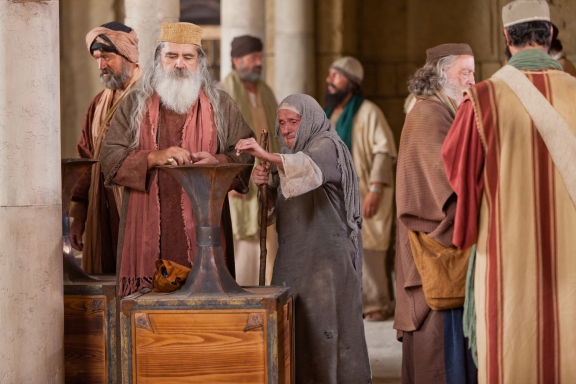
the-widow-gives-her-tithe


An important topic today is the Biblical doctrine of Tithe.  This is an especially popular teaching with regards to the prosperity gospel that has taken the world by storm.  To that end I am going to walk through the Bible starting in the Old Testament passages on Tithe and work my way to the New.

If you are unfamiliar with the doctrine of the New Covenant I recommend you read up on that first by clicking HERE.


Do we have to give 10%? Is that a law?


The short answer is “no”.  In truth, 10% is a church tradition not a Biblical law or even principle.  Where do we see the concept of giving 10% in the Bible?


“After his return from the defeat of Chedorlaomer and the kings who were with him, the king of Sodom went out to meet him at the Valley of Shaveh (that is, the King’s Valley). And Melchizedek king of Salem brought out bread and wine. (He was priest of God Most High.) And he blessed him and said, “Blessed be Abram by God Most High, Possessor of heaven and earth; and blessed be God Most High, who has delivered your enemies into your hand!” And Abram gave him a tenth of everything.” Genesis 14:17-20 ESV


In ancient Mesopotamian culture it was a tradition for a King or Patriarch of some kind to donate a tenth of his spoils to a pagan god of his choosing.  The idea is that your favorite god may now choose to favor you in future battles.  Above we see that Abraham honors the true God in this fashion and chooses to give a tenth of his spoils to Melchizedek, the High Priest of God in that day.  We don’t see the direct connection in the text to this pagan tradition but it is interesting that it plays out this way.

The point is though that this is a one time historical event, not a prescriptive command.  It is also worth noting that this is the only time Abraham ever felt the need to do this.  We never see 10% as an on-going standard either descriptively or prescriptively.

Throughout the Torah we do see many commands to give money, particularly to the Levites as they had no inheritance of the land and had to live off what was given to them in tithes and offerings (Num 18:24).


“Every tithe of the land, whether of the seed of the land or of the fruit of the trees, is the Lord ‘s; it is holy to the Lord . If a man wishes to redeem some of his tithe, he shall add a fifth to it. And every tithe of herds and flocks, every tenth animal of all that pass under the herdsman’s staff, shall be holy to the Lord . One shall not differentiate between good or bad, neither shall he make a substitute for it; and if he does substitute for it, then both it and the substitute shall be holy; it shall not be redeemed.” These are the commandments that the Lord commanded Moses for the people of Israel on Mount Sinai.” Leviticus 27:30-34 ESV


Above we see that both a tenth and a fifth is commanded of different things to be given in tithe.  So a strict 10% isn’t necessarily consistent here either, it depends on what you’re talking about.  I found a GotQuestions article online that addresses the issue of percentage very well in the old testament:


“Tithing is an Old Testament concept. The tithe was a requirement of the Law in which the Israelites were to give 10 percent of the crops they grew and the livestock they raised to the tabernacle/temple (Leviticus 27:30;Numbers 18:26; Deuteronomy 14:24; 2 Chronicles 31:5). In fact, the Old Testament Law required multiple tithes—one for the Levites, one for the use of the temple and the feasts, and one for the poor of the land—which would have pushed the total to around 23.3 percent. Some understand the Old Testament tithe as a method of taxation to provide for the needs of the priests and Levites in the sacrificial system.” –GotQuestions


An important thing to understand about ancient Israel is that they were a theocracy.  There was no separation between Church and state, the Church literally was the state.  Tithe in this system is simply taxes.  Furthermore, with the old covenant being obsolete (Heb 8:13) we shouldn’t even be turning to the old testament for laws on tithe or giving.  If your pastor is telling you not to “rob God” (Malachi 3:6-12) and pay up in tithe that is an indicator that he has not properly divided his covenants.  If this is a new concept to you I recommend you read my series on the New Covenant.


New Covenant Tithe (taxes!)


The Christian Church is not a theocracy.  We exist in many Christian and secular countries across the world.  Though there are laws pertaining to this in the new covenant they are not nearly as extensive as those we find in the old.  At its most basic the government is responsible to enforce the Moral Law of God and be a curb against sin.  When they fail in this it is God’s place to judge them not ours as the Church (Rom 13).

Because of this we are commanded to pay our new covenant tithe, which is taxes.  Furthermore, there is no strict percentage.  It ultimately amounts to whatever the government deems prudent.  We are supposed to pay it and complain to God if we have a problem with it so that he can judge them, not to the Government.


“For because of this you also pay taxes, for the authorities are ministers of God, attending to this very thing.  Pay to all what is owed to them: taxes to whom taxes are owed, revenue to whom revenue is owed, respect to whom respect is owed, honor to whom honor is owed.” Rom 13:6-7 ESV

“Show me the coin for the tax.” And they brought him a denarius.  And Jesus said to them, “Whose likeness and inscription is this?”  They said, “Caesar’s.” Then he said to them, “Therefore render to Caesar the things that are Caesar’s, and to God the things that are God’s.” Matt 22:19-21 ESV

If you pay your taxes to the government then you pay your tithe and don’t let anyone else tell you otherwise.  Being anti-government is very popular these days but we would be wise to remember that God has placed them here for a reason.


New Covenant Giving


Here is where we get down to the brass tax.  Are we commanded to give in the New Covenant and if so how much?


“Let the elders who rule well be considered worthy of double honor, especially those who labor in preaching and teaching.  For the Scripture says, “You shall not muzzle an ox when it treads out the grain,” and, “The laborer deserves his wages.” 1 Tim 5:17-18 ESV

Above we see that the Pastor needs to get a paycheck.  Hey, that’s fair!  He works hard and preaches the Gospel, he needs to be cared for and paid fairly.  That doesn’t mean he needs a 60 million dollar jet, but we shouldn’t be making him buy 20 year old cars and wearing 1970’s suits with those goofy ties from the thrift store either.  He should receive a fair wage in line with his education and experience.

What should be our attitude about New Covenant giving?  The scripture says we should be cheerful about it.


“So I thought it necessary to urge the brothers to go on ahead to you and arrange in advance for the gift you have promised, so that it may be ready as a willing gift, not as an exaction. The point is this: whoever sows sparingly will also reap sparingly, and whoever sows bountifully will also reap bountifully. Each one must give as he has decided in his heart, not reluctantly or under compulsion, for God loves a cheerful giver. And God is able to make all grace abound to you, so that having all sufficiency in all things at all times, you may abound in every good work. As it is written, “He has distributed freely, he has given to the poor; his righteousness endures forever.” He who supplies seed to the sower and bread for food will supply and multiply your seed for sowing and increase the harvest of your righteousness. You will be enriched in every way to be generous in every way, which through us will produce thanksgiving to God. For the ministry of this service is not only supplying the needs of the saints but is also overflowing in many thanksgivings to God. By their approval of this service, they will glorify God because of your submission that comes from your confession of the gospel of Christ, and the generosity of your contribution for them and for all others, while they long for you and pray for you, because of the surpassing grace of God upon you. Thanks be to God for his inexpressible gift!” 2 Corinthians 9:5-15 ESV


Some will twist the above passage to say that if you give more money you will get more back somehow some way.  Read the passage carefully word for word, nowhere does it directly promise proportional monetary returns on your offerings.  Only a first world capitalist mind is capable of reading this into the text.

It does promise blessings but it does not specify them as monetary in nature.  And we know this to be true.  The Church uses our offerings to hire pastors and missionaries that preach the Gospel.  One plants, another waters, and God provides the increase.  In this the kingdom of God grows and this is the greatest blessing ever.  Money will rot and burn but those saved by the Gospel of Christ will be a blessing in your life for all eternity.

Besides that, charitable giving with the expectation of receiving money for yourself is not giving cheerfully, it is giving in a selfish manner and should be condemned.

This is not to say that God does not bless his sheep monetarily.  But there is no magic button where you can be 100% sure that he will bless you in this regard.  Even the apostles themselves faced impoverished and grisly ends.  We should trust all we have and all we are to God, if he blesses one in riches praise the Lord, if he blesses one in poverty and tribulation then praise the Lord.  In all things Praise the Lord.

So the question remains, how much should we give?  The apostolic teachings of the new covenant do not give a cut and dry percentage.  We should give as much as we can.  I don’t believe we should impoverish our families or deny our children what they need to give instead to the church.  But there is nothing wrong with sacrificing a few extras when possible.  There is nothing wrong with 10% either, and that means there is nothing wrong with more than 10%.  Do as Paul says, give as much as you can cheerfully.


Posted in Armchair Lounge, Heresy & Heterodoxy | Tagged | 9 Comments

Penal Substitutionary Atonement

jesus-christ-death-cross-wide (1)


Believe it or not there are actually a lot of people who outright deny Penal Substitutionary Atonement.  Though anyone reading my blog is familiar with the concept not everyone is familiar with the term so here is the definition from Theopedia.


“Penal substitutionary atonement refers to the doctrine that Christ died on the cross as a substitute for sinners. God imputed the guilt of our sins to Christ, and he, in our place, bore the punishment that we deserve. This was a full payment for sins, which satisfied both the wrath and the righteousness of God, so that He could forgive sinners without compromising His own holy standard.” – Theopedia


Before studying this topic I highly recommend that the reader take a look at one of my earlier posts on the Holiness, Wrath, and Love of God.  This will give you the theological framework and foundation necessary for the Penal Substitutionary Atonement to make any sense.  And when people attack it, I find that their primary flaw is a failure of properly understanding those three doctrines and how they fit together.

I have analyzed the various arguments that I can find by those who deny Penal Substitutionary Atonement.  My discernment is that they use one of three approaches:

  1. Historical Approach
  2. Philosophical Approach
  3. Biblical Approach

That being the case I am going to present my findings of each and then demonstrate my view and why.  The reader may be the judge, please leave a comment if you feel I have missed something important.


Penal Substitution: Denial from History


This is the most common argument.  The author will usually assert that the Penal Substitution doctrine doesn’t exist at all in the early church.  I have very consistently found that deniers will first present that Christus Victor was the dominant view for the first thousand years of Christianity and then concluded that it must be the only correct view.  This is based largely on the work of Gustaf Aulén’s book, Christus Victor: An Historical Study of the Three Main Types of the Atonement.

The flaw with this approach is the assumption of exclusivity that goes along with it.  Just because God accomplished victory over the Devil in the atonement doesn’t mean that this is the only thing he did.


“11 In whom also ye are circumcised with the circumcision made without hands, in putting off the body of the sins of the flesh by the circumcision of Christ:; 12 Buried with him in baptism, wherein also ye are risen with him through the faith of the operation of God, who hath raised him from the dead.; 13 And you, being dead in your sins and the uncircumcision of your flesh, hath he quickened together with him, having forgiven you all trespasses; 14 Blotting out the handwriting of ordinances that was against us, which was contrary to us, and took it out of the way, nailing it to his cross; 15 And having spoiled principalities and powers, he made a shew of them openly, triumphing over them in it. 16 Let no man therefore judge you in meat, or in drink, or in respect of an holyday, or of the new moon, or of the sabbath days: 17 Which are a shadow of things to come; but the body is of Christ.” Col 2:11-17 KJV


Above is just one proof-text out of many regarding Christ crushing the head of the snake (Gen 3:15).  This is true, in the incarnation his infant feet crushed the head of Satan as if the Devil didn’t even matter.  This is because he doesn’t matter and Christ is the victor.  My issues are when people say this is the ONLY thing that Christ accomplished on the cross, and that Penal Substitution didn’t exist in the early Church.  It most certainly did, it has existed as a doctrine throughout the history of the Church, we just didn’t give it a clear name until later that’s all.  Similarly, the doctrine of the Trinity can be found in the first century writings of the Apostles and in Patristic writings, we just didn’t have a nice fancy theological word for it until later.

The fact is that the doctrine of Penal Substitutionary Atonement is as old as the hills.  Both Christus Victor and Penal Substitution are ancient and true Biblical Doctrines at the same time.  The teaching that pits them against each other is a false dichotomy.  Review a sample of Ante Nicene Church fathers below and see for yourself.

Each quote is individually cited, but if you want my source for locating them all together you can find that HERE.


“Because of the love he felt for us, Jesus Christ our Lord gave his blood for us by the will of God, his body for our bodies, and his soul for our souls.”  Clement, First Epistle of Clement to the Corinthians 49, in The Ante-Nicene Fathers, eds. Alexander Roberts and James Donaldson, 10 vols. (Peabody, Mass: Hendrickson, 1994) 1:18.

 “Now, He suffered all these things for our sakes, that we might be saved.” Ignatius, Epistle of Ignatius to the Smyrnaeans 2, The Ante-Nicene Fathers, 1:87.

For to this end the Lord endured to deliver up His flesh to corruption, that we might be sanctified through the remission of sins, which is effected by His blood of sprinkling. For it is written concerning Him, partly with reference to Israel, and partly to us; and [the Scripture] saith thus: “He was wounded for our transgressions, and bruised for our iniquities: with His stripes we are healed. He was brought as a sheep to the slaughter, and as a lamb which is dumb before its shearer.” Epistle of Barnabas 5, The Ante-Nicene Fathers, 1:139

“Moreover, when fixed to the cross, He had given Him to drink vinegar and gall. Hearken how the priests of the people gave previous indications of this. His commandment having been written, the Lord enjoined, that whosoever did not keep the fast should be put to death, because He also Himself was to offer in sacrifice for our sins the vessel of the Spirit, in order that the type established in Isaac when he was offered upon the altar might be fully accomplished.” Epistle of Barnabas 7, The Ante-Nicene Fathers, 1:141

“For the whole human race will be found to be under a curse. For it is written in the law of Moses, ‘Cursed is every one that continueth not in all things that are written in the book of the law to do them’ [Deut 27:26]. And no one has accurately done all, nor will you venture to deny this; but some more and some less than others have observed the ordinances enjoined. But if those who are under this law appear to be under a curse for not having observed all the requirements, how much more shall all the nations appear to be under a curse who practise idolatry, who seduce youths, and commit other crimes? If, then, the Father of all wished His Christ for the whole human family to take upon Him the curses of all, knowing that, after He had been crucified and was dead, He would raise Him up, why do you argue about Him, who submitted to suffer these things according to the Father’s will, as if He were accursed, and do not rather bewail yourselves? For although His Father caused Him to suffer these things in behalf of the human family, yet you did not commit the deed as in obedience to the will of God.” Justin Martyr, Dialogue with Trypho 95, The Ante-Nicene Fathers, 1:247


Many doctrines were clarified and expounded upon in the reformation, but they were not new.  It was a conservative movement not a Liberal one.  My only guess that that those who deny this doctrine either have a very low view of scripture or don’t expect anyone to critically double check their work.


Penal Substitution: Denial from Philosophy


I am not going to address every Philosophical argument as it would be too long and I don’t believe doing so is necessary.  Instead, I will examine some of the more prominent arguments below and why I disagree.

Argument #1 “Penal Substitution denies the Trinity”

This argument is just silly, yet still I cannot believe how often I see it from those who deny Penal Substitution.  In an effort not to misrepresent the position I am going to quote it directly from HERE.

“If Christ died for, and is our solution to, our sins against god the Father, then what about our sins against Christ? He’s just as god as the Father is. or our sins against the Holy Spirit? With penal substitution, God is pitted against God, either dividing God (and thus destroying the Trinity) or saying that Christ isn’t fully god.”


I don’t have a categorical problem with using philosophy in theology but it should not be used in a magisteral manner as the writer above does.  To illustrate my point, he needs a clear verse saying “Christ did not die for our sins” rather than to try to twist the doctrine of the Trinity against it.

Second, we are free to resolve philosophical issues with whatever manner stays in compliance with clear scripture.  Since the Bible is clear that Jesus did die as a substitute for sin (see passages below), and the Bible is clear on the Trinity, then we are to either use philosophy in a way that brings the two together or accept that we cannot and hold the teachings in tension.  But we should never abrogate one passage of clear scripture with another.

To address the argument philosophically, I would argue that the flesh of Christ died according to his human nature but that his spirit descended to hell according to the divine (1Pet 3:18-20).  In this act he has triumphed over our sins destroying them in his flesh, and rose new in body on Sunday morning.  Rather than Penal Substitution being a denial of the Trinity, the author of the above accusation is simply ignorant or in denial of the Two Natures of Christ and how such a doctrine allows for God to both exist in hell and punish himself in the flesh at the same time.  This Biblical teaching allows for both the Trinity and the Penal Substitution to co-exist simultaneously with no philosophical conflict.

I have not yet blogged at length on the Two natures of Christ, for a full breakdown by a reputable source please click HERE.


Argument #2 “Penal Substitution isn’t Loving”

This is one of the arguments that makes me angry.  The assertion is that if Penal Substitution is true then that means God’s love is not unconditional.  This argument asks the reader to bring their own definition of the Love of God to the table.  The problem is that the Bible defines the Love of God in the Penal Substitutionary atonement.  So in a very real sense to assert that such is unloving the one making the argument denies the Love of God altogether.


“But God commendeth his love toward us, in that, while we were yet sinners, Christ died for us.” Rom 5:8 KJV


To fall for that gag you have to just not read your Bible or care much for what it says.  If you define Unconditional Love as the Bible does there is no conflict.  If you define it as the world does then there is, I will certainly concede to that.  Let the debate be on how we define our terms rather than the atonement and then move from there.


Argument #3 “Jesus didn’t die for our sins”


No joke, this is actually a big problem that some have with the Penal Substitution doctrine, they reject the notion of Christ dying for our sins.  Don’t believe me?  Click HERE and see for yourself.  The jist of the argument is as follows:

“If god’s justice demands that He punish sin, then there is a higher force than God—necessity—which determines what God can and cannot do.” – Orthodox Problems with Penal Subustition

To that my only response is the following:


“For I delivered unto you first of all that which I also received, how that Christ died for our sins according to the scriptures” 1 Cor 15:3 KJV


If you are going to philosophically assert that Christ did not die for our sins then obviously our issue isn’t the doctrine of the atonement it is how seriously we are to take scripture, and we should instead be speaking about that.  This one is simply too clear to question.

To address it philosophically though I would argue that God is not compelled to act by any force outside of himself.  The holiness, wrath and by extension justice of God are attributes that come from him not outside of him, in like manner so is his love.  He is not compelled by any outside force to act at all and quite frankly we are lucky that he chose to because we don’t deserve it.

The sophistry presented by some to refute penal substitutionary atonement isn’t even good sophistry.  It relies on definitions of justice that are outside of God to govern God, in this their reasoning is circular.  Biblically, justice is defined by God’s desires and actions and cannot be removed from his nature.  Thus whatever he does is what actually defines justice in the first place, which in my estimation renders the argument moot.

There are other philosophical arguments but I believe I have demonstrated enough for the average reader.  If you feel I have left something critical out please drop a comment down below.


Penal Substitution: Denial from the Bible


“Scripture says one cannot die for another”


This one doesn’t make me so angry as some of the others, if this is the only reason one denies the doctrine at least they are starting from scripture.  I honestly understand how the average reader could get confused here when the passage is taken out of context.  Critical analysis in context though can easily reveal the error.


“14 Thou shalt not oppress an hired servant that is poor and needy, whether he be of thy brethren, or of thy strangers that are in thy land within thy gates: 15 At his day thou shalt give him his hire, neither shall the sun go down upon it; for he is poor, and setteth his heart upon it: lest he cry against thee unto the Lord, and it be sin unto thee. 16 The fathers shall not be put to death for the children, neither shall the children be put to death for the fathers: every man shall be put to death for his own sin. 17 Thou shalt not pervert the judgment of the stranger, nor of the fatherless; nor take a widow’s raiment to pledge: 18 But thou shalt remember that thou wast a bondman in Egypt, and the Lord thy God redeemed thee thence: therefore I command thee to do this thing.” Deu 24:14-18 KJV


The obvious answer is that the above passage is not teaching about the atonement at all.  Instead you have a piece of prescriptive civil law as part of the now obsolete Torah (Heb 8:13).  If you want to use it definitively to understand new covenant law in a Third Use sense then go for it.  The atonement however applies in the second use of the law, to confuse it with the third would ultimately obfuscate the Gospel.

To respond full though let’s see what the Bible says about this doctrine.  Ultimately that is what matters.  History and Philosophy, though they have their place, should always take a back seat to clear scripture.


“Who his own self bare our sins in his own body on the tree, that we, being dead to sins, should live unto righteousness: by whose stripes ye were healed.” 1 Peter 2: 24 KJV

“But he was wounded for our transgressions, he was bruised for our iniquities: the chastisement of our peace was upon him; and with his stripes we are healed.;  All we like sheep have gone astray; we have turned every one to his own way; and the Lord hath laid on him the iniquity of us all.” Isaiah 53:5-6 KJV

“For I delivered unto you first of all that which I also received, how that Christ died for our sins according to the scriptures” 1 Cor 15:3 KJV

“Blotting out the handwriting of ordinances that was against us, which was contrary to us, and took it out of the way, nailing it to his crossCol 2:14 KJV

“So Christ was once offered to bear the sins of many; and unto them that look for him shall he appear the second time without sin unto salvation.” Heb 9:28 KJV

“Saying, Blessed are they whose iniquities are forgiven, and whose sins are covered. Blessed is the man to whom the Lord will not impute sin.” Rom 4:7-8 KJV

“Who was delivered for our offences, and was raised again for our justification.” Rom 4:25 KJV


Above in Romans 4 we see both the Penal and the Substitution.  We see that the purpose of bearing out offenses in Substitution was for our “penal” Justification.


“For he hath made him to be sin for us, who knew no sin; that we might be made the righteousness of God in him.” 2 Cor 5:21 KJV

 “And be found in him, not having mine own righteousness, which is of the law, but that which is through the faith of Christ, the righteousness which is of God by faith That I may know him, and the power of his resurrection, and the fellowship of his sufferings, being made conformable unto his death” Php 3:9-10 KJV

 “In whom we have redemption through his blood, the forgiveness of sins, according to the riches of his grace” Eph 1:7 KJV

“Wherefore the law was our schoolmaster to bring us unto Christ, that we might be justified by faith.;  But after that faith is come, we are no longer under a schoolmaster.;  For ye are all the children of God by faith in Christ Jesus.;  For as many of you as have been baptized into Christ have put on Christ.” Gal 3:24-27 KJV


“bare our sins”

“for our transgressions”

“hath laid on him”

“Christ died for our sins”

“bear the sins”

“made him to be sin”

“for us”

“will not impute sin”

“have put on Christ”

“we have redemption”

“have been baptized”


Look carefully at the verbs and nouns above, who is doing the bearing of sins?  Who is doing the receiving of redemption and righteousness?  Jesus did die for our sins and whoever tells you otherwise is in open rebellion to the Word of God and needs to repent.


Posted in Armchair Lounge, Soteriology | Tagged | 8 Comments

Hardening of the Heart

burdened heart


Why is it that God died for everyone (1 Tim 2:4-6) yet some still go to hell?  I don’t find that this is a question that the Bible fully answers.  No matter how much we press there are philosophical conflicts unless one is willing to ignore clear passages on the former or the latter.

What does help with understanding this conundrum a little bit is the Biblical doctrine of the hardening of the heart.  Before digging in I will attempt to define this term with scripture.  After that I will attempt to answer the following questions from scripture:

  1. Does God harden the heart of man so that he cannot believe?
  2. Does Man harden his own heart so that he cannot believe?
  3. Or is it a synergism of both of the above?

I have found that different Christian traditions teach one of the above three in line with their other theological or philosophical conclusions.  I am fully aware that Lutherans teach #3, but going into this study I honestly didn’t know what I would find.  Take a look below and tell me what you think in the comments after you’re done.


The Biblical Heart


In Modern English the word heart most often refers to an organ in your chest which pumps blood to the rest of the body.  In the Bible we see a more broad use of the term.  It has more to do with ones intellect, reasoning, judgement, and or desires.


“Let not your heart be troubled: ye believe in God, believe also in me.” John 14:1 KJV

“But I say unto you, That whosoever looketh on a woman to lust after her hath committed adultery with her already in his heart.” Matt 5:28 KJV

“Speaking to yourselves in psalms and hymns and spiritual songs, singing and making melody in your heart to the Lord” Eph 5:19 KJV

“And God saw that the wickedness of man was great in the earth, and that every imagination of the thoughts of his heart was only evil continually.” Gen 6:5 KJV

“Take heed, brethren, lest there be in any of you an evil heart of unbelief, in departing from the living God.” Heb 3:12 KJV

“And immediately when Jesus perceived in his spirit that they so reasoned within themselves, he said unto them, Why reason ye these things in your hearts?Mark 2:8 KJV

“For with the heart man believeth unto righteousness; and with the mouth confession is made unto salvation.” Rom 10:10 KJV

“For verily I say unto you, That whosoever shall say unto this mountain, Be thou removed, and be thou cast into the sea; and shall not doubt in his heart, but shall believe that those things which he saith shall come to pass; he shall have whatsoever he saith.” Mark 11:23 KJV


What I want to narrow in on is the belief factor of the Heart.  We are Justified by Grace alone through Faith alone.  As demonstrated in my post on Faith, belief in Christ is something we would expect to see present in a heart of one who is Justified by Grace.  For without regeneration the scripture speaks of us as spiritually dead.


“The heart is deceitful above all things, and desperately wicked: who can know it?” Jer 17:9 KJV

“1 And you hath he quickened, who were dead in trespasses and sins; 2 Wherein in time past ye walked according to the course of this world,according to the prince of the power of the air, the spirit that now worketh in the children of disobedience:; 3 Among whom also we all had our conversation in times past in the lusts of our flesh, fulfilling the desires of the flesh and of the mind; and were by nature the children of wrath, even as others.” Eph 2:1-3 KJV

“Who hath delivered us from the power of darkness, and hath translated us into the kingdom of his dear Son” Col 1:13 KJV


As I have demonstrated in other posts, God uses means to give faith to the unbeliever.  This regenerates and creates belief in the heart (Eph 2:8-9) (Rom 10:14:-17).  Can this be hindered though?  Can something prevent this miracle of belief from taking place?  Biblically the answer is yes, in scripture this is referred to as a hardening of the heart.


Hardened by God


One of the more difficult things for me to accept has been that God can and does harden hearts in unbelief.  The most often quoted example of this is with Pharaoh.


“7 And Pharaoh sent, and, behold, there was not one of the cattle of the Israelites dead. And the heart of Pharaoh was hardened, and he did not let the people go……

12 And the Lord hardened the heart of Pharaoh, and he hearkened not unto them; as the Lord had spoken unto Moses……

34 And when Pharaoh saw that the rain and the hail and the thunders were ceased, he sinned yet more, and hardened his heart, he and his servants. 35 And the heart of Pharaoh was hardened, neither would he let the children of Israel go; as the Lord had spoken by Moses.” Exodus 9:7, 12, 34-35 KJV


Above we see that it specifically states that Pharaoh’s heart was hardened by God, it also says it was hardened in other cases but doesn’t state by whom.  Is this a synergistic hardening where Pharaoh was helping God harden his heart or is this more monergistic?  We don’t know from this passage.  What we do know though is that in some capacity part or whole it was most certainly done to him by God.  This is made more clear by a cross reference in Romans below:


“14 What shall we say then? Is there unrighteousness with God? God forbid. 15 For he saith to Moses, I will have mercy on whom I will have mercy, and I will have compassion on whom I will have compassion. 16 So then it is not of him that willeth, nor of him that runneth, but of God that sheweth mercy. 17 For the scripture saith unto Pharaoh, Even for this same purpose have I raised thee up, that I might shew my power in thee, and that my name might be declared throughout all the earth. 18 Therefore hath he mercy on whom he will have mercy, and whom he will he hardeneth. 19 Thou wilt say then unto me, Why doth he yet find fault? For who hath resisted his will? 20 Nay but, O man, who art thou that repliest against God? Shall the thing formed say to him that formed it, Why hast thou made me thus? 21 Hath not the potter power over the clay, of the same lump to make one vessel unto honour, and another unto dishonour? 22 What if God, willing to shew his wrath, and to make his power known, endured with much longsuffering the vessels of wrath fitted to destruction: 23 And that he might make known the riches of his glory on the vessels of mercy, which he had afore prepared unto glory, 24 Even us, whom he hath called, not of the Jews only, but also of the Gentiles?” Rom 9:14-24 KJV


What is clear from the above passage is that Pharaoh and all of us are God’s creation.  He has every right to harden or soften the hearts of his creatures as he wills to do so.  In his hands we are the clay of the potter.  He can and does create us for the purposes of his wrath or mercy.


“8 Also I heard the voice of the Lord, saying, Whom shall I send, and who will go for us? Then said I, Here am I; send me.; 9 And he said, Go, and tell this people, Hear ye indeed, but understand not; and see ye indeed, but perceive not. 10 Make the heart of this people fat, and make their ears heavy, and shut their eyes; lest they see with their eyes, and hear with their ears, and understand with their heart, and convert, and be healed.” Isaiah 6:8-10 KJV


Above we see a very specific example of where God wants people to hear the word but not believe.  For this purpose their heart is hardened so that they may stumble and fall in faithlessness.  This is indeed a judgment of God, not one they must wait for to receive in hellfire, but one that they receive here and now.


“11 He answered and said unto them, Because it is given unto you to know the mysteries of the kingdom of heaven, but to them it is not given. 12 For whosoever hath, to him shall be given, and he shall have more abundance: but whosoever hath not, from him shall be taken away even that he hath. 13 Therefore speak I to them in parables: because they seeing see not; and hearing they hear not, neither do they understand. 14 And in them is fulfilled the prophecy of Esaias, which saith, By hearing ye shall hear, and shall not understand; and seeing ye shall see, and shall not perceive: 15 For this people’s heart is waxed gross, and their ears are dull of hearing, and their eyes they have closed; lest at any time they should see with their eyes, and hear with their ears, and should understand with their heart, and should be converted, and I should heal them. 16 But blessed are your eyes, for they see: and your ears, for they hear. Matt 13:11-16 KJV


I believe I have at the very least demonstrated from scripture that God can and does harden hearts against faith so that some may never believe.  Or at the very least are withheld for a time.  Another good passage on this is Romans 11, I would recommend reading the whole thing.  I am going to post a few of the key proof-texts below though.


“7 What then? Israel hath not obtained that which he seeketh for; but the election hath obtained it, and the rest were blinded” 8  (According as it is written, God hath given them the spirit of slumber, eyes that they should not see, and ears that they should not hear;) unto this day. And David saith, Let their table be made a snare, and a trap, and a stumblingblock, and a recompence unto them: 10 Let their eyes be darkened, that they may not see, and bow down their back alway…  

…”16 For if the firstfruit be holy, the lump is also holy: and if the root be holy, so are the branches. 17 And if some of the branches be broken off, and thou, being a wild olive tree, wert grafted in among them, and with them partakest of the root and fatness of the olive tree; 18 Boast not against the branches. But if thou boast, thou bearest not the root, but the root thee. 19 Thou wilt say then, The branches were broken off, that I might be grafted in. 20 Well; because of unbelief they were broken off, and thou standest by faith. Be not highminded, but fear: 21 For if God spared not the natural branches, take heed lest he also spare not thee. 22 Behold therefore the goodness and severity of God: on them which fell, severity; but toward thee, goodness, if thou continue in his goodness: otherwise thou also shalt be cut off.”…

25 For I would not, brethren, that ye should be ignorant of this mystery, lest ye should be wise in your own conceits; that blindness in part is happened to Israel, until the fulness of the Gentiles be come in.” Rom 11:7-10, 16-22, 25 KJV


Hardened by Man


Another teaching in scripture is that man hardens his own heart to God.  I would argue that there is enough overlap with this teaching in scripture to say this can work either independently or synergistically with a divine judgement of a hardness of heart.


“7 For he is our God; and we are the people of his pasture, and the sheep of his hand. To day if ye will hear his voice, 8 Harden not your heart, as in the provocation, and as in the day of temptation in the wilderness: 9 When your fathers tempted me, proved me, and saw my work. 10 Forty years long was I grieved with this generation, and said, It is a people that do err in their heart, and they have not known my ways” Psa 95:7-10 KJV

“13 He that covereth his sins shall not prosper: but whoso confesseth and forsaketh them shall have mercy.; 14 Happy is the man that feareth alway: but he that hardeneth his heart shall fall into mischief.” Prov 28:13-14 KJV

“12 Yea, they made their hearts as an adamant stone, lest they should hear the law, and the words which the Lord of hosts hath sent in his spirit by the former prophets: therefore came a great wrath from the Lord of hosts. 13 Therefore it is come to pass, that as he cried, and they would not hear; so they cried, and I would not hear, saith the Lord of hosts” Zec 7:12-13 KJV

“5 But after thy hardness and impenitent heart treasurest up unto thyself wrath against the day of wrath and revelation of the righteous judgment of God” Rom 2:5 KJV

“7 If there be among you a poor man of one of thy brethren within any of thy gates in thy land which the Lord thy God giveth thee, thou shalt not harden thine heart, nor shut thine hand from thy poor brother” Deu 15:7 KJV

“8 Harden not your hearts, as in the provocation, in the day of temptation in the wilderness” Heb 3:8 KJV

“48 He that rejecteth me, and receiveth not my words, hath one that judgeth him: the word that I have spoken, the same shall judge him in the last day.” John 12:48 KJV

“22 Fear ye not me? saith the Lord: will ye not tremble at my presence, which have placed the sand for the bound of the sea by a perpetual decree, that it cannot pass it: and though the waves thereof toss themselves, yet can they not prevail; though they roar, yet can they not pass over it?; 23 But this people hath a revolting and a rebellious heart; they are revolted and gone.; 24 Neither say they in their heart, Let us now fear the Lord our God, that giveth rain, both the former and the latter, in his season: he reserveth unto us the appointed weeks of the harvest.; 25 Your iniquities have turned away these things, and your sins have withholden good things from you.” Jer 5:22-25 KJV

“18 Hear ye therefore the parable of the sower. 19 When any one heareth the word of the kingdom, and understandeth it not, then cometh the wicked one, and catcheth away that which was sown in his heart. This is he which received seed by the way side. 20 But he that received the seed into stony places, the same is he that heareth the word, and anon with joy receiveth it; 21 Yet hath he not root in himself, but dureth for a while: for when tribulation or persecution ariseth because of the word, by and by he is offended. 22 He also that received seed among the thorns is he that heareth the word; and the care of this world, and the deceitfulness of riches, choke the word, and he becometh unfruitful. 23 But he that received seed into the good ground is he that heareth the word, and understandeth it; which also beareth fruit, and bringeth forth, some an hundredfold, some sixty, some thirty.” Matt 13:3-23 KJV

Notice especially the verb noun association in the above passages

people that do err”

“he that hardeneth”

they made”

thy hardness and impenitent”

thou shalt not harden”

Neither say they”

“Harden not your hearts”

He that rejecteth me”

“[He that] receiveth not my words”

Then Juxtapose against the verb noun associations in the verses related to God hardening the heart previously discussed

“the Lord hardened”

“whom he will he hardeneth”

“Hath not the potter power over the clay”

“vessels of wrath”

“Make the heart of this people fat”

“and the rest were blinded”

“God hath given them the spirit of slumber”

“God spared not the natural branches”

“blindness in part is happened to”


Juxtapose both of those trees above against each other.  Clearly there are two teachings on the source of hardness of heart in the Bible.  One is God hardening the heart of man as a form of judgement and the other is man hardening his own heart.

How do these fit together with the cross?  This is part of what Lutherans call the Crux Theologorum (problem of the cross).  Getting into the details of that is beyond the scope of this post.  My goal is simply to answer the questions at the onset of the post.  I will dig deeper in future studies.  To that end I believe I have demonstrated that the Bible teaches both God and Man can and do harden the heart.


Conclusion


If you didn’t notice this teaching from the scriptures creates some glaring problems with both the Calvinist teaching of Irresistible Grace and the Arminian teaching of Libertarian Free Will.  Not only can man resist Grace (Gratia Universalis) by hardening his heart, but sometimes God for his own reasons imposes that hardening.

This is one of the reasons why I believe Lutherans are correct in confessing Monergism with regards to Justification and Synergism with regards to damnation.  Also, this confession allows one to accept all passages on this teaching as true rather than abrogating one thesis with the other as both Calvinists and Arminians do.

Clearly there are philosophical disputes one can and should have with what I presented above.  I have them myself, but at the end of the day I think it is best we accept a bit of mystery and or paradox rather than try to iron out or hide passages in scripture that conflict with tradition or personal beliefs.


Posted in Armchair Lounge, Soteriology | Tagged | 7 Comments

Justification

MartinLutherPreachingtoFaithful1561noticechasublecrucifix_zps9669e67a (1)

This post has been a long time coming, once you read it you will see that much of the work I have done on salvation over the past year has been building up to this one.  My apologies ahead of time for the length, but I want to do it justice and I don’t want to break it up into a series.

CARM defines the Biblical term Justification as follows:

“To be justified is to declared legally righteous. It is a divine act where God declares the sinner to be innocent of his sins.”

I agree with this definition but it is important to define our terms Biblically.  This is even more important with the word Justification as it is not only central to the Gospel, but to the Biblical narrative as a whole.  Because of it’s importance I am going to overkill defining this word.


Biblically Defining Justification


“For if Abraham was justified by works, he has something to boast about, but not before God. For what does the Scripture say? “Abraham believed God, and it was counted to him as righteousness.” Now to the one who works, his wages are not counted as a gift but as his due. And to the one who does not work but believes in him who justifies the ungodly, his faith is counted as righteousness, just as David also speaks of the blessing of the one to whom God counts righteousness apart from works: “Blessed are those whose lawless deeds are forgiven, and whose sins are covered; blessed is the man against whom the Lord will not count his sin.” Is this blessing then only for the circumcised, or also for the uncircumcised? For we say that faith was counted to Abraham as righteousness.” Romans 4:2-9 ESV


This is one of the clearest passages in scripture on Justification.  Paul opens up making it painfully obvious that Abraham was not justified by works but rather credited by his belief.  This belief is counted to Abraham as righteousness.  I would understand it as a form of currency exchange, in this case belief being of a higher value than works as simply believing counts for the whole sinless life of Christ on your behalf.

Notice that it says “to the one who works, his wages are are not counted as a gift but as his due”.  This is just common sense.  When you receive your paycheck from the boss is it a gift or does he owe it to you?  Your boss isn’t doing you any favors, he is paying you what is owed.  Rather we are directed to receive what is not earned for the text juxtaposes the next statement over the prior in that “to the one who does not work but believes in him who justifies the ungodly, his faith is counted as righteousness”.  This is an either or dichotomy, you can’t have both here at the same time as Paul makes this distinction between the two very clear.


Or do you not know that the unrighteous will not inherit the kingdom of God? Do not be deceived: neither the sexually immoral, nor idolaters, nor adulterers, nor men who practice homosexuality, nor thieves, nor the greedy, nor drunkards, nor revilers, nor swindlers will inherit the kingdom of God.  And such were some of you. But you were washed, you were sanctified, you were justified in the name of the Lord Jesus Christ and by the Spirit of our God.” 1 Cor 6:9-11 ESV


Above we see the same dichotomy mentioned in Romans played out in Paul’s teaching to the addresses.  In one category he is speaking of what they had earned with all their works, specifically death and hell.  But because of belief in Christ they are “sanctified” and “justified” in the past tense.  This verse is why I prefer not to use the word sanctification in the sense of an on-going process.  I am not denying new obedience, I am just downgrading it soteriologically speaking that’s all.  I would argue that in verse 11 sanctification is how God sees us in light of Justification, that is, we are set apart in Christ.


“For our sake he made him to be sin who knew no sin, so that in him we might become the righteousness of God.” 2 Cor 5:21 ESV

“8 Indeed, I count everything as loss because of the surpassing worth of knowing Christ Jesus my Lord. For his sake I have suffered the loss of all things and count them as rubbish, in order that I may gain Christ and be found in him, not having a righteousness of my own that comes from the law, but that which comes through faith in Christ, the righteousness from God that depends on faith10 that I may know him and the power of his resurrection, and may share his sufferings, becoming like him in his death, 11 that by any means possible I may attain the resurrection from the dead. 12 Not that I have already obtained this or am already perfect, but I press on to make it my own, because Christ Jesus has made me his own.” Philippians 3:8-12 ESV


Above we see that our righteousness is received in faith, the same language found in Romans 4.  But this time Paul reiterates that we do NOT have the righteousness that is of our own from the law, but rather have that which comes through faith.  The same dichotomy, the same juxtaposition.  Again, one cannot see earning righteousness and receiving it as two concurrent things as they are very clearly set against each other in the Bible.

Not By the Law


As if the above were not sufficient we have numerous passages in the Bible clarifying that Justification is not of the Law.


You are severed from Christ, you who would be justified by the law; you have fallen away from grace.” Galatians 5:4 ESV

For by works of the law no human being will be justified in his sight, since through the law comes knowledge of sin.” Romans 3:20 ESV

“For by grace you have been saved through faith. And this is not your own doing; it is the gift of God,  not a result of works, so that no one may boast.” Ephesians 2:8-9 ESV

“For we hold that one is justified by faith apart from works of the law.” Romans 3:28 ESV

“I do not nullify the grace of God, for if righteousness were through the law, then Christ died for no purpose.” Galatians 2:21 ESV

“yet we know that a person is not justified by works of the law but through faith in Jesus Christ, so we also have believed in Christ Jesus, in order to be justified by faith in Christ and not by works of the law, because by works of the law no one will be justified.” Galatians 2:16 ESV

“and be found in him, not having a righteousness of my own that comes from the law, but that which comes through faith in Christ, the righteousness from God that depends on faith” Philippians 3:9 ESV

“And to the one who does not work but believes in him who justifies the ungodly, his faith is counted as righteousness” Romans 4:5 ESV


But by Faith

Below we see it is also clarified that justification is received by Faith in Christ.  With such a large council of scripture to this effect I don’t see how anything could be more obvious.


“Do not think that I will accuse you to the Father. There is one who accuses you: Moses, on whom you have set your hope.  For if you believed Moses, you would believe me; for he wrote of me. But if you do not believe his writings, how will you believe my words?” John 5:45-47 ESV

“But the words “it was counted to him” were not written for his sake alone, but for ours also. It will be counted to us who believe in him who raised from the dead Jesus our Lord, who was delivered up for our trespasses and raised for our justification.” Romans 4:23-25 ESV

“And such were some of you. But you were washed, you were sanctified, you were justified in the name of the Lord Jesus Christ and by the Spirit of our God.” 1 Corinthians 6:11-12 ESV

“Therefore, since we have been justified by faith, we have peace with God through our Lord Jesus Christ.” Romans 5:1 ESV

“Behold, his soul is puffed up; it is not upright within him,but the righteous shall live by his faith.” Habakkuk 2:8 ESV

“But to all who did receive him, who believed in his name, he gave the right to become children of God” John 1:12 ESV


Through Means


The gift of Faith from God is delivered to man in around and under earthly means.  It is important to understand this not only theologically but practically as well.  For example, I know I am born again because I am baptized.  This is an objective undeniable event with a date on it.  If I were to look to the burning in the bossom while the music is playing and the smoke and laser show is going on at Church instead the ultimate measure of Justification then becomes myself and my own heart (Jer 17:9-10).

If I instead look to the Biblical means by which God by his Grace gives Faith unto Justification then there is no reliance upon myself, but rather on God.

The Bible teaches that Faith is a Gift and that you are Justified through it.


“For by grace you have been saved through faith. And this is not your own doing; it is the gift of God” Ephesians 2:8 ESV


The logical question is since Grace is defined as an unmerited disposition of God toward man how does one receive Faith as a promise of this Grace?  Since Faith is the saving substance given by Grace then it follows logically that any passage teaching means of God’s saving act upon the believer is God giving that believer faith.  This is God’s act of Justification performed on the believer.

We see this work of God in Baptism:

Baptism, which corresponds to this, now saves you, not as a removal of dirt from the body but as an appeal to God for a good conscience, through the resurrection of Jesus Christ, I Peter 3:21 ESV

“Husbands, love your wives, as Christ loved the church and gave himself up for her,  that he might sanctify her, having cleansed her by the washing of water with the word, so that he might present the church to himself in splendor, without spot or wrinkle or any such thing, that she might be holy and without blemish.” Ephesians 5:25-27 ESV

In him also you were circumcised with a circumcision made without hands, by putting off the body of the flesh, by the circumcision of Christ, having been buried with him in baptism, in which you were also raised with him through faith in the powerful working of God, who raised him from the dead. Colossians 2:11-12 ESV

But when the goodness and loving kindness of God our Savior appeared, he saved us, not because of works done by us in righteousness, but according to his own mercy, by the washing of regeneration and renewal of the Holy Spirit, whom he poured out on us richly through Jesus Christ our Savior, so that being justified by his grace we might become heirs according to the hope of eternal life. Titus 3:4-7 ESV

Above we see that God’s act in baptism saves you and gives you faith.  Understood through systematic soteriological texts such as (Eph 2:8) this is the act of God giving faith to the recipient.  This is why we say Sola Fide (Faith Alone).


We see this work of God in Sacrament of the Altar:

“Now as they were eating, Jesus took bread, and after blessing it broke it and gave it to the disciples, and said, “Take, eat; this is my body.” 27 And he took a cup, and when he had given thanks he gave it to them, saying, “Drink of it, all of you, 28 for this is my blood of the covenant, which is poured out for many for the forgiveness of sins.” Matthew 26:26-28 ESV


Don’t miss above that the forgiveness of sins is received in the true Body and Blood of Christ.  This is the same Gift of faith received in Baptism.  By different means God accomplishes the same act of giving faith for it is by faith alone that one is forgiven of sins and counted as righteous.


26 Jesus answered them, “Truly, truly, I say to you, you are seeking me, not because you saw signs, but because you ate your fill of the loaves. 27 Do not work for the food that perishes, but for the food that endures to eternal life, which the Son of Man will give to you.…. 31

Our fathers ate the manna in the wilderness; as it is written, ‘He gave them bread from heaven to eat.’” 32 Jesus then said to them, “Truly, truly, I say to you, it was not Moses who gave you the bread from heaven, but my Father gives you the true bread from heaven. 33  For the bread of God is he who comes down from heaven and gives life to the world.”

34 They said to him, “Sir, give us this bread always.” 35 Jesus said to them, “I am the bread of life; whoever comes to me shall not hunger, and whoever believes in me shall never thirst…

47 Truly, truly, I say to you, whoever believes has eternal life. 48 I am the bread of life. 49 Your fathers ate the manna in the wilderness, and they died. 50 This is the bread that comes down from heaven, so that one may eat of it and not die.

51 I am the living bread that came down from heaven. If anyone eats of this bread, he will live forever. And the bread that I will give for the life of the world is my flesh.”

52 The Jews then disputed among themselves, saying, “How can this man give us his flesh to eat?” 53 So Jesus said to them, “Truly, truly, I say to you, unless you eat the flesh of the Son of Man and drink his blood, you have no life in you. 

54 Whoever feeds on my flesh and drinks my blood has eternal life, and I will raise him up on the last day.

55 For my flesh is true food, and my blood is true drink.

56 Whoever feeds on my flesh and drinks my blood abides in me, and I in him.

57 As the living Father sent me, and I live because of the Father, so whoever feeds on me, he also will live because of me.

58 This is the bread that came down from heaven, not like the bread the fathers ate, and died. Whoever feeds on this bread will live forever.” John 6:26-65 ESV

I have condensed the above passage for brevity, if you want to read the whole thing click HERE.

Again, the text promises that those who eat and drink the flesh and blood of Christ will abide in him and have eternal life.  This is the forgiveness of sins given in Faith, for it is our Faith that God counts as righteousness.

We see this work of God in the Preaching of the Word:

“How then will they call on him in whom they have not believed? And how are they to believe in him of whom they have never heard? And how are they to hear without someone preaching? ; And how are they to preach unless they are sent? As it is written, “How beautiful are the feet of those who preach the good news!” ; But they have not all obeyed the gospel. For Isaiah says, “Lord, who has believed what he has heard from us?” ; So faith comes from hearing, and hearing through the word of Christ.” Romans 10:14-17 ESV


Above we see that it is by the preaching of the Word of God in which the Holy Spirit has promised to give faith to the hearer.  Ultimately this is Holy Absolution, the forgiveness of sins given to you by the Preaching of Christs church.  We see in scripture that this is the binding and loosing of sins that Christ gives;

To Peter:

“And Jesus answered him, “Blessed are you, Simon Bar-Jonah! For flesh and blood has not revealed this to you, but my Father who is in heaven. ;  And I tell you, you are Peter, and on this rock I will build my church, and the gates of hell shall not prevail against it. ;  I will give you the keys of the kingdom of heaven, and whatever you bind on earth shall be bound in heaven, and whatever you loose on earth shall be loosed in heaven.” Matt 16:17-19 ESV

To the Church:

Truly, I say to you, whatever you bind on earth shall be bound in heaven, and whatever you loose on earth shall be loosed in heaven. ;  Again I say to you, if two of you agree on earth about anything they ask, it will be done for them by my Father in heaven. ;  For where two or three are gathered in my name, there am I among them.” Matt 18:18-20 ESV

And to the Apostles:

“Jesus said to them again, “Peace be with you. As the Father has sent me, even so I am sending you.” ; And when he had said this, he breathed on them and said to them, “Receive the Holy Spirit. ; If you forgive the sins of any, they are forgiven them; if you withhold forgiveness from any, it is withheld.” John 20:21-23 ESV


Protestants I am familiar with all but ignore these keys in a theological sense.  Rome confers them only upon Peter.  Biblically all three passages are true, thus the keys apply to all three.  I challenge the reader to accept this without abrogating those they dislike with those they privilege.

In the preaching of God’s Word the Gospel of Jesus Christ is declared.  Faith is given and by this sins are forgiven thus these dead bones come to life (Ezk 37:1-14).  This absolution is the binding and loosing of sins.  How does the church bind sins to people rather than loose them?  The answer is by not preaching the gospel, and unfortunately this is a strong trend in many Churches today.  Pastors will preach instead that the Bible is an allegory of your life rather than proclaiming the gospel to sinners.  In doing this they are withholding the Gospel and binding hearers in their sins.


Justified….. Over and Over Again


This last point was very clarifying for me.  Coming from an mainline American Protestant understanding I thought of Justification as a one time event.  You often hear Evangelicals speak like this;

 “Back before I was saved…..”

“When I got saved back in….”

This is because in most evangelical circles salvation is seen theologically as a goal post in ones life, where before they were damned and now they are not.

I am not rebuking that as heresy, in fact there is a degree of truth to it.  At one time I was damned in trespasses and sins but now I am baptized.  I once was lost but now I am found. I am continually Justified by Grace through Faith in Christ.  This is how I am kept in Christ, by being Justified over and over every Sunday morning in Word and Sacrament.

Do we see this demonstrated in scripture?  We do, for starters we see that Paul stresses Word and sacrament to believers (Tit 3:4-7)(1Cor 10:15-17)(Rom 10:17).  Even Baptism is something that stays with you and is fed by Biblical teaching (Eph 5:25-27)(Matt 29:19-20).  However, the most polemic example is with Abraham.  I have listened to Theologians such as Dr. James White attempt to dance with these passages and have to confess I have not seen any honestly approach the text, you be the judge.

The first place we see Abraham receive Faith from the Word of God is in Genesis Chapter 12 where he is called from the land of Ur.

Now the Lord said to Abram, “Go from your country and your kindred and your father’s house to the land that I will show you. And I will make of you a great nation, and I will bless you and make your name great, so that you will be a blessing. I will bless those who bless you, and him who dishonors you I will curse, and in you all the families of the earth shall be blessed.” So Abram went, as the Lord had told him, and Lot went with him. Abram was seventy-five years old when he departed from Haran. And Abram took Sarai his wife, and Lot his brother’s son, and all their possessions that they had gathered, and the people that they had acquired in Haran, and they set out to go to the land of Canaan. When they came to the land of Canaan, Abram passed through the land to the place at Shechem, to the oak of Moreh. At that time the Canaanites were in the land. Then the Lord appeared to Abram and said, “To your offspring I will give this land.” So he built there an altar to the Lord , who had appeared to him.” Genesis 12:1-7 ESV


Above we see that God commands Abraham to leave and gives him heavenly promises of blessings associated with the command.  Though it is implied in the text we know that Abraham demonstrates Faith in this act by cross referencing it with Hebrews 11.


By faith Abraham obeyed when he was called to go out to a place that he was to receive as an inheritance. And he went out, not knowing where he was going. By faith he went to live in the land of promise, as in a foreign land, living in tents with Isaac and Jacob, heirs with him of the same promise. For he was looking forward to the city that has foundations, whose designer and builder is God.” Hebrews 11:8-10 ESV


The problem with the Evangelical motif is that when Paul speaks of Abraham’s faith counting as righteousness the referent is Genesis 15.


“And he brought him outside and said, “Look toward heaven, and number the stars, if you are able to number them.” Then he said to him, “So shall your offspring be.” And he believed the Lord , and he counted it to him as righteousness.” Genesis 15:5-6 ESV

“1 What then shall we say was gained by Abraham, our forefather according to the flesh? ; 2 For if Abraham was justified by works, he has something to boast about, but not before God. ; 3 For what does the Scripture say? “Abraham believed God, and it was counted to him as righteousness.” Romans 4:1-3 ESV

Here is the thing, in the Chronology of historic narrative Genesis 15 happened after Genesis 12.  Therefore Abraham already had faith in God at least once before he was given faith again.  Since it is through faith that one is justified, the scriptures teach at least one clear pattern of someone being justified twice.  A Roman Catholic might say that Abraham committed a mortal sin in between these events necessitating a repeat of Justification.

Though I would disagree with the Roman Catholic on distinctions between mortal and venial sins I would have to concede that they are more consistent with the text with regards to one being Justified more than once.  The goal post only view of salvation is a two dimensional soteriological structure not compatible with the Word when subjected to scrutiny.

I would argue that though Abraham was a faithful believer he was also a fallen man in the flesh.  And because of this God continually preserves him by the giving of faith through means.  Each time this happens Abraham is justified over and over.  Not in a incremental application of Favor Dei Grace but rather 100% of the righteousness of Christ imputed each time.

At the end of the day this changes one’s perspective on Church too.  The view of many is that church is primarily something we do for God, an act of worship and good christian discipline.  But with a proper understanding of Justification one goes to Church to receive Faith.

Words cannot express the comfort and peace in this.  No matter how weak or unsure one may be it is not within ourselves that we are to look but rather to God.  Salvation is received from outside of your person not within.  The promise of Justification is something spiritual delivered by something physical.  The objective undeniable Grace of God delivered by means creating faith within by which one is justified in Christ.

Thanks for reading,

May the peace of Christ which passes all understanding be with you

 

Posted in Armchair Lounge, Soteriology | Tagged | 11 Comments

Ishtar Meme – Debunked

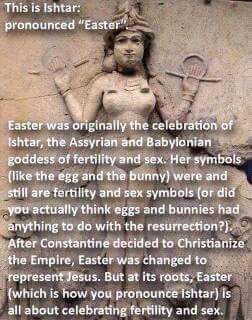
Below is a meme that gets played out by atheists and cultists every Easter.  It has been debunked time and time again by people far more knowledgeable than I.  Perhaps next year I will do a more in depth analysis but for now I am going to quote a friend of mine on Facebook named Reese Currie.  He put together a 5 point analysis that I think about sums up the major flaws of the Ishtar argument.

But first here is the meme:

12670806_1542646152696878_6255759179697394095_n


1. Ishtar is pronounced “Ishtar.” Check Wikipedia.

2. Constantine’s language was Latin. In Latin, following the Greek, the holiday English speakers call “Easter” is called Pascha. Germans and English much later named the festival after the month in which it was normally celebrated; their old names for April were Ostar-manoth (German) and Eostra (English). Polycarp and Anicetus debated the differing Eastern and Western views concerning the date to celebrate Easter well over 120 years before Constantine was born. Constantine did not invent Easter.

3. Ishtar’s symbols were not bunnies and eggs. Ishtar’s symbols were a lion and an 8-pointed star. Again, check Wikipedia.

4. Some ancient Christians viewed the rabbit hole as a symbol of Christ’s tomb. The rabbit symbolizes the resurrected Christ; as the rabbit came out of his hole, Christ came out of His tomb. As for the egg, it symbolizes the end of the Lenten fast. During Lent early Christians would not eat meat or birds (including eggs). On Easter morning, decorated eggs were eaten for breakfast to break the fast. Breaking the shell came to represent Christ breaking out of His tomb.

5. The foregoing points thoroughly bust this final assertion. This meme depends on ignorance of history, language and culture, and an unwillingness to do simple fact checking on the assertions made in points 1 and 3. It can only work on a unilingual English audience; for example the French word for this holiday is Pâques. As a show of sophistication, it is a FAIL.

Simple yet effective. If you want a more detailed breakdown of this with cited sources I recommend the article linked HERE.

Posted in Heresy & Heterodoxy | Tagged | 3 Comments

Paul was a Sinner

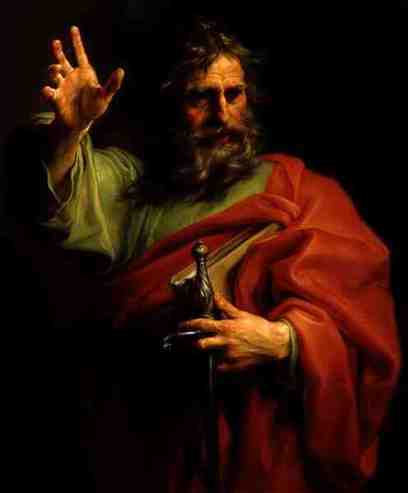
paul-the-apostle-batoni-2 - Copy


Various Christian denominations, cults, and legalists in general will argue that Paul was not a sinner.  Generally their teaching is that Paul was only a sinner before he obtained mercy,  And then afterwards a he was perfect.  Those who argue this have varied reasons for doing so, but ultimately the implication is that you and I must also expect to become wholly perfect in word thought and deed.

I used to study Pentacostal theology, and the reason they make this argument is that for the gifts of the Spirit to manifest in your life that means you must have “enough” faith and be wholly sanctified.  Keep in mind, when they say sanctified, they don’t mean water baptism in the death burial and resurrection of Christ, they mean actually sinless in one’s day to day activities.  I am not going to delve into those teachings in this post.  Instead of that I am going to address the matter of Paul being a sinner.  Does Paul teach he was only a sinner before becoming an Apostle?

The prooftext that stands out the most and is easiest to just quote is found in Timothy.

“The saying is trustworthy and deserving of full acceptance, that Christ Jesus came into the world to save sinners, of whom I am the foremost.” 1 Tim 1:15 ESV


Notice above that Paul speaks of being a sinner in the present tense “I am”.  He could have said I “was” the foremost, but he did not.  Jesus stood on the tense of a verb to teach that Abraham, Isaac and Jacob were currently alive in heaven so I think I am in good company (Matt 22:29-33).


“13 Did that which is good [ The Law ], then, bring death to me? By no means! It was sin, producing death in me through what is good, in order that sin might be shown to be sin, and through the commandment might become sinful beyond measure. ; 14 For we know that the law is spiritual, but I am of the flesh, sold under sin. ; 15 For I do not understand my own actions. For I do not do what I want, but I do the very thing I hate. ; 16 Now if I do what I do not want, I agree with the law, that it is good. ; 17 So now it is no longer I who do it, but sin that dwells within me. ; 18 For I know that nothing good dwells in me, that is, in my flesh. For I have the desire to do what is right, but not the ability to carry it out. ; 19 For I do not do the good I want, but the evil I do not want is what I keep on doing. ; 20 Now if I do what I do not want, it is no longer I who do it, but sin that dwells within me. ; 21 So I find it to be a law that when I want to do right, evil lies close at hand. ; 22 For I delight in the law of God, in my inner being, ; 23 but I see in my members another law waging war against the law of my mind and making me captive to the law of sin that dwells in my members. ; 24 Wretched man that I am! Who will deliver me from this body of death? ; 25 Thanks be to God through Jesus Christ our Lord! So then, I myself serve the law of God with my mind, but with my flesh I serve the law of sin.” Rom 7:13-25 ESV


There is a great deal that can be said about the text above.  But I am going to pull out a few key points that Paul makes.

“For I do not do what I want, but I do the very thing I hate”

“For I have the desire to do what is right, but not the ability to carry it out”

“Now if I do what I do not want, it is no longer I who do it, but sin that dwells within me”

“For I delight in the law of God, in my inner being”

“but I see in my members another law waging war against the law of my mind and making me captive to the law of sin that dwells in my members”

“I myself serve the law of God with my mind, but with my flesh I serve the law of sin”

The reason I pulled out the specific statements above is that they demonstrate a tug of war going on inside of Paul.  We see his sinful nature of the flesh and his saint nature of the new man pushing and pulling against each other.  To argue that he is speaking of himself before being called by Christ would be semi-pelagian at best.  You would have to in a sense argue that all are regenerate from birth for a tug of war between the new man and the old to even be a thing.

In Paul’s case though he speaks of a part of himself that “delight[s] in the law of God”.  We see one part of himself “waging war” against another.  We see that he “serve[s] the law of God” but also the “law of sin” with his flesh.

This is a fascinating piece of scripture, the old man and new at war inside of Paul.  It would be fair to argue that this is the life of the Christian.  We are born again in the waters of our baptism, given Grace (Gratia Infusa & Favor Dei) by Word and Sacrament while the old man is killed with the preaching of the law.  Every Sunday we are made new and justified in the sight of God.  Yet, even still the old man rages on in our flesh dying a little more each time.

Should you expect to see a visible change in yourself?  I don’t think so, in fact I would argue that as God’s work is performed you will only become more aware of your sin.  The changes you do notice will only depress you because you will see your sin with greater clarity than you did before.  And this is why along with the law we also must hear the gospel to restore us and comfort us, so that we cling to Christ all the more.

“7 So to keep me from becoming conceited because of the surpassing greatness of the revelations, a thorn was given me in the flesh, a messenger of Satan to harass me, to keep me from becoming conceited. ; 8 Three times I pleaded with the Lord about this, that it should leave me. ; 9 But he said to me, “My grace is sufficient for you, for my power is made perfect in weakness.” Therefore I will boast all the more gladly of my weaknesses, so that the power of Christ may rest upon me. 10 For the sake of Christ, then, I am content with weaknesses, insults, hardships, persecutions, and calamities. For when I am weak, then I am strong.” 2 Cor 12:7-10 ESV


Paul certainly was a sinner.  Notice above that he wrestles with this “thorn” in his flesh.  Some argue it is a sickness or malady rather than sin.  I don’t think so, Paul asks for the Grace to have it removed but is denied.  Also, Paul likens it to the flesh which in other passages he uses as synonymous with sin.


Like Paul it is this tug of war between new man and old that crushes us in repentance so that we rely on Christ as the object of our faith all the more.

Posted in Armchair Lounge, Heresy & Heterodoxy | Tagged , | 2 Comments

Grace

luther-predigt-lc-wb1

In this post I am going to present the Biblical Doctrine of the Grace of God.  My goal is to do this in a way that makes sense out of all of the different uses of the word Grace.  Very quickly when I started studying this I was overwhelmed by the fact that it is not used the same in all instances.


Keeping it simple, most theologians define the Grace of God as unmerited favor.  I am not going to just assume that though, one should strive to define words with scripture itself as much as possible.


“Even so then at this present time also there is a remnant according to the election of grace.  And if by grace, then is it no more of works: otherwise grace is no more grace. But if it be of works, then is it no more grace: otherwise work is no more work.” Romans 11:5-6 KJV

“Who hath saved us, and called us with an holy calling, not according to our works, but according to his own purpose and grace, which was given us in Christ Jesus before the world began” 2 Tim 1:9 KJV

“For by grace are ye saved through faith; and that not of yourselves: it is the gift of GodEph 2:8 KJV

The above passages are very clear that Grace is an undeserved gift that is given to us by God.  This is not something that is earned, instead we deserve his wrath.


“10 As it is written, There is none righteous, no, not one:; 11 There is none that understandeth, there is none that seeketh after God.; 12 They are all gone out of the way, they are together become unprofitable; there is none that doeth good, no, not one.; 13 Their throat is an open sepulchre; with their tongues they have used deceit; the poison of asps is under their lips:; 14 Whose mouth is full of cursing and bitterness:; 15 Their feet are swift to shed blood:; 16 Destruction and misery are in their ways:; 17 And the way of peace have they not known:; 18 There is no fear of God before their eyes.; 19 Now we know that what things soever the law saith, it saith to them who are under the law: that every mouth may be stopped, and all the world may become guilty before God.” Rom 3:10-19 KJV

“1 And you hath he quickened, who were dead in trespasses and sins;; 2 Wherein in time past ye walked according to the course of this world, according to the prince of the power of the air, the spirit that now worketh in the children of disobedience:; 3 Among whom also we all had our conversation in times past in the lusts of our flesh, fulfilling the desires of the flesh and of the mind; and were by nature the children of wrath, even as others.; 4 But God, who is rich in mercy, for his great love wherewith he loved us,; 5 Even when we were dead in sins, hath quickened us together with Christ, (by grace ye are saved)” Eph 2:1-5 KJV

Above we see the teaching that we deserve death and hell but instead receive a blessing we do not deserve because of the disposition of Love and Mercy that God has for us.  Instead of condemning us he “quickens” us alive in Christ.  This is defined in scripture as the Grace of God.  I would argue based on the above passages that it is the Bible which has defined the Grace of God as a disposition of unmerited favor that God has on our account.

This is a gift that we expect to receive from God in heaven as the scripture teaches that such things come from God.

“John answered and said, A man can receive nothing, except it be given him from heaven.” John 3:27 KJV

“Every good gift and every perfect gift is from above, and cometh down from the Father of lights, with whom is no variableness, neither shadow of turning.” James 1:17 KJV

“Not that we are sufficient of ourselves to think any thing as of ourselves; but our sufficiency is of God” 2 Cor 3:5 KJV

“No man can come to me, except the Father which hath sent me draw him: and I will raise him up at the last day.” John 6:44 KJV

“For who maketh thee to differ from another? and what hast thou that thou didst not receive? now if thou didst receive it, why dost thou glory, as if thou hadst not received it?” 1 Cor 4:7 KJV

“Giving thanks unto the Father, which hath made us meet to be partakers of the inheritance of the saints in light” Col 1:12 KJV


It is not so simple though to define Grace and move on.  This is because we see it employed differently in various passages throughout scripture.  I got some help understanding this from a real Theologian by the name of Francis Pieper.  I highly recommend his work, you can find his study on Grace in Vol II.  He maintains that though Grace is always unmerited favor, there are three categories of this Grace seen in scripture.


Favor Dei (God’s Favor)

This is distinguished from the other uses of the word Grace in two distinct points:


  1. It always speaks of God’s saving act
  2. It excludes the works of the law


Ultimately this is a chief distinction between Christianity and other religions of the world.  All other faiths and cults lack the true Gospel and instead require the believer to perform certain acts to achieve an ultimate goal or plane.  In Christianity God has supplied the work that must be done and it is accounted to us by his Grace (Favor Dei).


Therefore by the deeds of the law there shall no flesh be justified in his sight: for by the law is the knowledge of sin.; But now the righteousness of God without the law is manifested, being witnessed by the law and the prophets; Even the righteousness of God which is by faith of Jesus Christ unto all and upon all them that believe: for there is no difference: For all have sinned, and come short of the glory of God;  Being justified freely by his grace through the redemption that is in Christ Jesus:  Whom God hath set forth to be a propitiation through faith in his blood, to declare his righteousness for the remission of sins that are past, through the forbearance of God;  To declare, I say, at this time his righteousness: that he might be just, and the justifier of him which believeth in Jesus.” Romans 3:20-26 KJV

“Therefore being justified by faith, we have peace with God through our Lord Jesus Christ:  By whom also we have access by faith into this grace wherein we stand, and rejoice in hope of the glory of God.” Romans 5:1-2 KJV

“For sin shall not have dominion over you: for ye are not under the law, but under grace.  What then? shall we sin, because we are not under the law, but under grace? God forbid” Romans 6:14-15 KJV


Notice above that the verse says we are not under the law at all but under Grace.  It also says that we shouldn’t sin.  I challenge the reader not to ignore either of these, both are true.  We are not saved by good works, but that doesn’t mean sinning should be aspired to.


“For what saith the scripture? Abraham believed God, and it was counted unto him for righteousness. Now to him that worketh is the reward not reckoned of grace, but of debt. But to him that worketh not, but believeth on him that justifieth the ungodly, his faith is counted for righteousness.” Romans 4:3-5 KJV


Read the above passage one more time, notice that you do not want what is earned but rather what is given.  If you receive what you have earned then enjoy an eternity in hell, because that is all any of us have earned.  What is given is something we do not deserve.  This is greater even than mercy.  If God only showed mercy he would spare us from hell, but instead he has given Grace as well which not only withholds the punishment we deserve but gives us heaven instead.


“I do not frustrate the grace of God: for if righteousness come by the law, then Christ is dead in vain.” Gal 2:21 KJV

“And if by grace, then is it no more of works: otherwise grace is no more grace. But if it be of works, then is it no more grace: otherwise work is no more work.” Rom 11:6 KJV

“Who hath saved us, and called us with an holy calling, not according to our works, but according to his own purpose and grace, which was given us in Christ Jesus before the world began” 2 Tim 1:9 KJV

This Grace is a gift, Paul is making it very clear that it is not something that is coming from you but something that is coming from God.

“For by grace are ye saved through faith; and that not of yourselves: it is the gift of God:; Not of works, lest any man should boast.” Eph 2:8-9 KJV

“But we believe that through the grace of the Lord Jesus Christ we shall be saved, even as they.” Act 15:11 KJV

“For if by one man’s offence death reigned by one; much more they which receive abundance of grace and of the gift of righteousness shall reign in life by one, Jesus Christ” Romans 5:17 KJV


Gratia Infusa (Infused Grace)

This is the Grace from God we find in the Bible that I had the greatest difficulty understanding.  When I was digging into the topic I noticed that there are some passages that use the word very differently.  They speak of Grace like a substance placed inside of the believer by God.  This Grace stands out in three distinct ways:


  1. Spoken of like a substance placed inside of the believer by God.
  2. Associated either directly or indirectly with the good works of the believer.
  3. Never spoken of as a means of salvation or justification.


“1 My heart is inditing a good matter: I speak of the things which I have made touching the king: my tongue is the pen of a ready writer. 2 Thou art fairer than the children of men: grace is poured into thy lips: therefore God hath blessed thee for ever. 3 Gird thy sword upon thy thigh, O most mighty, with thy glory and thy majesty. 4 And in thy majesty ride prosperously because of truth and meekness and righteousness; and thy right hand shall teach thee terrible things. 5 Thine arrows are sharp in the heart of the king’s enemies; whereby the people fall under thee. 6 Thy throne, O God, is for ever and ever: the sceptre of thy kingdom is a right sceptre. 7 Thou lovest righteousness, and hatest wickedness: therefore God, thy God, hath anointed thee with the oil of gladness above thy fellows.” Psalm 45:1-7 KJV


I have chosen to use the above verse first to demonstrate infused Grace.  We see that the Grace in the above text is received by means which we would expect, the Word of God (Rom 10:17).  And in receiving this grace the writer extols the virtues of the good works that flow from them with poetic imagery.


Below are a few statements that are very common to find at the opening of Paul’s letters.  Notice what I did, Grace is being spoken of as something that can be received and would bring peace.


“Grace be to you and peace from God the Father, and from our Lord Jesus Christ”
Galatians 1:3 KJV

“Grace be to you, and peace, from God our Father, and from the Lord Jesus Christ.”
Ephesians 1:2 KJV

“Grace be unto you, and peace, from God our Father, and from the Lord Jesus Christ” Philippians 1:2 KJV

“To the saints and faithful brethren in Christ which are at Colosse: Grace be unto you, and peace, from God our Father and the Lord Jesus Christ” Colossians 1:2 KJV


In the Acts we see that Grace is an agent working the apostles manifested in Good works.


“And with great power gave the apostles witness of the resurrection of the Lord Jesus: and great grace was upon them all.” Acts 4:33 KJV


This next passage is even more interesting.  We see that Paul is speaking of what I believe to be his personal sin.  He doesn’t tell us what it is, he calls it a “thorn in the flesh”.  I believe it is his sin though because he calls himself the “chiefest” of sinners (1 Tim 1:15) and because of his association of this “thorn” with the word “flesh”, which is of course a word commonly associated with sin by Paul.


“For this thing I besought the Lord thrice, that it might depart from me.; And he said unto me, My grace is sufficient for thee: for my strength is made perfect in weakness. Most gladly therefore will I rather glory in my infirmities, that the power of Christ may rest upon me.” 2 Cor 12:8-9 KJV


Above we see that Paul prayed in hope and expectation that God would remove this thorn from him.  But at the same time we find something even more comforting, and this is that we cannot expect to be sinnless in this life and that the Grace of God is sufficient for us even in our weakness.  I see this verse working for both Favor Dei and Gratia Infusa.  That is because Paul has a hope of overcoming his sin but is also assured that though he does not the Grace of God is sufficient for him.  Ultimately this is the tug of war that we all push and pull in.


Below we see that Grace is something that can be poured and rest upon believers, and that Jesus was even referred to as “full of Grace”.


“And I will pour upon the house of David, and upon the inhabitants of Jerusalem, the spirit of grace and of supplications: and they shall look upon me whom they have pierced, and they shall mourn for him, as one mourneth for his only son, and shall be in bitterness for him, as one that is in bitterness for his firstborn.” Zechariah 12:10 KJV

“And the Word was made flesh, and dwelt among us, (and we beheld his glory, the glory as of the only begotten of the Father,) full of grace and truth.” John 1:14 KJV


This next passage is also very interesting in that was see Grace is received and good works come out of it.


“Paul, a servant of Jesus Christ, called to be an apostle, separated unto the gospel of God,;  (Which he had promised afore by his prophets in the holy scriptures,);  Concerning his Son Jesus Christ our Lord, which was made of the seed of David according to the flesh;;  And declared to be the Son of God with power, according to the spirit of holiness, by the resurrection from the dead:;  By whom we have received grace and apostleship, for obedience to the faith among all nations, for his name” Rom 1:1-5 KJV


In hebrews we find that Grace establishes the heart and protects us from strange doctrine.  Also notice that he gives this in the form of a command.  I would argue that this Grace is something we participate in as well.  Though God is giving us this Grace in the same manner and likeness which we receive Favor Dei, here with this Gratia Infusa we collaborate, not as a means of salvation but certainly as a means of earthly blessings and peace toward one another.


“Be not carried about with divers and strange doctrines. For it is a good thing that the heart be established with grace; not with meats, which have not profited them that have been occupied therein.” Heb 13:9 ESV


Gratia Universalis (Universal Grace)

This is God’s universal Grace on everyone.  The Bible is very clear that God want’s to save everybody.  All tribes, all nations, all tongues, all men and women of all ages in every generation.


“For God so loved the world, that he gave his only begotten Son, that whosoever believeth in him should not perish, but have everlasting life.; For God sent not his Son into the world to condemn the world; but that the world through him might be saved.” John 3:16-17 KJV

“Go ye therefore, and teach all nations, baptizing them in the name of the Father, and of the Son, and of the Holy Ghost” Matt 28:19 KJV

“Who will have all men to be saved, and to come unto the knowledge of the truth.;  For there is one God, and one mediator between God and men, the man Christ Jesus;  Who gave himself a ransom for all, to be testified in due time.” 1 Tim 2:4-6 KJV

“The Lord is not slack concerning his promise, as some men count slackness; but is longsuffering to us-ward, not willing that any should perish, but that all should come to repentance.” 2 Peter 3:9 KJV


Scripture is also very clear that not all are saved.  These are two things that we must accept is being true at the same time.  Some will choose to abrogate one of those teachings with the other.  I would argue that it is a good idea to accept a healthy amount of Biblical paradox, we can’t connect all of the pieces.  That said, though there are three forms of Gods Grace taught in scripture, all are worked through means.  That is, God applies his Grace to you (all three at once) through physical means here on planet earth.


Conclusion


When God’s word is rightly preached and the sacraments rightly administered God’s Grace is given as a gift by a work of God through the Holy Spirit.  His Favor Dei is poured out on you to Justification,  His Gratia Infusa is poured into you unto blessings and good works,  and his Gratia Universalis is revealed in that anyone can receive his Grace through the means given with no distinction of persons or privilege.


I would argue that where most err in this is that they favor one teaching of Grace over the other two in their systematic theology and or dogma.  All three are true at the same time, all should be confessed, taught, and rightly distinguished from each other.

If this is your first encounter with Lutheran theology and you just choked when I dropped the word Sacrament you can find more on that below.

  1. Holy Baptism
  2. The Real Presence

Posted in Armchair Lounge, Christianity 101, Soteriology | Tagged | 6 Comments

Is Pastrix a Biblical Office?

istock_000001476421xsmall

This is not a popular topic in the day and age that we live in, but it is a very important one.  The issue of Women’s Ordination has torn many denominations and synods apart.  In this post I am going to present the Biblical argument, as I understand it, from both sides.  I am also going to indicate early on which one I believe is correct and why it matters.  If you perceive that I missed an important text or argument let me know and I will address it in the comments or add it to the blog.

Pro Women’s Ordination

The argument for women’s ordination has both Biblical and extra Biblical support.  I will present and address both.

“For as many of you as have been baptized into Christ have put on Christ. There is neither Jew nor Greek, there is neither bond nor free, there is neither male nor female: for ye are all one in Christ Jesus.” Gal 3:27-28 KJV


Above we see that all are considered equal in Christ.  This is important to understand and surprising to find in scripture.  Considering the times it was written in we wouldn’t expect to see such a bold statement regarding equality of persons in the eyes of God.  I would however argue that equal doesn’t necessarily mean the same.  For example, though a child is equal to an adult that doesn’t mean a child can vote.  Though a boy is equal to a girl it doesn’t mean he can be a sister.  Though a man is equal to a woman it doesn’t mean he can be a mother.

Another oft quoted passage to support women’s ordination is found in the book of Romans.


“Salute Andronicus and Junia, my kinsmen, and my fellow prisoners, who are of note among the apostles, who also were in Christ before me.” Rom 16:7 KJV


It is argued regarding the above text that “Junia” was a female.  I am no Greek expert but I have read those who are, from what I have found the understanding of the sex comes down to the placement of an accent.  And that accent is placed differently in various sources.  Nobody really knows if the name is masculine or feminine.  Click HERE for more information along those lines.

As for myself, I don’t think it’s relevant to the office of pastor.  Based on the ambiguity with regards to the accent I would disregard the text in this matter due to lack of clarity.  That said, the passage says Junia was among the apostles.  That means Junia was either one of the second class of apostles in the new testament or was working with them in some capacity.  Even if Junia was a female apostle that would only mean that a woman can be an apostle.  Either way I just don’t see how it matters.  This is because nobody alive is a witness to the Resurrection, thus neither males nor females qualify for this office today.

The other Biblical argument for women’s ordination is the example of Deborah.  You can find her story in Judges 4.  She was not only a Judge of ancient Israel but a Prophet to boot.  It’s a good story and I recommend reading it.  As above though, this would prove that a woman can be a Judge in ancient Israel, and even an old testament prophet.  But it is irrelevant with regards to the Biblical office of Pastor.

Other arguments supporting women’s ordination stray from the scripture entirely.  They will vary from rejecting the canonicity of the epistles to a full blown ad hominem attack on anyone who disagrees.  I don’t consider these arguments relevant enough to even address.  If there were no clear scripture defining the office to be held by a man then I don’t think this would be an issue at all.


Against Women’s Ordination

1 This is a true saying, If a man desire the office of a bishop, he desireth a good work.; 2 A bishop then must be blameless, the husband of one wife, vigilant, sober, of good behaviour, given to hospitality, apt to teach; 3 Not given to wine, no striker, not greedy of filthy lucre; but patient, not a brawler, not covetous;; 4 One that ruleth well his own house, having his children in subjection with all gravity; 5 (For if a man know not how to rule his own house, how shall he take care of the church of God?); 6 Not a novice, lest being lifted up with pride he fall into the condemnation of the devil.; 7 Moreover he must have a good report of them which are without; lest he fall into reproach and the snare of the devil.” 1 Tim 3:1-7 KJV


There are a number of qualifications listed above:

man

blameless

husband

vigilant

sober

good behaviour

That is just a few of the qualifications drawn from the text.  If I pull them all out it would double the length of my blog.  None is more important than another.

For those unaware or asking what a Bishop is, the term in modern translations is overseer.  Essentially the word “Episcopos” is used consistently in the New Testament to refer to Elders, Bishops, and Deacons.  Today we use the word Pastor but the meaning is the same, essentially what you have is the office of Holy Ministry charged with preaching the Word.  We know that Timothy held this office in Ephesus because we see him referred to as such in Church history, and we can see this inferred in the directions given to him by Paul.


“Timothy, so it is recorded, was the first to receive the episcopate of the parish in Ephesus, Titus of the churches in Crete.” Eusebius Ecclesiastical History 3.4.6


“1 I charge thee [Timothy] therefore before God, and the Lord Jesus Christ, who shall judge the quick and the dead at his appearing and his kingdom; 2 Preach the word; be instant in season, out of season; reprove, rebuke, exhort with all long suffering and doctrine.; 3 For the time will come when they will not endure sound doctrine; but after their own lusts shall they heap to themselves teachers, having itching ears;; 4 And they shall turn away their ears from the truth, and shall be turned unto fables.; 5 But watch thou in all things, endure afflictions, do the work of an evangelist, make full proof of thy ministry.” 2 Tim 4:1-5 KJV


Bottom line, Timothy was filling an office then which we now call Pastor.  And this office is defined by the Apostle Paul as, among other things, being filled by a man.  There is no text saying this is because men are better or smarter.  It is simply part of the definition of the office.  Anyone who doesn’t meet that definition isn’t a pastor.


Conclusion

Am I saying that a woman cannot perform the basic functions of the job?  Of course not.  Chromosomes don’t prevent or enable someone from carrying out the Sacrament of Holy Baptism or Communion.  They don’t prevent someone from standing at a pulpit and speaking.  They have nothing to do with any of the tasks that one would expect a Pastor to fulfill.  Physical or mental capability is not the issue.  The issue is that the text on this is just too clear to disregard.  And this is ultimately why I believe it is important.  Timothy is charged by Paul to preach the Word.


“1 I charge thee therefore before God, and the Lord Jesus Christ, who shall judge the quick and the dead at his appearing and his kingdom; 2 Preach the word; be instant in season, out of season; reprove, rebuke, exhort with all long suffering and doctrine.” 2 Tim 4:1-2 KJV


A pastrix simply cannot fulfill that command.  Not because their chromosomes render them incapable of speaking at a pulpit.  But rather because they have to disregard very clear scriptures to accept ordination in the first place.  At the very least a pastrix cannot exegete 1 Timothy 3 with any credibility.  And if one holds a confession that disregards clear scripture to that degree what else will they be unable to preach?

This isn’t just for women, if a man fails to preach the word then he isn’t a pastor either.  There are many examples of men who have failed their calling in this case.  I believe this is a Biblical teaching that we need to kindly and carefully confess for the right reasons.  Too many will twist the epistle of Timothy into an excuse for sexism, and in doing so make the same error with the same pitfalls as those they accuse.

If you want to argue that the Bible is archaic and misogynistic and should be rejected, then please let that be your argument.  But don’t twist the word while you’re at it.  I would instead urge that one should accept the Bible or reject it on the merits of what the clearest passages are teaching.  If in doing this denominations and synods are going to part ways from each other then so be it.


“Think not that I am come to send peace on earth: I came not to send peace, but a sword.  For I am come to set a man at variance against his father, and the daughter against her mother, and the daughter in law against her mother in law.  And a man’s foes shall be they of his own household.  He that loveth father or mother more than me is not worthy of me: and he that loveth son or daughter more than me is not worthy of me.” Matt 10:34-37 KJV

“For the word of God is quick, and powerful, and sharper than any two edged sword, piercing even to the dividing asunder of soul and spirit, and of the joints and marrow, and is a discerner of the thoughts and intents of the heart.” Heb 4:12 KJV


Posted in Armchair Lounge, Heresy & Heterodoxy | Tagged , | 3 Comments

Modern Apostles?

5b797221-2101-4390-baaf-8f979f0dd9d4

This is a very important question t ask and answer Biblically.  The reason it is necessary is that there are many out there today who claim to be Apostles.  The Mormon Church for example believes that they have 12 living Apostles to this day.  The New Apostolic Reformation claims to have many apostles.  Also there have been many random people who have bestowed upon themselves the title of Apostle.  How do we discern who an apostle is?

The word Apostle simply means “one who is sent”.  A good way of thinking about it would be like an ambassador or messenger sent by a Nation.  With that understanding we can see that there are two kinds of Apostles in the Bible.

Apostles of Jesus Christ

There are only twelve apostles that fit this definition.  These apostles were commissioned directly by Christ in the flesh and thus are eye witnesses to the Resurrection.

“16 You did not choose me, but I chose you and appointed you that you should go and bear fruit and that your fruit should abide, so that whatever you ask the Father in my name, he may give it to you.” John 15:16 ESV

“15 But the Lord said to him, “Go, for he [Paul] is a chosen instrument of mine to carry my name before the Gentiles and kings and the children of Israel.  16 For I will show him how much he must suffer for the sake of my name.” Acts 9:15-16 ESV

“27 Now you are the body of Christ and individually members of it.  28 And God has appointed in the church first apostles, second prophets, third teachers, then miracles, then gifts of healing, helping, administrating, and various kinds of tongues.” 1 Cor 12:27-28 ESV

“11 And he gave the apostles, the prophets, the evangelists, the shepherds and teachers,  12 to equip the saints for the work of ministry, for building up the body of Christ” Eph 4:11-12 ESV

“13 And he went up on the mountain and called to him those whom he desired, and they came to him.” Mark 3:13 ESV

“6 So when they had come together, they asked him, “Lord, will you at this time restore the kingdom to Israel?” He said to them, “It is not for you to know times or seasons that the Father has fixed by his own authority. But you will receive power when the Holy Spirit has come upon you, and you will be my witnesses in Jerusalem and in all Judea and Samaria, and to the end of the earth.” Acts 1:6-8 ESV


Are the Apostles still witnesses to the ends of the earth?  Yes they are, they simply teach us in the New Testament now instead of in person.  We have this promise from Jesus in the Gospel of John.


“26 But the Helper, the Holy Spirit, whom the Father will send in my name, he will teach you all things and bring to your remembrance all that I have said to you.” John 14:26 ESV


Many today try to use the above verse to argue that the Holy Spirit reveals all truth to use individually when we ask in prayer.  This promise in scripture is not for us though, notice Jesus is speaking directly to the Apostles.  So we know from scripture that all truth is promised to them.  Therefore we would expect that which God intended for us to know of that truth to be found in the New Testament.


Those sent by the Apostles

Another group of Apostles in scripture are those sent by the apostles directly.  They seemed to have qualifications for whom they chose.


“21 So one of the men who have accompanied us during all the time that the Lord Jesus went in and out among us, 22 beginning from the baptism of John until the day when he was taken up from us—one of these men must become with us a witness to his resurrection.” 23 And they put forward two, Joseph called Barsabbas, who was also called Justus, and Matthias. 24 And they prayed and said, “You, Lord, who know the hearts of all, show which one of these two you have chosen 25 to take the place in this ministry and apostleship from which Judas turned aside to go to his own place.” 26 And they cast lots for them, and the lot fell on Matthias, and he was numbered with the eleven apostles.” Acts 1:21-26 ESV


Did God choose Matthias through the casting of the lot above?  This I don’t know.  I personally find the notion unlikely as the text doesn’t directly say.  But what I do see is that qualifications are cited that the Apostles used to ordain and send out:

  • They had accompanied them during Christ Ministry
  • They had witnessed the Resurrection


This second group of “apostle” is referred to in scripture as “messengers of the churches”(2Cor 8:23).  Instead of being sent by Christ in the flesh they were sent out by an Apostle who was.  Grace to You, a Ministry by John MacArthur has an excellent article that addresses the two classes of Apostles you can find HERE.  Below is an excerpt:


“The term apostle is used in a more general sense of other men in the early church, such as Barnabas (Acts 14:4), Silas and Timothy (1 Thess. 2:6), and a few other outstanding leaders (Rom. 16:7; 2 Cor. 8:23; Phil. 2:25). The false apostles spoken of in 2 Cor. 11:13 no doubt counterfeited this class of apostleship…

…Apostles in both groups were authenticated “by signs and wonders and miracles” (2 Cor. 12:12), but neither group was self–perpetuating. In neither sense is the term apostle used in the book of Acts after 16:4. Nor is there any New Testament record of an apostle in either group being replaced when he died.” – Grace to You


Conclusion


The bottom line is that the qualifications for the Biblical office of Apostle are rather narrow.  At the very least you would need to have lived in the first century to be sent by Christ in the flesh or to have witnessed the Resurrection.  Since there isn’t a soul on this planet who can claim either of those, it follows that if someone is claiming to be an Apostle they are simply lying.


Posted in Armchair Lounge, Heresy & Heterodoxy | Tagged | 5 Comments